Era
Commemoratives: America Told in Coins
From the 1892 Columbian half dollar to today — souvenir coins that carried the country's stories, crashed in a 1936 bubble, and came back.
In 1936 the U.S. Mint struck twenty-one different commemorative half dollars in a single year — nearly half of every classic design it would ever make. It wasn't patriotism. It was a bubble, and it was about to pop. Decades later, Congress let the coins come back — and they never stopped.
The world then
In 1892, the United States was throwing itself a party. Chicago was building the World's Columbian Exposition — a gleaming "White City" to mark four hundred years since Columbus reached the Americas, and to announce that America had arrived as a world power.
The fair needed money. So Congress did something it had never done: it authorized a coin not to spend, but to sell. The 1892 Columbian half dollar was America's first commemorative — a legal half dollar offered to the public at a dollar, double its face value, with the profit going to the exposition.
That single idea — a coin as souvenir, as fundraiser, as small monument — ran for the next sixty-two years. It carried the country through the Gilded Age, two world wars, and the Great Depression. And along the way it got gloriously, and then disgracefully, out of hand — until Congress shut it down. The story didn't end there, though. In 1982 the coins came back, and the modern program has run ever since.
The money
A commemorative coin works differently from the change in your pocket. The Mint struck these coins, but it did not sell them to the public. By law, a sponsoring group — a fair committee, a memorial association, a state centennial — bought the whole issue at face value, then resold each coin at a premium to fund their cause. The coin was a monument you could hold and a donation box in one.
For decades the results were beautiful. The 1893 Isabella quarter put a real woman — Queen Isabella of Spain, Columbus's patron — on a U.S. coin for the first time. The 1900 Lafayette dollar was the only silver dollar of the whole classic series. In 1915 San Francisco celebrated the Panama Canal with the Panama-Pacific set, including two massive $50 gold pieces — one round, one octagonal — the largest gold coins the U.S. Mint has ever made.
Then the model's flaw surfaced. The sponsors controlled the supply. A small mintage — the mintage is simply how many coins were struck — meant instant scarcity, and scarcity meant profit. By the mid-1930s, that incentive curdled into a racket.
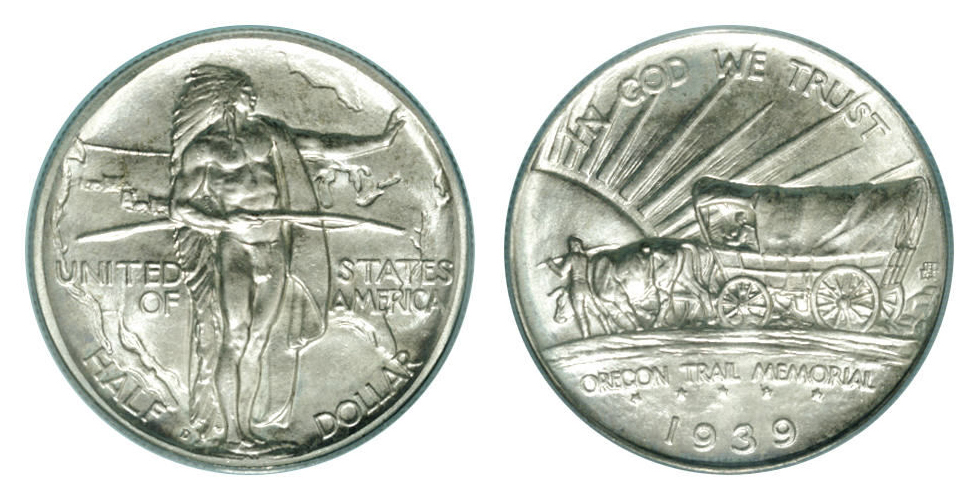
The Oregon Trail half dollar shows how. It carried one of the most admired designs in all of American coinage — a covered wagon rolling west, a Native American standing against a sunset, cut by the husband-and-wife sculptors James Earle and Laura Gardin Fraser. But the sponsors didn't issue it once. They strung it out across eight different years, from 1926 to 1939, in tiny batches from three different mints, so a "complete" collection kept needing one more coin. The 1939 issues were held to just 3,000 each.
The Daniel Boone half dollar went further. The same design was struck for five straight years across three mints — and in 1935 the sponsors had the tiny date "1934" added to the reverse, instantly making the earlier coins a different, scarcer variety that collectors now had to chase. The Cincinnati Musical Center half dollar of 1936 dispensed with the pretense entirely: a coin collector named Thomas Melish hired a sculptor, formed his own association, and split a tiny issue of 5,000 sets across three mints — a coin one writer said was "made for pure profit and greed."
This is the mint mark in action — a small letter (D for Denver, S for San Francisco, none for Philadelphia) marking where a coin was struck. A clever sponsor could turn one design into three "collectible" coins simply by ordering a sliver from each mint.
A short timeline
- 1892America's first commemorative
The Columbian half dollar is struck to fund Chicago's World's Columbian Exposition — a coin sold, not spent.
- 1893A real woman on a coin
The Isabella quarter — the only classic commemorative quarter — depicts Queen Isabella of Spain.
- 1900The lone silver dollar
The Lafayette dollar honors the French general — the only silver dollar of the classic series.
- 1915Gold for the canal
The Panama-Pacific set in San Francisco includes two $50 gold pieces, the largest U.S. gold coins ever struck.
- 1926–1939The Oregon Trail drags on
A beloved design is issued across eight years and three mints in small batches — the template for abuse.
- 1928The Hawaiian rarity
Just 10,008 Hawaiian half dollars are struck — among the scarcest of the entire classic series.
- 1936The flood
Twenty-one different commemorative half dollars appear in one year. The speculative bubble peaks.
- late 1936The bubble bursts
Collectors tire of the manufactured rarities; the easy-profit market collapses.
- 1939Congress shuts it down
Congress halts production of previously approved issues. The party is over.
- 1946–1954The quiet finale
The Booker T. Washington and Carver-Washington halves close the classic era — the last U.S. commemoratives for 28 years.
- 1982The coins come back
The Washington 250th Anniversary half dollar revives the program — the first 90% silver U.S. coin since 1964.
- 1986A run for the books
Statue of Liberty centennial coins help the modern program raise money for surcharge causes on a national scale.
- 2014The first curved coin
The Baseball Hall of Fame trio — concave obverse, convex reverse — is the first curved coin the U.S. Mint ever struck.
- 2018Pink gold
The Breast Cancer Awareness $5 uses a copper-rich alloy to take on a pink hue — a first in Mint history.
Key facts
- What it is
- U.S. commemorative coins — the classic era (1892–1954) and the modern program (1982–present)
- Country
- United States
- Classic era span
- 1892–1954 (62 years)
- Modern revival
- 1982–present, restarted after a 28-year gap
- First coin
- 1892 Columbian half dollar (obverse Charles E. Barber, reverse George T. Morgan)
- Last classic coin
- Carver-Washington half dollar, struck through 1954
- First modern coin
- 1982 Washington 250th Anniversary half dollar
- Peak classic year
- 1936 — 21 different commemorative half dollars struck
- Lowest-mintage classic half
- 1928 Hawaiian — 10,008 struck
- How they were sold
- Sponsoring groups (classic) or congressional surcharges (modern) raised money for a cause through each coin's premium
The coins of this era
This is the full sweep of American commemorative coinage — every U.S. coin struck not to spend, but to remember something. It splits cleanly into two halves: the classic commemoratives of 1892 to 1954, and the modern program that revived in 1982 and runs to this day. They share one DNA: each coin is a small monument that doubled as a fundraiser, sold at a premium to support a cause.
The classic era ran on silver and gold. The half dollar was its heart — of the roughly 142 commemorative half-dollar varieties struck between 1892 and 1954, nearly all rode the fifty-cent piece. The quarter appeared exactly once: the 1893 Isabella quarter, the only commemorative quarter dollar ever made, putting Queen Isabella of Spain on the obverse (the "heads" side) — the first real woman and first foreign monarch on a U.S. coin. The silver dollar appeared once too, as the 1900 Lafayette dollar. Gold ran alongside: small gold dollars (Lewis & Clark, McKinley, Grant, Panama-Pacific), $2.50 quarter eagles (Panama-Pacific 1915, Sesquicentennial 1926), and the two colossal Panama-Pacific $50 gold pieces of 1915. The most famous classic coins are the storied ones — the Columbian half, the Oregon Trail, the elusive 1928 Hawaiian, the 1935 Hudson and Old Spanish Trail — and the notorious abusers, the Daniel Boone and Cincinnati halves that turned scarcity into a sales tactic.
After 28 years of silence, the modern era opened in 1982 with the Washington 250th Anniversary half dollar — the first 90% silver coin the Mint had struck since 1964. The modern program is far larger and more ambitious than the classic one: it issues coins in matched clad half dollar / silver dollar / gold $5 sets, governed by congressional acts that attach a surcharge to fund a named cause. It honors the same kinds of subjects — anniversaries, places, heroes — but on a national scale. The 1986 Statue of Liberty coins set the template. The Olympics drove dozens of issues across the Los Angeles (1984), Seoul (1988), Albertville/Barcelona (1992), Atlanta (1995–96), and Salt Lake City (2002) games. Halls of fame, war memorials, civil-rights milestones, and institutions from the Smithsonian to the Library of Congress all got their coins. The modern program also broke new technical ground: the 2014 Baseball Hall of Fame trio was the first curved coin the U.S. Mint ever struck — concave on the obverse to cradle a baseball glove — and the 2018 Breast Cancer Awareness $5 was the Mint's first "pink gold," a copper-rich alloy that tints the metal rose.
So the designers of this era span more than a century of American sculpture. A handful of classic names cut the early dies — Charles E. Barber and George T. Morgan on the Columbian and Panama-Pacific coins, John R. Sinnock on the Sesquicentennial, Laura Gardin Fraser on the Oregon Trail. The Depression-era boom drew in dozens of outside sculptors — Gutzon Borglum (Stone Mountain), Cyrus E. Dallin, Chester Beach, Henry Kreis, Gertrude K. Lathrop, Brenda Putnam. The modern program runs on the Mint's own staff engravers — John Mercanti, Don Everhart, Joseph Menna, Phebe Hemphill — alongside the outside artists of the Mint's Artistic Infusion Program, like Cassie McFarland (who won the public competition for the curved baseball coin) and Emily Damstra (the pink-gold breast-cancer design). Read this era and you read the whole arc of American commemorative art, from Gilded-Age relief to twenty-first-century curved gold.
Why it fascinates collectors
There is nothing else quite like the commemoratives. Each coin is a little time capsule — a state's centennial, a fair, a battlefield, a person the country wanted to remember. The classic set alone holds forty-eight half-dollar designs, forty-eight different stories, and a collector can chase the whole run without ever needing a fortune. Most are genuinely available today.
The scarcities are real, and they're famous. The 1928 Hawaiian, with barely ten thousand struck and many spent as ordinary money in Hawaii, is the prize of the classic series. The 1935 Hudson and Old Spanish Trail are elusive in their own right. And the Panama-Pacific $50 gold pieces — round and octagonal — are among the most coveted coins in all of American numismatics. In the modern era, low-mintage issues like the 1994 Prisoner of War silver dollar and a number of the gold $5 pieces have become quiet keys, prized precisely because the public bought so few.
But the deepest fascination is the story itself: a noble idea that taught a generation of Americans to collect, then turned into a speculative mania, then collapsed and was shut down by Congress — only to return, in 1982, on different rules. The coins are beautiful. The history behind them is a cautionary tale about what happens when scarcity becomes a sales pitch. Holding a 1936 Cincinnati half dollar, you're holding a small, lovely piece of a bubble.
Questions collectors ask
What was the first U.S. commemorative coin?
The 1892 Columbian half dollar, struck to help fund Chicago's World's Columbian Exposition. It was the first U.S. coin made to be sold to the public at a premium rather than spent at face value.
Why were so many commemoratives made in 1936?
By the mid-1930s, earlier commemoratives were selling well above their issue prices, and the easy profits drew speculators. Congress approved a flood of new issues, and sponsors split tiny mintages across mints to manufacture rarities. Twenty-one different half-dollar designs appeared in 1936 alone — then the bubble burst.
Why did the classic commemorative series end?
The abuses — dragging single designs across many years and mints, holding back coins to spike prices — soured collectors and drew criticism. In 1939 Congress halted production of previously approved issues, and the classic program wound down by 1954.
When did U.S. commemoratives come back?
In 1982, after a 28-year gap. The Washington 250th Anniversary half dollar revived the program — and the first 90% silver U.S. coin since 1964. The modern program has run continuously since, issuing matched clad, silver, and gold coins each year to fund congressionally named causes.
Which classic commemorative is the rarest?
Among the half dollars, the 1928 Hawaiian is the standout — just 10,008 were struck, and many were spent as ordinary money. The Panama-Pacific $50 gold pieces of 1915 are far rarer still, with only a few hundred surviving.
Are commemoratives expensive to collect?
Most of the 48 classic half-dollar designs are readily available, so a representative classic collection is within reach for many collectors. A handful of classic key dates — the Hawaiian, Hudson, Old Spanish Trail, and the gold issues — command serious premiums, as do some low-mintage modern coins.
Sources
- U.S. Mint — Commemorative Coins from 1892–1954
- U.S. Mint — Columbian Exposition Half Dollar
- U.S. Mint — Daniel Boone Bicentennial Half Dollar
- CoinWeek — The Crest of the Classic Commemorative Coin Wave, 1936
- CoinWeek — Classic Commemorative Coins, 1892–1954
- Wikipedia — Cincinnati Musical Center half dollar
- Wikipedia — Oregon Trail Memorial half dollar
- Wikipedia — Hawaii Sesquicentennial half dollar
- PCGS CoinFacts — 1893 25C Isabella (Silver Commemorative)
- PCGS CoinFacts — 1900 $1 Lafayette (Silver Commemorative)
- PCGS CoinFacts — 1915-S $50 Panama-Pacific, Octagonal (Gold Commemorative)
- U.S. Mint — George Washington 250th Anniversary Half Dollar
- Wikipedia — George Washington 250th Anniversary half dollar
- U.S. Mint — First Curved Coins from the United States Mint (press release)
- Wikipedia — National Baseball Hall of Fame commemorative coins
- U.S. Mint — Breast Cancer Awareness Commemorative Coin Program
- PCGS CoinFacts — Silver Commemorative (1892–1954) category
- PCGS CoinFacts — Modern Commemoratives category