US coin · series

The coin that shows nine pairs of feet walking into history

A 2007 silver dollar for the students who desegregated Little Rock Central High — and the soldiers it took to get them through the door.

The coin that shows nine pairs of feet walking into history
United States Mint · public domain · source

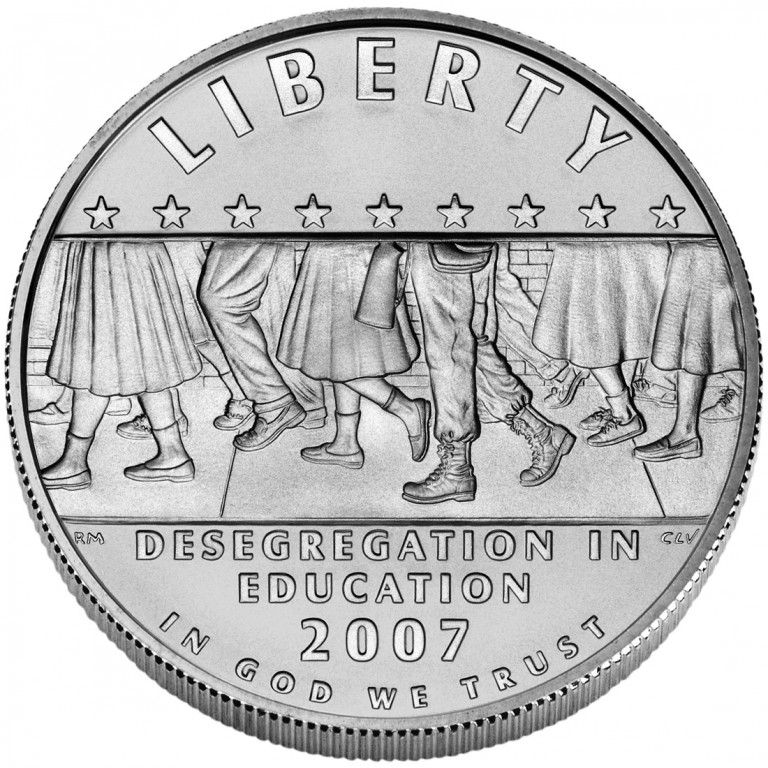
In 1957, it took the 101st Airborne Division to walk nine Black teenagers into a public high school in Arkansas. Fifty years later, the United States put that walk on a silver dollar — and chose to show it from the ground up, at the level of their feet.

The story behind the coin

In September 1957, nine Black teenagers tried to walk into Little Rock Central High School in Arkansas. The Supreme Court had already ruled, in Brown v. Board of Education (1954), that segregated schools were unconstitutional. The students had the law on their side. They still couldn't get through the door.

Arkansas Governor Orval Faubus ordered the state's National Guard to physically block them. A mob gathered outside. For weeks the standoff held — a state government using soldiers to keep children out of a school, broadcast to the country on the evening news. Then President Dwight D. Eisenhower did something no president had done since Reconstruction: he federalized the Arkansas Guard and sent in the U.S. Army's 101st Airborne Division. On September 25, 1957, paratroopers escorted the nine students up the steps and inside.

They are remembered as the Little Rock Nine. The crisis became one of the defining images of the civil rights era — and a hard, public test of whether federal law meant anything against a state that refused it. This coin marks the 50th anniversary of that day.

What the coin shows — and why it looks down

Most commemorative coins reach for a face or a monument. This one looks at the ground. The obverse — the heads side — shows the feet of the Little Rock Nine, marching forward, with the boots and lower legs of a soldier escorting them. Nine stars stand in for the nine students. The legend reads DESEGREGATION IN EDUCATION, with LIBERTY, IN GOD WE TRUST, and 2007.

It's an unusual, deliberate choice. By cropping out the faces and showing only the walk itself, the design makes the moment universal — and quietly insists on the central, uncomfortable fact: it took armed escort for children to attend school. The obverse was designed by Richard Masters and sculpted by U.S. Mint engraver Charles L. Vickers.

The reverse — the tails side — is the building they were walking toward: Little Rock Central High School as it looked in 1957, designed and engraved by Don Everhart. It carries LITTLE ROCK CENTRAL HIGH SCHOOL, UNITED STATES OF AMERICA, E PLURIBUS UNUM, ONE DOLLAR, and the P mint mark — the small letter showing the coin was struck in Philadelphia.

Key facts

Denomination
Silver dollar ($1)
Year struck
2007
Authorizing act
Public Law 109-146, signed Dec 22, 2005
Obverse designer
Richard Masters (sculpted by Charles L. Vickers)
Reverse designer
Don Everhart
Composition
90% silver, 10% copper
Weight / diameter
26.73 g / 38.1 mm, reeded edge
Mint
Philadelphia (P mint mark)
Maximum authorized
500,000 coins
Proof mintage
124,678
Uncirculated mintage
66,093
Surcharge
$10 per coin to the Little Rock Central High School National Historic Site

Collecting it

This is a one-year, one-mint coin: every example is a 2007-P from Philadelphia, struck in two finishes. The proof — the mirror-polished, sharply frosted version made for collectors — outsold the uncirculated by nearly two to one (124,678 to 66,093). That makes the uncirculated the scarcer of the pair, the opposite of what newcomers often assume.

Both finishes sold far below the 500,000 coins Congress authorized, so neither is rare in absolute terms. The collecting interest sits at the top of the grading scale. Coins certified in perfect grades — PCGS MS70 for the uncirculated, PR70DCAM for the proof, the highest marks a grading service assigns — command a premium, though for this issue the step up from a near-perfect 69 to a flawless 70 is usually modest. As a 90%-silver dollar, it also carries a floor of bullion value that moves with the silver price.

The original sale did real work. A $10 surcharge rode on every coin, paid to the National Park Service for the Little Rock Central High School National Historic Site — preservation, restoration, and education programs at the school, which is still an operating public high school today. The Mint also packaged the uncirculated dollar with a bronze Little Rock Nine medal in a limited coin-and-medal set.

Questions collectors ask

Why does the coin show feet instead of faces?

It's a deliberate design choice. The obverse shows the feet of the Little Rock Nine and the boots of a soldier escorting them, with nine stars for the nine students. Cropping out the faces makes the image universal and centers the hard fact of the moment: it took armed federal escort for these teenagers to walk into a public school in 1957.

Is the uncirculated or the proof version rarer?

The uncirculated. The Mint sold 66,093 uncirculated coins versus 124,678 proofs, so the everyday-finish version is actually the scarcer of the two — the reverse of what many new collectors expect.

How many were made, and how rare is it?

Congress authorized up to 500,000, but only about 190,000 total were sold across both finishes. It's a low-mintage commemorative but not genuinely rare; the premium examples are those certified in perfect MS70 or PR70 grades.

Does it contain silver?

Yes. It's struck in 90% silver and weighs 26.73 grams, so it carries a melt value tied to the silver price beneath whatever collector premium it holds.

What was the $10 surcharge for?

Every coin carried a $10 surcharge paid to the Secretary of the Interior for the Little Rock Central High School National Historic Site — preservation, restoration, and educational programs at the school, which remains an active high school and a national landmark.

Sources