US coin · series

The 1988 Seoul Olympic $5 Gold Half Eagle

A goddess of victory, the first woman to run the Mint's engraving shop, and a depository that became a Mint.

The 1988 Seoul Olympic $5 Gold Half Eagle
www.usmint.gov (U.S. Mint); coin designed by Elizabeth Jones (obverse) and Marcel Jovine (reverse) · public domain · source

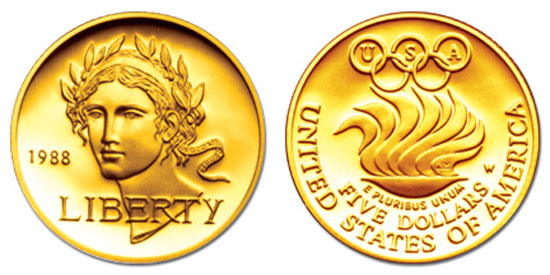
In 1988, the United States struck a small gold coin to pay for its own Olympic team. On the front: Nike, the Greek goddess of victory, carved by the first woman ever to serve as the Mint's chief engraver. It was minted at West Point — in the very year that building stopped being a vault and officially became a Mint.

Why this coin exists

The United States does not fund its Olympic team out of the federal budget. It never has. So when American athletes were preparing for the 1988 Summer Games in Seoul, South Korea, Congress reached for a tool it had been sharpening for a few years: it sold collectors a coin and skimmed a little off each sale for the team.

That tool was the 1988 Olympic Commemorative Coin Act — Public Law 100-141, signed on October 28, 1987. It authorized two coins: a silver dollar and this small gold piece, a "$5 half eagle." Every coin carried a built-in surcharge on top of its price, and the law sent that surcharge straight to the United States Olympic Committee — earmarked to train athletes, support local amateur sports, and build training facilities.

A commemorative coin is one struck to honor a person or event rather than to make change at the grocery store. You buy it from the Mint directly, often at a premium, and the premium does the work. The 1988 program was the third time the modern U.S. Mint had run this play for the Olympics, after the 1983-84 Los Angeles coins — and by now the formula was set: a beautiful coin, a good cause, and a deadline.

The design — a goddess and a flame

The obverse — the heads side — shows Nike, the Greek goddess of victory, in a wreath of olive leaves, with "LIBERTY" reading across the design. It was the work of Elizabeth Jones, who in 1981 became the eleventh chief engraver of the United States Mint and the first woman ever to hold that job. (The chief engraver runs the team that cuts the dies — the hardened steel stamps that press the design into each blank.) Putting a classical goddess of victory on an Olympic coin is an old idea done with real skill: Jones gives Nike a calm, monumental face that looks back across two and a half millennia to the ancient Games.

The reverse — the tails side — was designed by the sculptor Marcel Jovine, and it is pure 1988: a stylized Olympic flame rising beneath the five Olympic rings, with "USA" set into the rings. Where Jones reached for antiquity, Jovine reached for the modern Games and their living symbol, the torch.

The coin is small and dense — about 21.6 mm across, smaller than a U.S. quarter, but struck in 90% gold, so it has real heft for its size. It carries the "W" mint mark of West Point, New York.

Key facts

Year struck
1988 (one year only)
Denomination
$5 (gold half eagle)
Honors
U.S. team at the 1988 Seoul Summer Olympics
Obverse designer
Elizabeth Jones — Nike, goddess of victory
Reverse designer
Marcel Jovine — Olympic flame and rings
Composition
90% gold (0.2418 oz / 0.242 troy oz pure gold)
Weight
8.359 g
Diameter
21.6 mm
Mint
West Point (W mint mark)
Authorizing law
1988 Olympic Commemorative Coin Act — Pub. L. 100-141 (1987)
Maximum authorized
1,000,000
Proof mintage
281,465
Uncirculated mintage
62,913
Surcharge recipient
United States Olympic Committee

Collecting the 1988 Olympic half eagle

There is only one date and one mint: 1988-W. That makes this an unusually simple coin to "complete" — there is no rare branch mint, no key date that costs ten times the others. What varies is finish and grade.

The Mint made the coin two ways. The proof version — struck on polished blanks with specially prepared dies to give mirror-like fields and frosted devices — was by far the more popular, with 281,465 sold. The uncirculated (or "Mint State") version, with a normal satiny finish, sold far fewer: 62,913. That makes the uncirculated coin the scarcer of the two, a fact that surprises newcomers who assume the polished proof must be the rare one.

Because these coins were sold to collectors and tucked away — not spent — most survive in very high grade. The interesting hunting happens at the very top of the scale: a coin graded a flawless PF70 or MS70 (perfect, under magnification) trades for a real premium over an otherwise lovely PF69 or MS69. For most of the population, though, the floor under the price is the gold itself: at roughly a quarter ounce of pure gold, the coin is always worth at least its melt value — the market price of the metal it contains.

One more thing makes 1988 quietly notable. West Point had stamped coins for years as a bullion depository, but it was formally elevated to United States Mint status on March 31, 1988 — the same year this coin was made. (A common claim that 1988 marks the first "W" mint mark is wrong: the W debuted earlier, on the 1984 Los Angeles Olympic $10 gold coin. What changed in 1988 was West Point's official rank.)

Questions collectors ask

What does the 1988 Olympic $5 gold coin commemorate?

It honored the U.S. team at the 1988 Summer Olympics in Seoul, South Korea. Congress authorized it under the 1988 Olympic Commemorative Coin Act (Public Law 100-141), and a surcharge on every coin sold went to the United States Olympic Committee to fund athlete training and amateur sport.

Who designed the 1988 Olympic $5 gold coin?

Elizabeth Jones designed the obverse — Nike, the Greek goddess of victory. She was the eleventh chief engraver of the U.S. Mint and the first woman to hold that position. The sculptor Marcel Jovine designed the reverse, an Olympic flame beneath the five rings.

Is the proof or the uncirculated version rarer?

The uncirculated (Mint State) version is rarer. The Mint struck 62,913 uncirculated coins versus 281,465 proofs — so despite its plainer finish, the uncirculated coin is the scarcer of the two.

How much gold is in the coin?

It contains about 0.242 troy ounce of pure gold (the coin is 90% gold, weighing 8.359 grams). That gold content sets a floor under the coin's value at the current metal price.

Why does it have a 'W' mint mark?

It was struck at West Point, New York. Notably, West Point was officially elevated to United States Mint status on March 31, 1988 — the same year this coin was made.

Sources