US coin · series

The 1995 Cycling Dollar — the Olympic coin nobody bought

America planned for a flood of collectors. They didn't come. That's exactly why this one is scarce.

The 1995 Cycling Dollar — the Olympic coin nobody bought
United States Mint · public domain · source

The U.S. Mint struck sixteen coins for the 1996 Atlanta Olympics — the biggest commemorative push in its history. Most of them sold poorly. The Cycling dollar sold worst of all, and that quiet failure is what makes the 1995-D the scarcest 1995 Olympic silver dollar today.

The story behind the coin

In 1992, Congress made a bet. The 1996 Summer Olympics were coming to Atlanta — the centennial Games, a hundred years after the modern Olympics began in Athens — and lawmakers authorized the most ambitious commemorative coin program the United States had ever attempted: sixteen different coins struck across 1995 and 1996, in copper-nickel, silver, and gold.

The math was supposed to work like this. Each coin carried a surcharge — an extra fee baked into the price, on top of the metal and the Mint's costs. For every silver dollar, that surcharge was $10. The money flowed to Atlanta Centennial Olympic Properties and was split between the Atlanta Committee for the Olympic Games and the U.S. Olympic Committee. Collectors, the thinking went, would buy in droves, and their enthusiasm would help pay for the Games.

Collectors did not buy in droves. Sixteen coins was too many — too much to chase, too much to afford all at once — and sales came in among the lowest of any modern commemorative. By March 1996, government auditors recorded a $3.2 million loss on the program. For a coin buyer, though, a sales flop has a silver lining: the coins that didn't sell were never struck. Low demand became low mintage. And no 1995 Olympic dollar was struck in smaller numbers than this one.

The design — three riders and two clasped hands

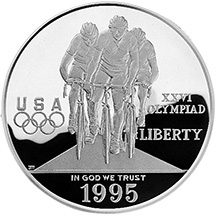
The obverse — the heads side — shows three cyclists bunched together mid-race, the lead rider's wheel just ahead of the others. The Olympic rings sit to the left, with USA above and the words XXVI OLYMPIAD curving around — the 26th Olympic Games, the Roman numeral the modern Olympics use to count themselves. It was designed by John M. Mercanti, the Mint's longtime sculptor-engraver (and later its 12th Chief Engraver), whose work most Americans already owned without knowing it: he designed the eagle on the Silver Eagle bullion coin.

Turn it over and the racing stops. The reverse — the tails side — is quiet and almost solemn: two hands clasped beneath an Olympic torch, a symbol of brotherhood and team spirit, with ATLANTA below. It was designed by William Krawczewicz and engraved by Thomas D. Ferrell. The pairing is the whole story of the coin in two pictures — the competition on one face, the camaraderie on the other.

Key facts

Year struck
1995 (for the 1996 Atlanta Games)
Denomination
Silver dollar
Obverse designer
John M. Mercanti
Reverse designer
William Krawczewicz (engraved by Thomas D. Ferrell)
Composition
90% silver, 10% copper
Weight / diameter
26.73 g / 38.1 mm, reeded edge
Mintage — Denver, uncirculated
19,662
Mintage — Philadelphia, proof
118,795
Authorized by
1996 Atlanta Centennial Olympic Games Commemorative Coin Act (Public Law 102-390, Oct 6, 1992)
Surcharge
$10 per coin → Atlanta Committee for the Olympic Games + U.S. Olympic Committee

Collecting it

Here's the part that surprises newcomers: with this coin, the uncirculated version is the rare one, not the proof.

A proof is a specially made coin — struck twice on polished dies for a mirror-bright finish, sold to collectors in a presentation case. An uncirculated business-strike coin is the ordinary version. Normally proofs are the scarcer, fancier sibling. But the 1995 Cycling dollar inverts that: the Denver uncirculated coin was struck just 19,662 times — the lowest of any 1995 Olympic silver dollar — while the Philadelphia proof reached 118,795. The plain coin is six times scarcer than the pretty one.

That makes the 1995-D the key date of the whole eight-dollar silver run. Because so few were made and most went straight into collector hands, high grades survive in decent numbers — but the raw scarcity at the top of the grade scale (a flawless MS-70 or PF-70) is real, and that's where the premiums live. For a first-time buyer, the lesson is simple: with this coin, ask which version before you ask about condition. The mint mark — the small letter showing where it was struck, D for Denver or P for Philadelphia — tells you which story you're holding.

Questions collectors ask

Why does a 1995 coin say it's for the 1996 Olympics?

The Atlanta program ran across two years. The 1995-dated coins (cycling, gymnastics, track and field, and others) were the first wave; the 1996-dated coins followed. All of them honored the same event — the 1996 Summer Games, the XXVI Olympiad, held in Atlanta.

Which 1995 Cycling dollar is the rare one — proof or uncirculated?

The uncirculated. The Denver uncirculated coin was struck just 19,662 times, the lowest mintage of any 1995 Olympic silver dollar. The Philadelphia proof reached 118,795 — still modest, but far more common.

Who designed the 1995 Cycling dollar?

John M. Mercanti designed the obverse with its three cyclists; he later became the Mint's 12th Chief Engraver and is best known for the Silver Eagle's reverse. William Krawczewicz designed the clasped-hands-and-torch reverse, engraved by Thomas D. Ferrell.

Is the silver worth more than the coin?

The coin contains about three-quarters of an ounce of pure silver, so it has a real metal floor. But as the scarcest 1995 Olympic dollar, the Denver uncirculated piece typically trades well above melt — its value is collector demand, not just silver. Check a live listing for the current number.

Sources