US coin · series

The 1995 Civil War Battlefield Half Dollar

A famed Civil War painter put a drummer boy on a coin — and every one sold helped buy back the ground where the war was fought.

The 1995 Civil War Battlefield Half Dollar
United States Mint (credit: https://www.usmint.gov/learn/coin-and-medal-programs/commemorative-coins) · public domain · source

In 1995 the U.S. Mint struck a half dollar to mark a quieter centennial than most: not a battle, but the moment Americans first started buying battlefields to save them. The man who designed it had spent his life painting that war. And the $2 added to every coin went straight to the fields at Gettysburg and Antietam.

The story behind the coin

Most Civil War monuments mark a battle. This coin marks the rescue.

By the 1890s the great battlefields — Gettysburg, Antietam, Shiloh, Chickamauga — were thirty years past the fighting and quietly vanishing under farms and roads. So Congress began setting aside the ground itself, creating the first national military parks in 1890. A century later, that preservation effort was the thing worth a coin.

The Civil War Battlefields Commemorative Coin Act of 1992 (Public Law 102-379) authorized three coins to honor it — a copper-nickel clad half dollar, a silver dollar, and a $5 gold piece. President George H. W. Bush signed the bill on October 5, 1992. The Mint released the finished coins on March 31, 1995.

The half dollar is the entry point to that set: the cheapest of the three, struck in ordinary copper-nickel rather than precious metal, meant for the collector who wanted the design without the bullion. (A commemorative is a coin Congress authorizes for a specific occasion — sold at a premium, not spent at a store.)

What the coin shows — and who drew it

The obverse — the heads side — shows a Civil War drummer boy, the youngest soldier on any battlefield. That choice was not an accident, because of who designed it.

The drummer was drawn by Don Troiani, widely called the foremost historical military artist in America. Troiani doesn't paint from imagination. He keeps one of the great private collections of original Civil War uniforms, weapons, and gear, dresses live models in it, and studies the actual battlefields, weather, and buildings before he lifts a brush. That obsession with getting the buttons right is exactly why the Mint wanted him: he designed the obverse for all three coins in the program. Look closely and you'll find his initials, "DT," worked into the field.

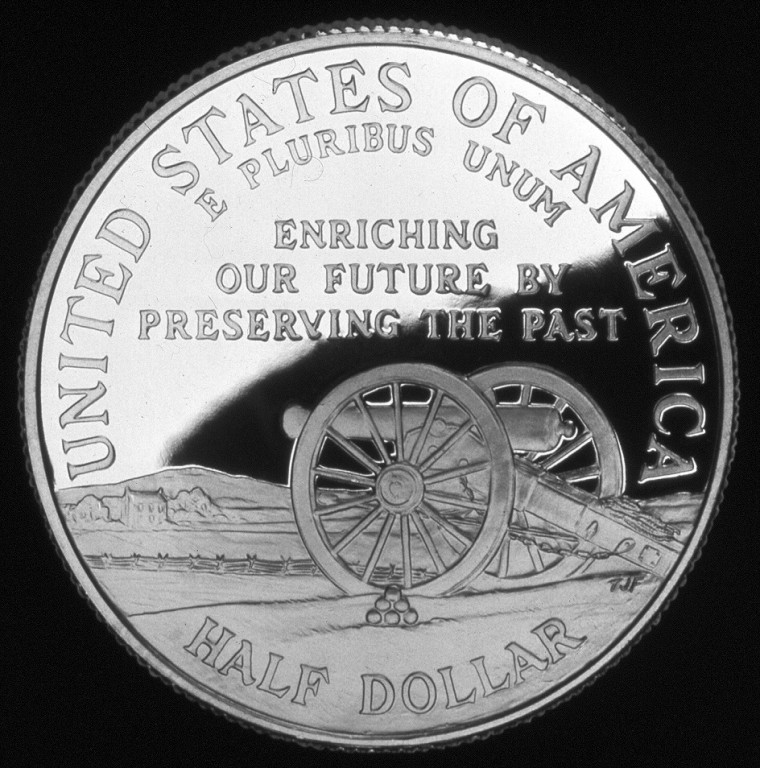
The reverse — the tails side — was designed and engraved by U.S. Mint sculptor-engraver T. James Ferrell, who also engraved Troiani's obverse for striking. It carries a battlefield scene and a line that doubles as the program's whole reason for being: Enriching Our Future by Preserving Our Past. Ferrell's initials, "TJF," appear on both sides.

Key facts

Denomination
Half dollar (50 cents)
Year struck
1995 (mint mark S — San Francisco)
Obverse designer
Don Troiani (drummer boy)
Reverse designer / engraver
T. James Ferrell
Composition
Copper-nickel clad (about 92% copper, 8% nickel)
Weight
11.34 g
Diameter
30.61 mm
Edge
Reeded
Mintage — proof
330,002
Mintage — uncirculated
119,520
Surcharge
$2 per coin, to the Civil War Battlefield Foundation
Authorized by
Civil War Battlefields Commemorative Coin Act of 1992 (P.L. 102-379)
Release date
March 31, 1995

Collecting it

Here is the surprise hiding inside this coin: the Mint lost money on the whole program.

The mid-1990s were the high-water mark of the commemorative glut. In 1995 alone, collectors were asked to buy the six-coin Civil War set and the sprawling 1995–96 Atlanta Olympic program — dozens of issues competing for the same wallets. A 1996 Government Accountability Office report found the pattern plainly: the best-selling U.S. commemoratives were the ones that didn't compete with another new program, and the worst-selling ones did. The Civil War program, the GAO reported, lost roughly $400,000 — even as its sponsor received about $6 million in surcharges. The coins funded preservation; they just didn't make the Mint rich.

For a collector, that crowded market is the whole story of why grades and figures matter here. The two finishes have very different survival counts. The proof — the mirror-finish collector strike (proofs are struck with polished dies on polished blanks for a deep, reflective field) — saw 330,002 made. The uncirculated business-strike finish is far scarcer at 119,520, so a high-grade uncirculated example is the harder of the pair to find.

Neither is rare in absolute terms — these are modern coins, well preserved by buyers who knew they were collectibles. The value lives at the top of the grading scale, where a near-perfect coin stands out from the many ordinary ones, and in the story: a Troiani design, a real preservation legacy, struck in a year the hobby remembers for asking too much of it.

Questions collectors ask

What does the 1995 Civil War Battlefield half dollar commemorate?

It marks the centennial of the battlefield-preservation movement — the era around 1890 when the United States began setting aside Civil War sites as national military parks rather than letting them disappear. It does not commemorate a single battle. The Civil War Battlefields Commemorative Coin Act of 1992 authorized it along with a silver dollar and a $5 gold coin.

Who designed the coin?

The drummer-boy obverse was designed by Don Troiani, often called America's foremost historical military artist, who painted the Civil War from his own collection of original uniforms and equipment. He designed the obverse of all three coins in the program. The reverse battlefield scene was designed and engraved by U.S. Mint sculptor-engraver T. James Ferrell.

Is it real silver?

No. The half dollar is copper-nickel clad — roughly 92% copper and 8% nickel, the same kind of metal as a circulating half dollar. The silver dollar and the $5 gold half eagle in the same 1995 program carry the precious metal; the half dollar was the affordable entry to the set.

What was the surcharge, and where did the money go?

Each half dollar carried a $2 surcharge — money added above the coin's cost — paid to the Civil War Battlefield Foundation for preserving historically significant Civil War battlefields. The silver dollar carried $7 and the $5 gold coin $35.

How many were made, and is it rare?

The Mint struck 330,002 proof and 119,520 uncirculated half dollars. Neither is rare for a modern coin, but the uncirculated finish is the scarcer of the two. Value concentrates in the highest grades, where well-struck, well-preserved examples stand apart from the common ones.

Sources