US coin · series

The 1989 Congress Bicentennial Silver Dollar

A coin for the Capitol's 200th birthday — wearing two of its oldest symbols.

The 1989 Congress Bicentennial Silver Dollar
United States Mint (www.usmint.gov) · public domain · source

In 1989, the United States made a silver dollar to honor the one institution Americans love to complain about: Congress. The result is quietly one of the richest commemoratives of its era — a coin carrying a statue cast by an enslaved man and a ceremonial mace older than the silver in your pocket.

The story behind the coin

On March 4, 1789, the first United States Congress was supposed to convene in New York. Not enough members showed up. It took until April to gather a quorum and actually start governing. Two hundred years later, in 1989, the nation marked that anniversary the way it marks most big ones — with a coin.

Congress authorized three commemoratives for its own bicentennial: a copper-nickel half dollar, this 90% silver dollar, and a small gold five-dollar piece. The authorizing law was the Bicentennial of the United States Congress Commemorative Coin Act, signed in late 1988. The first coins were struck on June 14, 1989, at a ceremony on the Capitol grounds — the building these designs celebrate.

Here is the quiet twist. Congress as an institution doesn't photograph well; you can't put "the legislative branch" on a coin. So the designs reach for the symbols around it — and those symbols carry stories sharper than the anniversary itself.

What the coin shows

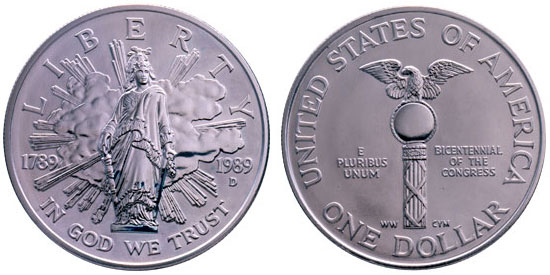
Both sides were designed by sculptor William Woodward, with the models prepared by Chester Y. Martin of the Mint's engraving staff. Their initials — WW and CYM — sit small on the reverse.

The obverse — the heads side — looks straight up at the Statue of Freedom, the 19-and-a-half-foot bronze woman who has crowned the Capitol dome since 1863. Her story is the real one. The sculptor, Thomas Crawford, died in 1857 before his model ever left his studio. Her crested helmet wasn't the original plan: Crawford first gave her a liberty cap, the ancient Roman badge of a freed slave — until Secretary of War Jefferson Davis, soon to lead the Confederacy, objected and had it swapped for a helmet ringed with eagle feathers. And when the foundry crew went on strike, the bronze casting was finished under Philip Reid, a man who was enslaved when the work began and freed by emancipation in the District before the statue's head was hoisted into place on December 2, 1863. A monument to liberty, completed by a man who had just won his own.

The reverse — the tails side — shows the mace of the House of Representatives: thirteen ebony rods bound with silver, topped by a silver globe and a spread-winged eagle. The bundle echoes the Roman fasces — strength through unity — and the thirteen rods stand for the first thirteen states. This is not a museum piece. The current mace was made by New York silversmith William Adams in 1841, and the House Sergeant at Arms still carries it onto the floor when the chamber is in session, and raises it to restore order in a heated debate. The coin puts a working tool of government in your hand.

Key facts

Year struck
1989
Denomination
One dollar (commemorative, non-circulating)
Designer
William Woodward; models by Chester Y. Martin
Obverse
Statue of Freedom atop the Capitol dome
Reverse
Mace of the House of Representatives
Composition
90% silver, 10% copper
Weight
26.73 g (about 0.77 oz of pure silver)
Diameter
38.1 mm
Edge
Reeded
Uncirculated
1989-D — 135,203 struck (Denver)
Proof
1989-S — 762,198 struck (San Francisco)
Surcharge
$7 per dollar, toward the Capitol Preservation Fund

Collecting it

Congress authorized up to three million of these silver dollars. It sold a fraction of that. The final figures were 135,203 uncirculated coins from Denver (the 1989-D) and 762,198 proofs from San Francisco (the 1989-S, with mirror-like fields and frosted devices — that's what "proof" means). Together that's well under a million coins against a three-million ceiling. Buyers in 1989 had a lot of commemoratives to choose from, and the Congress series was not the one that caught fire.

That undersold print run is exactly why the coin is interesting now. The 1989-D, the lower-mintage uncirculated strike, is the scarcer of the two and the one most collectors chase. As with nearly all modern commemoratives, raw examples are common and affordable; the value lives at the top of the grading scale, where a coin graded MS69 or PR69 — near-flawless — or the rare 70 commands a real premium over a typical piece. The story sells the coin; the grade prices it.

A buyer's surcharge of seven dollars rode on every silver dollar sold. By the law's terms, that money was directed toward the Capitol Preservation Fund — so each coin literally helped pay to maintain the building it depicts.

Questions collectors ask

What does the 1989 Congress Bicentennial dollar commemorate?

The 200th anniversary of the first United States Congress, which convened in 1789. It was one of three coins — a half dollar, this silver dollar, and a gold five-dollar piece — authorized for the bicentennial.

What's on the 1989 Congress silver dollar?

The obverse shows the Statue of Freedom, the bronze figure that has crowned the Capitol dome since 1863. The reverse shows the mace of the House of Representatives — thirteen ebony rods bound in silver, topped by an eagle on a globe. Both were designed by William Woodward.

Which is rarer, the 1989-D or the 1989-S?

The 1989-D uncirculated dollar from Denver had the lower mintage at 135,203, versus 762,198 for the 1989-S proof from San Francisco. The Denver coin is the scarcer of the two.

How much silver is in it?

The coin is 90% silver, weighs 26.73 grams, and contains roughly 0.77 troy ounces of pure silver — the same standard as classic U.S. silver dollars.

Did it sell out?

No. Congress authorized up to three million silver dollars, but combined sales of the two versions came to under one million. The series sold modestly compared with other commemoratives of the late 1980s.

Sources