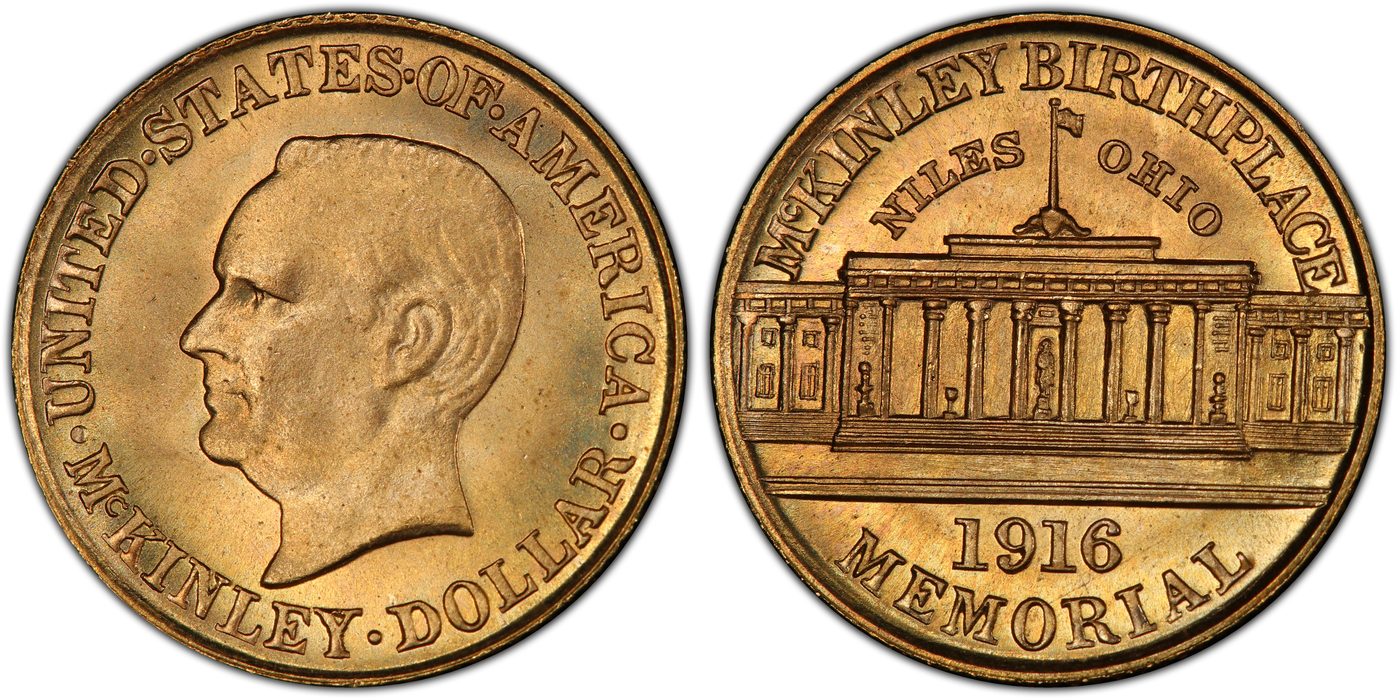
US coin · series

McKinley Birthplace Memorial Gold Dollar

A coin smaller than a dime, made to raise a marble temple to a murdered president.

McKinley Birthplace Memorial Gold Dollar
Professional Coin Grading Service (PCGS) — credit per Wikimedia Commons file.pcgs.com/coinfacts/coin/1916-g-1-mckinley/7454) · public domain · source

When this little gold dollar appeared in 1916, William McKinley became the first person ever to be honored on two different United States coins. It was supposed to pay for a grand memorial. Instead, nearly half of it was melted back into bars.

A second coin for a fallen president

In September 1901, an anarchist named Leon Czolgosz shot President William McKinley at the Pan-American Exposition in Buffalo. McKinley died eight days later. He was the third American president to be assassinated in thirty-six years.

Fifteen years on, his hometown wanted a monument — and Congress let them mint coins to pay for it. On February 23, 1916, President Woodrow Wilson signed the act authorizing a commemorative gold dollar. The money raised would build the National McKinley Birthplace Memorial in Niles, Ohio, the small steel town where McKinley was born.

There was a quiet milestone in it. McKinley had already appeared on a gold dollar back in 1903, struck for the Louisiana Purchase Exposition. When this new coin shipped, he became the first person ever depicted on two different U.S. coin issues — a distinction that, at the time, not even Washington or Lincoln held.

The man behind the project was Joseph G. Butler, Jr., a Niles industrialist and boyhood friend of McKinley, who headed the memorial association. He first suggested a silver dollar, then asked for gold instead. His reasoning was pure politics: McKinley, he noted, "was elected in 1896 mainly on the question of the gold standard." A gold coin for the gold president.

What's on the coin

The obverse — the heads side — carries a bust of McKinley, designed by Charles E. Barber, the Mint's long-serving Chief Engraver. The reverse — the tails side — shows the memorial building itself, a columned Greek-classical structure of Georgia marble, designed by Barber's assistant, George T. Morgan. The two men had collaborated on coinage for decades.

Barber made a deliberate choice that still puzzles collectors: he sculpted a McKinley portrait so unlike his own 1903 version that, by his own intent, you wouldn't recognize them as the same man. Not everyone admired the result. The art historian Cornelius Vermeule later judged the Barber-Morgan pairing "oppressive" and called the obverse "tastelessly Roman." The federal Commission of Fine Arts reviewed the designs in 1916 and asked for changes; the Mint made them anyway without the revisions.

For all that, it's a handsome little object in the hand. It is genuinely tiny — 15 millimeters across, smaller than a U.S. dime, struck in 90% gold and weighing under two grams.

Key facts

Years struck
1916–1917
Denomination
Gold dollar ($1)
Designers
Charles E. Barber (obverse), George T. Morgan (reverse)
Composition
90% gold, 10% copper
Weight
1.7432 g (0.04837 troy oz gold)
Diameter
15 mm — smaller than a dime
Edge
Reeded
Mint
Philadelphia (no mint mark)
Authorized by
Act of February 23, 1916 (up to 100,000 coins)
Coined — 1916
20,000 + 26 assay pieces
Coined — 1917
10,000 + 14 assay pieces
Original issue price
$3.00 each

Collecting it today

Here is the twist that makes this coin interesting. Congress authorized up to 100,000 pieces. Only about 30,000 were ever coined — and a large share of those came straight back to the Mint to be melted.

The exact survival count is genuinely disputed in the numismatic record, and it's worth knowing both sides. Walter Breen reported that of the 20,026 coined for 1916, some 10,023 were melted, leaving a net of about 9,977 for that year, while he believed all 10,000 of the 1917s were distributed. Q. David Bowers, drawing on the recollections of dealer B. Max Mehl, paints a different picture — roughly 15,000 of the 1916s issued and only about 5,000 of the 1917s surviving the furnace. Both accounts agree on the bottom line: this is a low-survival coin, and the 1917 is the scarcer, pricier date.

The poor showing wasn't a mystery even then. Mehl — a Texas dealer who took 10,000 of the coins and resold them at $2.50, below the $3 issue price — bluntly observed that the committee "apparently realized that the number of collectors in the country could not and would not absorb an issue of 100,000 coins at $3.00 each." There simply weren't enough buyers.

For collectors, that history shows up in two places. First, both dates command real premiums in high grade because so few uncirculated pieces survived — a top-grade 1916 has crossed five figures at auction. Second, the coin is a fixture of the classic U.S. gold commemorative set, the eleven-coin grouping that runs from this McKinley dollar through the great Panama-Pacific issues. Date, year, and grade are what move the value; condition is everything in a coin this small and this scarce.

Questions collectors ask

Why is the McKinley gold dollar scarcer than its mintage suggests?

Because a large portion was never sold. Only about 30,000 of an authorized 100,000 were coined, and thousands of unsold pieces were returned to the Mint and melted. Accounts differ on the exact survivors, but both Breen and Bowers/Mehl agree the net distributed figure is far below the coined total — and the 1917 is the scarcer date.

Who designed the McKinley Memorial gold dollar?

Mint Chief Engraver Charles E. Barber designed the obverse portrait of McKinley; his assistant George T. Morgan designed the reverse, which depicts the marble memorial building in Niles, Ohio.

Why was McKinley the first person on two U.S. coins?

He had already appeared on the 1903 Louisiana Purchase Exposition gold dollar. When this 1916 memorial dollar was issued, he became the first person depicted on two separate U.S. coin issues.

Is the 1916 or the 1917 more valuable?

The 1917 is generally the scarcer and more valuable date, as more 1917-dated pieces are believed to have been melted. In every grade the 1917 typically carries a premium over the 1916, though both are condition-sensitive.

What did the coin pay for?

Sales proceeds funded the National McKinley Birthplace Memorial in Niles, Ohio — a Greek-classical Georgia-marble building with a museum, library, and auditorium, dedicated in 1917.

Sources