US coin · series

The 2011 United States Army $5 Gold Coin

A coin that helped build a museum — one that wouldn't open for nine more years.

The 2011 United States Army $5 Gold Coin
United States Mint · public domain · source

In 2011, the U.S. Mint struck a small gold coin to honor the oldest branch of the American military. The money it raised went toward a museum that didn't open its doors until 2020. Fewer than 26,000 of these coins were ever made.

The story behind the coin

The United States Army is older than the United States. On June 14, 1775 — more than a year before the Declaration of Independence — the Second Continental Congress voted to raise a Continental Army, then named George Washington to command it the next day. By the time this gold coin was struck, the Army had been in continuous service for 236 years.

Congress decided that milestone deserved a coin. The United States Army Commemorative Coin Act of 2008 (Public Law 110-450) was signed into law on December 1, 2008, and ordered the Mint to strike a three-coin program in a single year: a copper-nickel clad half dollar, a silver dollar, and this gold piece — the $5 "half eagle," the traditional name for a five-dollar U.S. gold coin.

There was a second purpose, written right into the law. Every gold coin sold carried a $35 surcharge, paid to the Army Historical Foundation to help build the National Museum of the United States Army at Fort Belvoir, Virginia. Buyers weren't just collecting a coin — they were chipping in on a building. The catch, in hindsight: that museum took years. It finally opened on November 11, 2020 — nearly a decade after the coins went on sale. So a coin minted in 2011 quietly helped pay for a hall of Army history that visitors couldn't walk through until almost ten years later.

The design

The front of a coin is the obverse — the "heads" side. Here, designer Joel Iskowitz did something unusual: he put five soldiers on it, each from a different chapter of American history. Reading across, they represent the Continental Army of the Revolution, the Civil War, the modern era, World War II, and World War I — roughly two and a half centuries of service standing shoulder to shoulder. The sculptor who turned that drawing into three-dimensional metal was Mint engraver Phebe Hemphill. The inscriptions are spare: LIBERTY, the date 2011, and IN GOD WE TRUST.

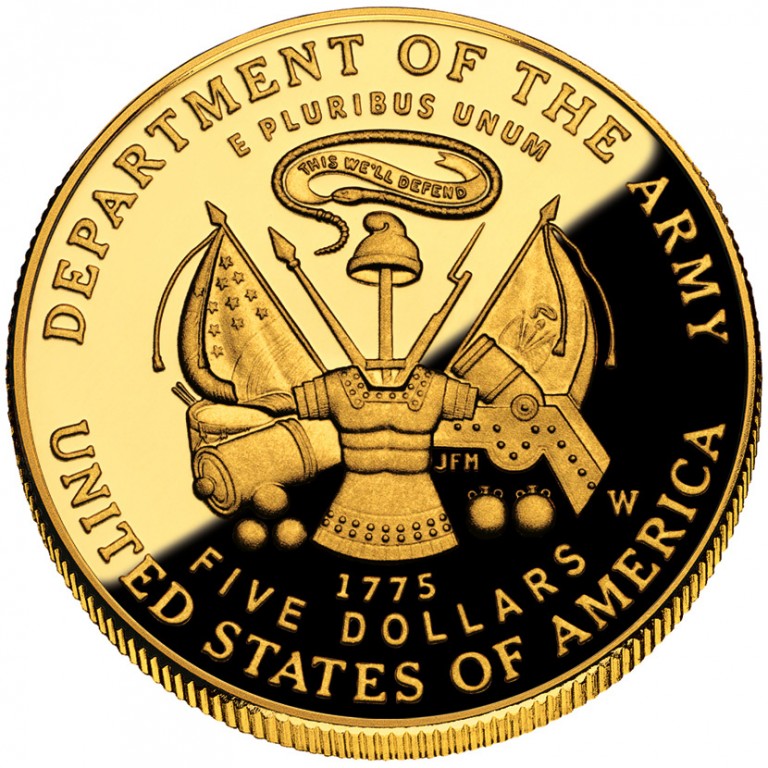
The back — the reverse, the "tails" side — is built around the official emblem of the U.S. Army, designed and sculpted by Mint artist Joseph Menna. It carries the Army's motto, THIS WE'LL DEFEND, along with DEPARTMENT OF THE ARMY, the founding year 1775, E PLURIBUS UNUM, the denomination FIVE DOLLARS, and UNITED STATES OF AMERICA.

It's a small object. At 21.6 millimeters across — a touch smaller than a U.S. nickel — and a little over a quarter-ounce of gold, the coin packs five figures and a full emblem into a tight space. That density of detail is part of why collectors prize the sharp, frosted proof strikes, made on polished dies for a mirror-like finish.

Key facts

Years struck
2011 only (one-year program)
Denomination
$5 gold (half eagle)
Honors
236th anniversary of the U.S. Army (founded 1775)
Authorizing act
U.S. Army Commemorative Coin Act of 2008 (Pub. L. 110-450)
Obverse design
Joel Iskowitz (designer), Phebe Hemphill (sculptor)
Reverse design
Joseph Menna (designer and sculptor) — official Army emblem
Composition
90% gold, 6% silver, 4% copper
Weight
8.359 g (0.242 troy oz gold content)
Diameter
21.6 mm
Authorized maximum
100,000 coins (all options combined)
Proof mintage (2011-W)
17,148
Uncirculated mintage (2011-P)
8,052
Surcharge
$35 per coin to the Army Historical Foundation

Collecting it

The whole point of a commemorative is that it never circulates — it's sold straight from the Mint to collectors, in a box, at a premium over its gold value. So with this coin the question isn't "is it rare in high grade?" the way it is for a worn old penny. The question is simply: how many did people buy?

The answer is: not many. The Mint was authorized to strike up to 100,000 gold coins across both finishes. It made far fewer. The proof version, struck at West Point and carrying a W mint mark — the small letter showing which facility made it — sold 17,148. The uncirculated version, struck at Philadelphia with a P mint mark, sold just 8,052. That uncirculated figure is the one collectors watch: it sits among the lowest mintages of any modern U.S. gold commemorative, which makes the 2011-P the scarcer of the two and the prize of the pair.

Because every coin came from the Mint factory-fresh, the meaningful distinctions are the finish (proof versus uncirculated), the mint mark (W versus P), and the grade — how flawless a given coin is. Both versions are common enough to find, but the low absolute numbers mean there simply aren't many to go around. There are no major die varieties to chase; the story here is scarcity by design, not by accident.

Questions collectors ask

How rare is the 2011 Army $5 gold coin?

It's genuinely scarce. The Mint sold 17,148 proof coins (2011-W) and only 8,052 uncirculated coins (2011-P). That uncirculated total ranks among the lowest mintages of any modern U.S. gold commemorative, even though the Mint was allowed to strike up to 100,000.

What's the difference between the 2011-W and 2011-P versions?

The mint mark tells you which facility struck the coin and which finish you have. The 2011-W is the proof — struck at West Point on polished dies for a mirror finish, with the higher mintage of 17,148. The 2011-P is the uncirculated (business-strike) version from Philadelphia, with the much lower mintage of 8,052.

How much gold is in the coin?

It contains 0.242 troy ounces of pure gold. The coin is 90% gold, alloyed with silver and copper for durability, and weighs 8.359 grams overall at 21.6 mm across.

Why does the coin have a surcharge, and where did the money go?

The authorizing law added a $35 surcharge to every gold coin sold, paid to the Army Historical Foundation. The funds helped build the National Museum of the United States Army at Fort Belvoir, Virginia, which opened on November 11, 2020.

Who designed the 2011 Army $5 gold coin?

The obverse — five soldiers from five eras of American history — was designed by Joel Iskowitz and sculpted by U.S. Mint engraver Phebe Hemphill. The reverse, based on the official U.S. Army emblem, was designed and sculpted by Mint artist Joseph Menna.

Sources