US coin · series

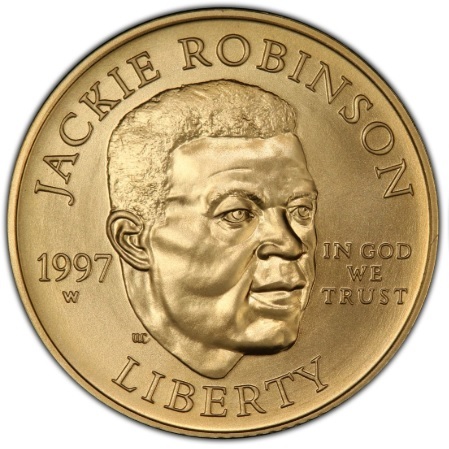
The 1997 Jackie Robinson $5 Gold Coin

A tribute to the man who broke baseball's color line — and the rarest modern U.S. commemorative because almost nobody bought it.

The 1997 Jackie Robinson $5 Gold Coin
U.S. Mint (us.mint.gov) · public domain · source

In 1947, Jackie Robinson walked onto a major-league field and changed America. Fifty years later the U.S. Mint honored him in gold — and collectors stayed away in droves. Only 5,174 of the uncirculated coins sold. That flop turned a $180 souvenir into the key date of the entire modern commemorative series.

The story behind the coin

On April 15, 1947, Jackie Robinson stepped onto the field for the Brooklyn Dodgers and became the first Black player in the modern major leagues. He did it under a torrent of abuse — from opposing dugouts, from the stands, from teammates who circulated a petition to keep him off the roster. He answered with his bat, his speed, and a discipline that cost him more than anyone watching could see. He didn't just integrate baseball. He cracked open the idea that America's institutions could stay segregated.

Fifty years later, Congress decided gold was the right way to remember it. The Jackie Robinson Commemorative Coin Act — folded into the United States Commemorative Coin Act of 1996, Public Law 104-329, signed on October 20, 1996 — authorized a $5 gold coin and a $1 silver dollar for the anniversary. A surcharge on every sale was earmarked for the Jackie Robinson Foundation, the nonprofit Robinson's widow Rachel founded in 1973 to send minority students to college on scholarship. Buy the coin, fund a scholarship: that was the deal.

Then something strange happened. The coin barely sold. The Mint was authorized to strike up to 100,000 of the gold pieces. It sold a few thousand. The tribute to one of the most consequential Americans of the century became, almost by accident, one of the rarest coins the modern Mint has ever made.

The design

Look at the obverse — the "heads" side — and you might not recognize a ballplayer at all. There's no swinging bat, no Dodgers cap. Instead the portrait shows Robinson in his later years, the civil-rights advocate and businessman he became after baseball, gazing slightly off to the side. It's a deliberate choice: the coin honors the whole man, not just the rookie. The design is credited to U.S. Mint sculptor-engraver William C. Cousins, sculpted in steel by Thomas James Ferrell. Around him run the words JACKIE ROBINSON, LIBERTY, IN GOD WE TRUST, the date 1997, and a small W — the mint mark, the single letter that says where a coin was struck. This one came from West Point, New York.

Turn it over. The reverse — the "tails" side — is the one that says baseball. A single baseball sits at the center, wrapped in the inscription LEGACY OF COURAGE and the two dates that bracket Robinson's life, 1919–1972. It was designed by Mint graphic designer James M. Peed and engraved by John Mercanti, the Mint's chief engraver. Two sides, two halves of one life: the elder statesman on the front, the game that made him famous on the back.

Key facts

Year struck
1997 (West Point, mint mark W)
Denomination
$5 gold (quarter-ounce)
Composition
90% gold, 10% copper (.900 fine)
Weight / diameter
8.359 g / 21.6 mm, reeded edge
Obverse design
William C. Cousins (engraved by Thomas James Ferrell)
Reverse design
James M. Peed (engraved by John Mercanti)
Uncirculated mintage
5,174 — the lowest of any modern U.S. commemorative of its era
Proof mintage
24,072
Authorizing law
Public Law 104-329 (Oct. 20, 1996)
Surcharge
$35 per gold coin, paid to the Jackie Robinson Foundation

Collecting it

Here's the twist that makes this coin matter to collectors. The Mint struck two versions: a proof — the mirror-polished, specially-finished collector strike — and an uncirculated business strike with an ordinary satiny finish. The proof sold reasonably: 24,072 pieces. The uncirculated coin sold just 5,174. That single number is the whole story. It is the lowest mintage of any modern U.S. commemorative struck in the program's first decades, and it made the 1997 Jackie Robinson the key date — the scarcest, most-chased issue — of the entire modern commemorative run.

Why did it flop? A few reasons collectors point to. The $5 gold commemorative was a hard sell in 1997: the pre-issue price was $180, climbing to $205 after the early window closed, for a coin carrying only a quarter-ounce of gold. The series was crowded — the late 1990s flooded the market with commemoratives, and buyer fatigue was real. And gold simply attracts fewer buyers than silver. The result is a coin that almost nobody wanted at the cash register and that many people want now.

Because so few exist, condition is everything. The grade — a coin's preservation, scored on the 70-point scale the major grading services use — separates a five-figure prize from a merely scarce one. Top-grade uncirculated examples are genuinely tough, and the coin appears on published lists of the great modern U.S. rarities. The lesson the 1997 Jackie Robinson teaches every collector: a low mintage isn't planned. It's what happens when a coin fails to sell — and the failure is exactly what makes it valuable.

Questions collectors ask

Why is the 1997 Jackie Robinson $5 gold coin so rare?

It simply didn't sell. The Mint was authorized to strike up to 100,000, but only 5,174 of the uncirculated version found buyers — the lowest mintage of any modern U.S. commemorative of its era. A $180-and-up price for a quarter-ounce gold coin, a crowded commemorative market, and gold's smaller collector base all kept buyers away. That sales flop is exactly what made it a key date.

What's the difference between the proof and the uncirculated version?

Both were struck at West Point in 1997. The proof has a mirror-like, specially polished finish made for collectors, and 24,072 sold. The uncirculated coin has an ordinary satiny business-strike finish — and only 5,174 sold. The uncirculated is far scarcer and far more valuable as a result.

What does 'Legacy of Courage' on the back mean?

It's the inscription wrapped around the baseball on the reverse, paired with the dates 1919–1972. It points past Robinson's stats to what the coin is really honoring: the courage it took to integrate Major League Baseball in 1947 under relentless abuse, and the civil-rights work he carried on afterward.

What anniversary does the coin commemorate?

The 50th anniversary of Jackie Robinson breaking baseball's color line. He debuted for the Brooklyn Dodgers on April 15, 1947, becoming the first Black player in the modern major leagues — the coins were authorized for the 1997 anniversary.

Where did the money from the coin go?

Each $5 gold coin carried a $35 surcharge paid to the Jackie Robinson Foundation, the nonprofit Rachel Robinson founded in 1973. The funds supported its education, youth-leadership, and college-scholarship programs for economically disadvantaged students.

Sources