US coin · series

The 1993 Bill of Rights Half Dollar

A silver tribute to the man who wrote America's first ten amendments — and to the document itself.

The 1993 Bill of Rights Half Dollar
United States Mint (www.usmint.gov) · public domain · source

In 1993, the U.S. Mint did something it almost never does with a half dollar anymore: it struck this one in real silver. The coin honors James Madison and the Bill of Rights — and its quiet metal choice is the first clue that this was meant to be kept, not spent.

The story behind the coin

The Bill of Rights — the first ten amendments to the Constitution — was ratified on December 15, 1791. It guarantees the freedoms Americans tend to take for granted: speech, religion, the press, a fair trial. Two hundred years later, Congress decided that anniversary deserved a coin.

So in 1992 it passed the James Madison–Bill of Rights Commemorative Coin Act (Public Law 102-281), signed into law on May 13, 1992. The act authorized a three-coin program: a half dollar and a $5 gold piece "emblematic of the Bill of Rights," plus a silver dollar honoring James Madison himself. The coins went on sale on January 22, 1993.

Why Madison? Because more than anyone, the Bill of Rights was his work. As a young congressman he drafted the amendments, argued them through a skeptical House, and shepherded them to ratification. The half dollar puts that fact right on the coin: the inscription names him "Father of the Bill of Rights."

The design

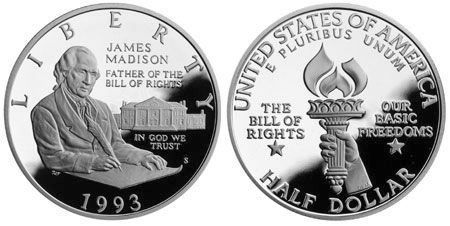
The obverse — the heads side — was designed by Mint sculptor-engraver T. James Ferrell. It shows Madison seated, pen in hand, drafting the amendments, with his Virginia plantation home, Montpelier, behind him. The legend reads "JAMES MADISON FATHER OF THE BILL OF RIGHTS." It is an unusually literal portrait of a man at work — not a heroic bust, but a writer mid-sentence.

The reverse — the tails side — is by Dean McMullen and carries a torch, a long-standing American shorthand for liberty and enlightenment. Around it run the words "THE BILL OF RIGHTS" and "OUR BASIC FREEDOMS," together with the usual national mottoes.

The most interesting design decision, though, isn't on either face — it's in the metal. Most commemorative half dollars of this era were struck in copper-nickel clad, the same sandwich as the quarters in your pocket. This one was struck in 90% silver, the old pre-1965 alloy. A circulating coin would never be made this way again. Choosing silver signaled what the coin really was: a keepsake.

Key facts

Year struck
1993
Denomination
Half dollar (50 cents)
Honors
The Bill of Rights & James Madison
Obverse designer
T. James Ferrell
Reverse designer
Dean McMullen
Composition
90% silver, 10% copper (≈0.3617 oz silver)
Weight
12.50 g
Diameter
30.61 mm
Edge
Reeded
Uncirculated
1993-W (West Point) — about 193,300 struck
Proof
1993-S (San Francisco) — 586,315 struck
Authorizing act
Public Law 102-281 (signed May 13, 1992)
Surcharges to
James Madison Memorial Fellowship Trust Fund

Collecting it

This is not a rare coin, and that's the honest place to start. Hundreds of thousands were made, and the Mint sold them straight to collectors in nice packaging, so well-preserved examples are common. For most of its life it has traded close to its silver content plus a modest premium.

Two versions exist, and they split cleanly. The proof — the 1993-S from San Francisco, struck twice from polished dies for a mirror finish — is the more common of the two, at 586,315 pieces. The uncirculated business strike — the 1993-W from West Point, with its frosty, satin look — is the scarcer one, at roughly 193,300. That smaller number is what draws the eye of someone building a complete modern commemorative set.

Like every commemorative of this generation, each coin carried a surcharge — a few dollars added to the price that went to a cause. Here it funded the James Madison Memorial Fellowship Trust Fund, which supports graduate study of the Constitution. So a collector who bought one in 1993 was, in a small way, paying to teach the very document on the coin.

One quirk worth knowing: a small batch — collectors cite roughly 9,656 pieces — was specially marked by the American Numismatic Association with Madison Foundation serial numbers as a promotional issue. Those carry a story, and sometimes a premium, beyond the plain coin.

Questions collectors ask

Is the 1993 Bill of Rights half dollar real silver?

Yes. Unlike most modern half dollars, which are copper-nickel clad, this commemorative was struck in 90% silver and 10% copper — the same alloy U.S. coins used before 1965. Each one holds about 0.36 troy ounces of silver.

Who designed the Bill of Rights half dollar?

Two U.S. Mint artists. T. James Ferrell designed the obverse, showing James Madison drafting the Bill of Rights with his home, Montpelier, behind him. Dean McMullen designed the reverse, which features a torch of liberty.

What's the difference between the 1993-W and 1993-S versions?

The 1993-W is the uncirculated business strike from West Point — frosty and satin in look — with the smaller mintage of roughly 193,300. The 1993-S is the proof from San Francisco — a mirror-like finish struck from polished dies — with 586,315 made. The W is the scarcer of the pair.

Why does the coin call Madison the 'Father of the Bill of Rights'?

Because the title is earned. As a member of the first Congress, James Madison drafted the amendments, pushed them through the House, and led the effort to get them ratified in 1791. The coin marks the bicentennial of that achievement.

What were the surcharges used for?

Sales of the program's coins added a surcharge that went to the James Madison Memorial Fellowship Trust Fund, which supports graduate study of the U.S. Constitution — its origins, principles, and history.

Sources