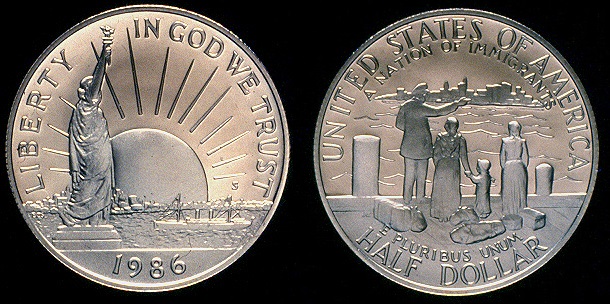
The story behind the coin
By the early 1980s, the most famous statue in America was rusting. A century of salt air, wind, and a hundred million visitors had eaten into Lady Liberty's iron skeleton. Across the harbor, Ellis Island — the gateway that processed more than twelve million immigrants between 1892 and 1954 — sat abandoned and crumbling.
The fix would cost hundreds of millions of dollars, and the government wasn't paying. A private commission, chaired by Chrysler boss Lee Iacocca and formed in 1982, had to raise it. One of their tools was a coin.
In 1985, Congress passed the Statue of Liberty–Ellis Island Commemorative Coin Act. President Reagan signed it on July 9, 1985 (Public Law 99-61). It authorized a three-coin set — a half dollar, a silver dollar, and a five-dollar gold piece — timed for the statue's centennial. Every coin carried a built-in donation. The half dollar's surcharge was $2; buy one, and two dollars went to the Statue of Liberty–Ellis Island Foundation. The coins went on sale beginning in late 1985, with the celebrations cresting over the July 4, 1986 "Liberty Weekend." It became the most successful commemorative program in U.S. Mint history, raising tens of millions for the restoration.