US coin · series

The 1982 Washington Half Dollar: The Coin That Broke a 28-Year Silence

Washington on horseback, real silver again, and the first US commemorative in a generation.

The 1982 Washington Half Dollar: The Coin That Broke a 28-Year Silence
United States Mint · public domain · source

For 28 years, the United States struck no commemorative coins at all. In 1982, that silence ended with a half dollar honoring George Washington — and for the first time since 1964, the Mint poured real silver into a coin.

The coin that ended a 28-year silence

For most of a generation, the United States simply stopped making commemorative coins. The last one — a half dollar honoring Booker T. Washington and George Washington Carver — left the press in 1954. Then nothing. For 28 years.

The reason was a mess of the Mint's own making. In the 1930s, commemoratives had spun out of control: too many designs, too many local sponsors, too many coins sold at a markup to anyone with a cause. Congress grew suspicious that the flood made counterfeiting easier and the program look like a racket. In 1939 it began shutting the whole thing down, and after 1954 the door closed entirely.

What reopened it was a birthday. 1982 marked 250 years since George Washington was born in 1732. Congress passed Public Law 97-104, authorizing a silver half dollar to mark the occasion — and with that single coin, the modern commemorative era began. Collectors split US commemoratives into two ages: the classic ones, 1892 to 1954, and the modern ones, 1982 to today. This is the coin that opens the second book.

It carried a second distinction that delighted anyone who remembered older money. Since 1965, US coins had been struck in copper-nickel "clad" — no precious metal at all. The 1982 Washington half was struck in 90% silver, the first time the Mint had used that classic alloy since 1964. After nearly two decades of pocket change with no silver in it, the metal was back, if only for a coin you bought rather than spent.

The design: Washington on horseback

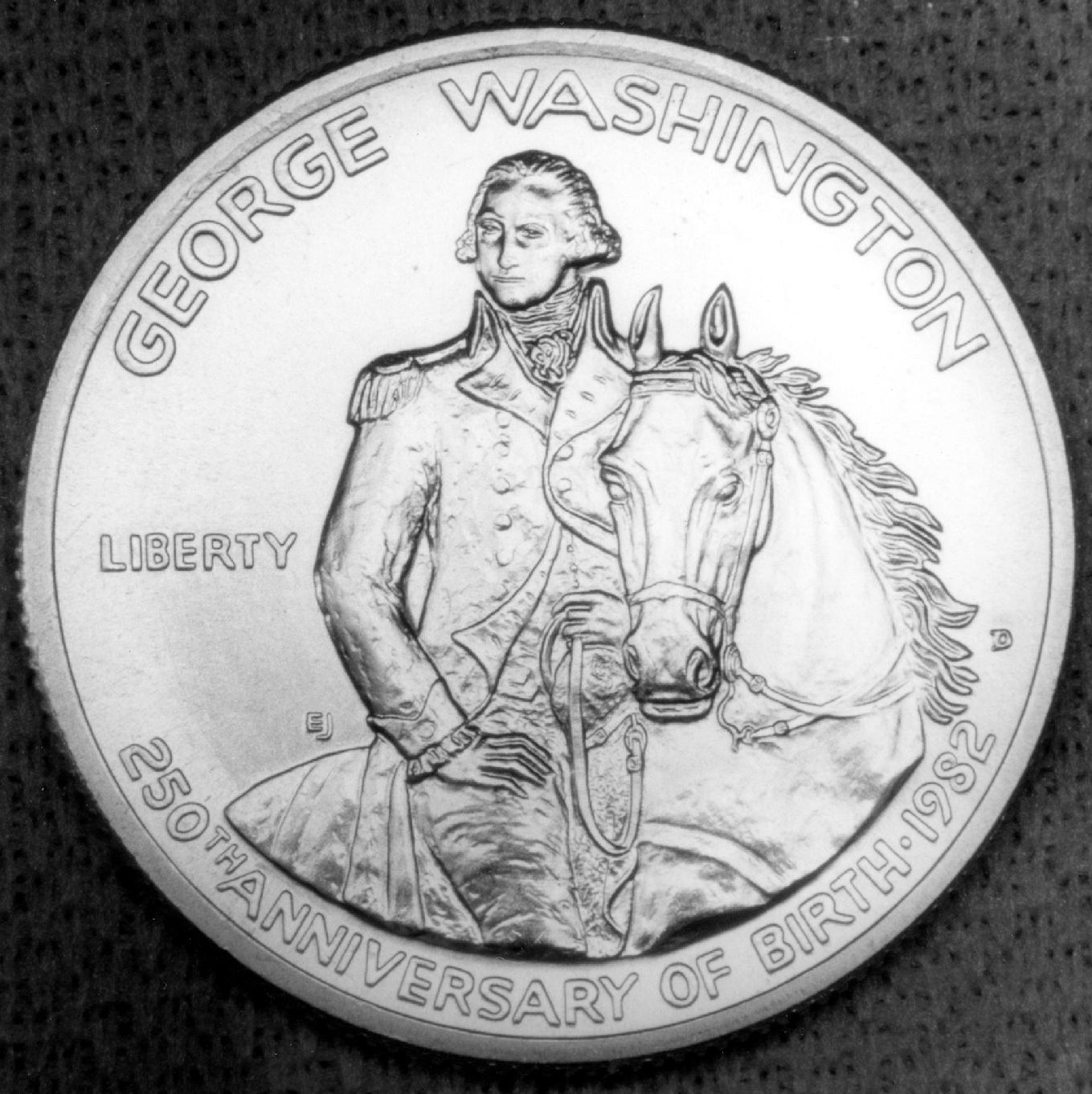
The obverse — the heads side — breaks from a century of habit. Nearly every coin bearing Washington shows the same calm profile, modeled on a 1785 bust. This one puts him on a horse.

The designer was Elizabeth Jones, the Mint's chief engraver, and the choice was deliberate. By her own account to Coin World, she settled on it at once: "I decided instantaneously I was going to put him on a horse." She gave us Washington the soldier — hatless, in military uniform, mounted and in motion — rather than the familiar statesman in repose. The inscriptions read GEORGE WASHINGTON, LIBERTY, and 250TH ANNIVERSARY OF BIRTH·1982.

The reverse — the tails side — turns to home. It shows the eastern face of Mount Vernon, Washington's Virginia estate on the Potomac, with a heraldic eagle below and the legends UNITED STATES OF AMERICA, IN GOD WE TRUST, and HALF DOLLAR.

Jones herself is part of why this coin matters. Appointed by President Reagan in 1981, she was the 11th chief engraver of the United States Mint — and the first woman ever to hold the post. The coin that relaunched American commemorative coinage was hers, start to finish: she designed both sides.

Key facts

Year struck
1982
Designer
Elizabeth Jones (obverse and reverse)
Composition
90% silver, 10% copper
Weight
12.50 g
Diameter
30.6 mm
Edge
Reeded
Uncirculated (1982-D)
2,210,458 sold
Proof (1982-S)
4,894,044 sold
Authorized by
Public Law 97-104 (cap of 10,000,000)
Honors
250th anniversary of George Washington's birth (1732)

Collecting the 1982 Washington half

This is an accessible coin, and that is a feature, not a flaw. The Mint sold it in two forms: an uncirculated version struck at Denver (the small D mint mark — the tiny letter showing which facility made it) and a proof struck at San Francisco (the S). A proof is a special collector's strike — polished dies on polished blanks, giving mirror fields and frosted devices.

Neither version is rare. Combined sales topped seven million coins, with the proof outselling the uncirculated by more than two to one — 4,894,044 against 2,210,458. The Mint had been authorized to make up to ten million, and demand never reached that ceiling. For most collectors, the value here is the silver, the history, and the eye appeal rather than scarcity.

So the chase is about condition, not date. Because so many survive, a common coin in an ordinary grade and a near-flawless one can sit far apart in price. On a proof, collectors look for deep, contrast-rich "cameo" frosting; on the uncirculated coin, they look for clean, unmarked surfaces. A high grade on a coin this plentiful is the real prize — the difference between one of millions and one of the best few.

Questions collectors ask

Why is the 1982 Washington half dollar historically important?

It was the first US commemorative coin in 28 years — the last had been struck in 1954 — and it launched the 'modern' commemorative era that continues today. It was also the first 90% silver coin the US Mint had produced since 1964.

Is the 1982 Washington half dollar made of real silver?

Yes. It is 90% silver and 10% copper, weighing 12.50 grams. That makes it the first 90% silver coin from the US Mint since 1964.

Who designed the 1982 Washington half dollar?

Elizabeth Jones, the chief engraver of the US Mint and the first woman to hold that post. She designed both sides — Washington on horseback on the obverse and Mount Vernon on the reverse.

What do the D and S mint marks mean on this coin?

The D means the uncirculated version was struck at the Denver Mint; the S means the proof version was struck at San Francisco. The proof (4,894,044) outsold the uncirculated (2,210,458).

Is the 1982 Washington half dollar rare or valuable?

It is common — over seven million were sold across both versions. Its value comes mainly from its silver content and history. The exceptions are top-grade examples, where condition rather than scarcity drives the premium.

Sources