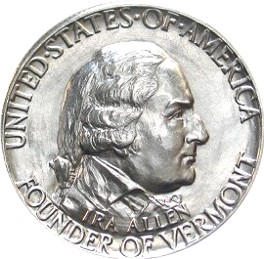
The story behind the coin
In August 1777, the Revolution was going badly. A British army under General Burgoyne was driving down from Canada toward the Hudson, splitting the colonies in two. To feed his troops he sent a raiding force toward a supply depot at Bennington, in the disputed territory that would become Vermont.
He never reached it. American militia — including the Green Mountain Boys, the rough frontier fighters who had made the region ungovernable for years — met the raiders and crushed them. The Battle of Bennington bled Burgoyne of men he could not replace. Weeks later he surrendered at Saratoga, the turning point that brought France into the war.
Vermont remembered. The same year, 1777, it declared itself an independent republic — a small nation that would not join the United States for fourteen more years. So when the 150th anniversary came around, the state had two milestones to honor at once: a battle that helped win a war, and the moment it declared itself free. Congress agreed. On February 24, 1925, President Calvin Coolidge — himself a Vermonter by birth — signed the act authorizing a commemorative half dollar.