US coin · series

The Texas Centennial Half Dollar

The coin Texas built around the Alamo — and the one that dared to put the eagle on the wrong side.

The Texas Centennial Half Dollar
Wikimedia Commons uploader "Bobby131313"; work of the U.S. Government, ineligible for US copyright (public domain) · public domain · source

In 1934 Texas did something no U.S. coin had done before: it moved the American eagle to the heads side and handed the back of the coin to the Alamo. The result was a fifty-cent piece sold to celebrate a century of Texas independence — and a five-year sales campaign that fizzled so badly the Mint melted more than half of them.

The story behind the coin

In 1836 a few thousand Texans broke away from Mexico and made their own republic. A hundred years later, Texas wanted to throw itself a party — and it needed money to do it.

So Texas turned to a trick that was wildly popular in the 1930s: the commemorative coin. Congress could authorize a special half dollar, the Mint would strike it at face value, and a sponsor could then sell it to collectors at a markup. The profit funded the celebration. On June 16, 1933, President Franklin Roosevelt signed the act — pushed through by Texas Senator Tom Connally and Representative Wright Patman — authorizing up to 1,500,000 half dollars "in commemoration of the one hundredth anniversary in 1936 of the independence of Texas."

The coins sold for a dollar each. The extra fifty cents above face value — the surcharge, the markup baked into the price — was meant to fund the Texas Memorial Museum at the University of Texas at Austin. It was history paying for a building about history.

There was just one problem. Texas struck these coins for five straight years, from 1934 through 1938, long after the centennial fever had cooled. Collectors and Texans simply stopped buying. By the end, the Mint had melted down more than half of every coin it made — a quiet admission that the party had run too long.

The design — an eagle where it doesn't belong

The coin was the work of Pompeo Coppini, an Italian-born sculptor who had made Texas his adopted home and filled the state with monuments. He designed both sides — and, by one account, charged nothing for the work.

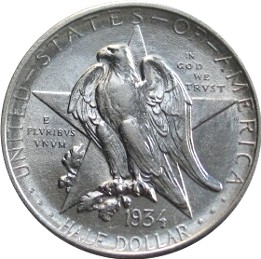
Coppini broke a rule on purpose. On almost every U.S. coin, the eagle lives on the reverse — the tails side. Coppini put it on the obverse (the heads side), perched in front of the five-pointed Lone Star of Texas. It was a statement: this is a Texas coin first.

The reverse is where the drama is. A winged Victory kneels, an olive branch in one hand, the other resting on the Alamo itself. Behind her stand six flags — the famous "Six Flags Over Texas," the six nations that have ruled the land — half-hidden behind a scroll reading "Liberty." Tucked into the clouds beside her are two small portrait medallions: Sam Houston, who won Texas its independence on the battlefield, and Stephen F. Austin, the "Father of Texas" who first brought American settlers in. Along the bottom runs the rallying cry of the revolution: REMEMBER THE ALAMO.

It was a lot to pack onto a 30-millimeter disc. Charles Moore, who chaired the U.S. Commission of Fine Arts — the body that reviews coin and monument designs — called an early version "a perfect hodgepodge." Sculptor Lee Lawrie was brought in to help tidy it up, and a revised design was approved in June 1934. The crowded reverse is, in a sense, the whole point: it tries to tell the entire story of Texas in a single glance.

Key facts

Years struck
1934–1938
Denomination
Half dollar (50¢)
Designer
Pompeo Coppini
Obverse
Eagle in front of the Lone Star of Texas
Reverse
Winged Victory with the Alamo; Sam Houston & Stephen F. Austin medallions; 'Remember the Alamo'
Composition
90% silver, 10% copper
Weight
12.5 grams
Diameter
30.6 mm
Edge
Reeded
Issue price
$1 (50¢ surcharge above face value)
Funded
Texas Memorial Museum, UT Austin
Authorized
Up to 1,500,000 — signed June 16, 1933
Total net distributed
About 149,500 (roughly half of ~304,000 struck were melted)
Mints
Philadelphia, Denver (D), San Francisco (S)

Collecting it — where the scarcity hides

Here is the quirk that makes this series fun to chase. The first year is by far the most common, and the last year is the rarest — the exact opposite of how most coins age.

The 1934 coin, struck before anyone knew sales would slump, exists in healthy numbers — around 61,000 survived the melting pot. But from 1935 on, Texas issued the coin in matched sets: one each from Philadelphia, Denver, and San Francisco (the "D" and "S" mint marks — tiny letters showing which mint struck the coin). Each year fewer people bought in, so each year the surviving numbers shrank.

By 1938, the final year, only about 3,700–3,800 coins came out of each mint and stuck around — roughly 11,000 total across all three. That makes the 1938 set the key to the series: the scarcest, most sought-after, and most expensive to complete in high grade. The 1937 issues are the next-scarcest step down.

What collectors prize today is a complete run — every date, every mint mark — in matching, high condition. Because so many of these coins sat untouched in their original holders for decades, a fair number survive in excellent mint state (uncirculated, never spent). But the low-mintage later dates in top grades are genuinely hard to find, and that's where the chase — and the value — lives.

Questions collectors ask

Why is the eagle on the front of the Texas Centennial half dollar?

Designer Pompeo Coppini put it there on purpose. On nearly every U.S. coin the eagle sits on the reverse (tails), but Coppini moved it to the obverse (heads), in front of the Lone Star, to make a statement that this was a Texas coin first. The Alamo and Texas heroes got the back of the coin instead.

Which Texas Centennial half dollar is the rarest?

The 1938 issues. By the final year, sales had collapsed and only about 3,700–3,800 coins from each of the three mints (Philadelphia, Denver, San Francisco) were distributed — roughly 11,000 total. The 1938 set is the key date of the series. The 1937 issues are the next-scarcest.

Why did the U.S. Mint melt so many of them?

Texas kept striking the coin for five years, well past the 1936 centennial, and the public stopped buying. Unsold coins were returned and melted. Of roughly 304,000 struck, more than half went back to the melting pot, leaving about 149,500 in collectors' hands.

What did the extra money pay for?

The coins sold for $1 — fifty cents above their face value. That surcharge was earmarked to help fund the Texas Memorial Museum on the University of Texas campus in Austin.

Is it real silver?

Yes. Like U.S. half dollars of its era, it's 90% silver and 10% copper, weighing 12.5 grams — about 0.36 troy ounces of silver.

Sources