US coin · series

The 2011 Medal of Honor Silver Dollar

A coin for the medal worn around the neck — struck 150 years after the first one was pinned on.

The 2011 Medal of Honor Silver Dollar
Jim Licaretz (designer and engraver); credit: United States Mint pressroom · public domain · source

In 1861 the United States created an award for valor that, by design, almost nobody would ever earn. A century and a half later, the Mint put it on a silver dollar — and gave every coin a job: helping fund the foundation that keeps the recipients' stories alive.

The story behind the coin

Most medals reward rank, service, or showing up. The Medal of Honor rewards a single thing: extraordinary courage at the risk of your own life, above and beyond the call of duty. It is the highest military decoration the United States gives, and it is deliberately rare — most recipients receive it for actions that nearly killed them, and many receive it after they were.

The award traces to the Civil War. President Lincoln signed a Navy version into law in December 1861, and Congress extended it to the Army in 1862. The first medals were presented in 1863. By the war's end more than 2,400 had been granted — though hundreds were later reviewed and revoked as the standard tightened into the demanding one we know today.

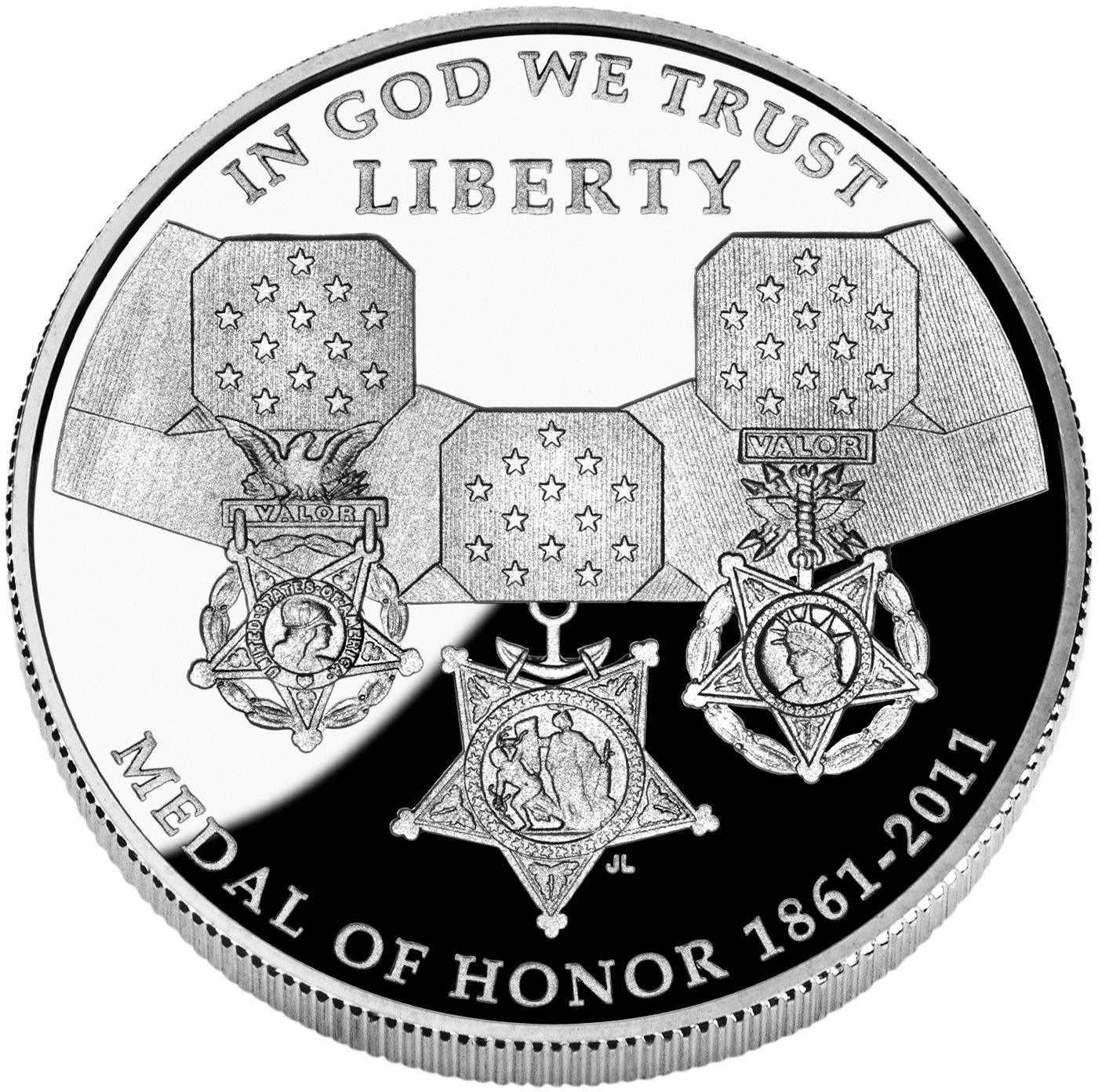
That 1861 origin is the whole reason this coin exists. The Medal of Honor Commemorative Coin Act of 2009 (Public Law 111-91) authorized a 2011 program to mark the award's 150th anniversary. Hence the date that anchors the obverse — the "heads" side — of the silver dollar: 1861–2011.

The design

The obverse takes a clever approach. Instead of one medal, it shows all three of the modern designs — Army, Navy (also worn by Marines and the Coast Guard), and Air Force — arranged left to right. They share one feature: a ribbon with a field of stars at the center. That common thread reflects how the medal works across every branch, and a quiet fact most people don't know — the Medal of Honor is the only U.S. military award worn around the neck rather than pinned to the chest. The obverse was designed and sculpted by U.S. Mint Sculptor-Engraver Jim Licaretz.

The reverse — the "tails" side — turns from object to act. It depicts a modern infantry soldier carrying a wounded comrade to safety under fire. No single battle, no single name: just the impulse the medal honors, distilled into one figure shouldering another. Richard Masters designed it; Mint Sculptor-Engraver Phebe Hemphill sculpted it into the relief — the raised, three-dimensional surface — that gives the scene its weight.

It is a quietly ambitious pairing. One side names the honor; the other shows what earns it.

Key facts

Year struck
2011
Denomination
Silver dollar (commemorative)
Occasion
150th anniversary of the Medal of Honor (1861–2011)
Authorizing law
Medal of Honor Commemorative Coin Act of 2009 (P.L. 111-91)
Obverse designer
Jim Licaretz (three modern Medals of Honor)
Reverse designer
Richard Masters; sculpted by Phebe Hemphill (soldier carrying a wounded comrade)
Composition
90% silver, 10% copper
Weight
26.73 g
Diameter
38.1 mm
Edge
Reeded
Proof mintage
2011-P — 112,833
Uncirculated mintage
2011-S — 44,752
Surcharge
$10 per coin to the Congressional Medal of Honor Foundation
Released
February 25, 2011

Collecting it

This is a modern commemorative, not a circulating coin — it was sold directly by the Mint to collectors, never spent at a store. That shapes everything about how people chase it.

There are two versions, and they're easy to tell apart by mint mark — the small letter showing which facility struck the coin. The 2011-P proof (a mirror-finish coin struck on polished dies for collectors) came from Philadelphia, and the Mint sold roughly 112,833 of them. The 2011-S uncirculated version came from San Francisco, and far fewer were sold — about 44,752. That gap matters: the uncirculated coin is the scarcer of the two, and collectors who want both finishes often find the uncirculated harder to track down in top grade.

Because these coins went straight from the Mint into careful hands, most survive in pristine condition, and high grades are common rather than rare. The collecting interest here is less about hunting flawless examples and more about the coin itself — the subject, the design, and a low-mintage modern issue tied to one of the most respected symbols in American life. As with all silver commemoratives, the 90% silver content also gives each coin a floor of melt value beneath whatever a collector will pay.

Questions collectors ask

Why was a Medal of Honor silver dollar made in 2011?

To mark 150 years since the Medal of Honor was first authorized in 1861. Congress passed the Medal of Honor Commemorative Coin Act of 2009 (Public Law 111-91) to create the 2011 program, which included this silver dollar and a $5 gold coin.

What's the difference between the 2011-P and 2011-S Medal of Honor dollar?

The mint mark tells you which finish you have. The 2011-P, from Philadelphia, is the proof — a mirror-like collector finish. The 2011-S, from San Francisco, is the uncirculated version. Far fewer uncirculated coins were sold (about 44,752 versus roughly 112,833 proofs), making the S the scarcer of the two.

How much silver is in the coin?

It's struck in 90% silver, weighs 26.73 grams, and measures 38.1 mm across — the standard format for a modern U.S. silver commemorative dollar. The remaining 10% is copper for durability.

What do the two sides show?

The obverse shows all three modern Medals of Honor — Army, Navy, and Air Force — side by side, designed by Jim Licaretz. The reverse, designed by Richard Masters and sculpted by Phebe Hemphill, shows a soldier carrying a wounded comrade to safety under fire.

Did buying the coin support anything?

Yes. A $10 surcharge from every silver dollar sold was directed to the Congressional Medal of Honor Foundation to help fund its educational, scholarship, and outreach work.

Sources