Designer

Gutzon Borglum

The man who carved a mountain — and designed the coin that paid for one he never finished.

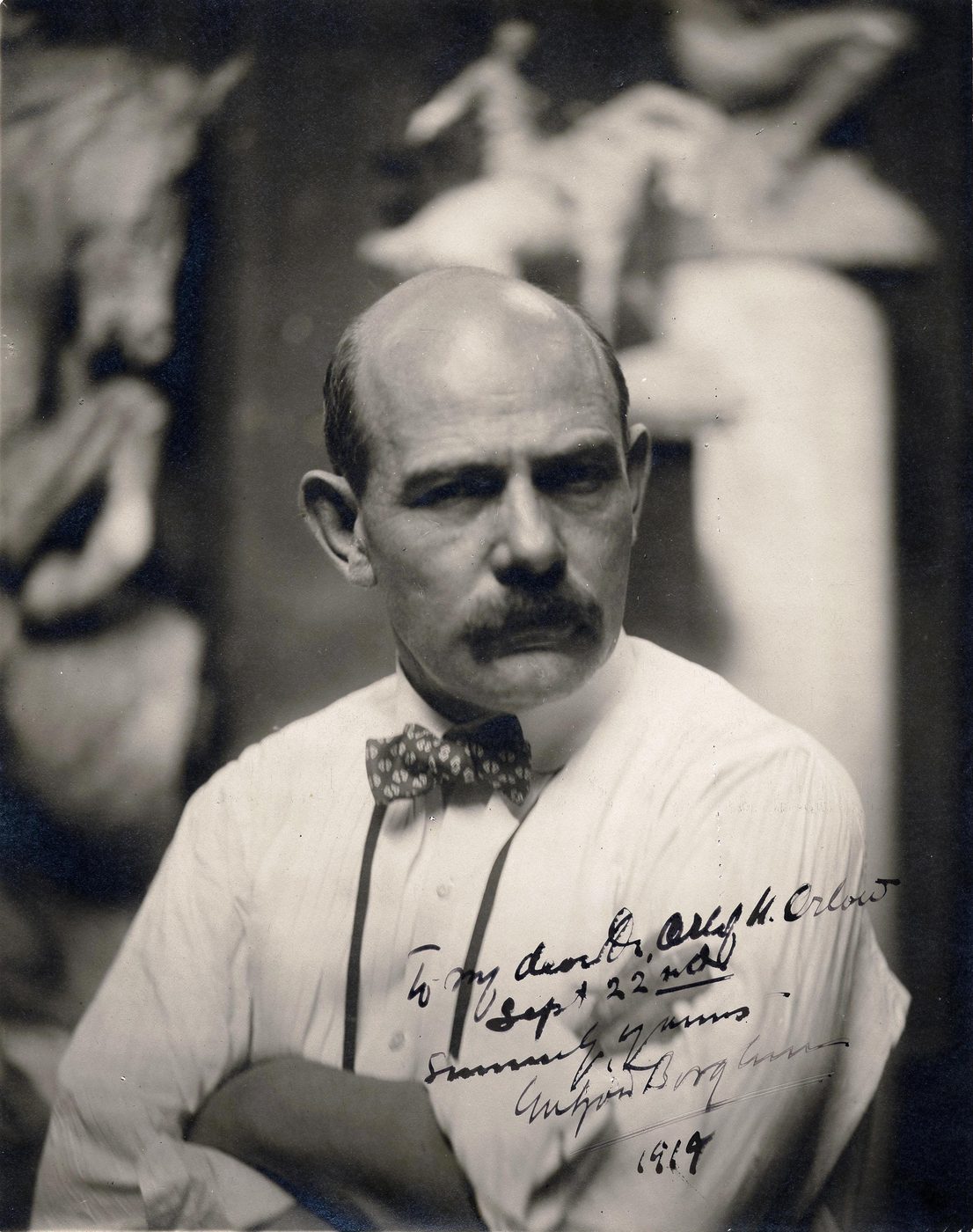
Gutzon Borglum
Unidentified photographer · public domain · source

Gutzon Borglum is the sculptor of Mount Rushmore. But years before he blasted four presidents into the Black Hills, he designed a single US coin — the 1925 Stone Mountain half dollar — to fund a Confederate monument in Georgia. He was fired off that project before it was done, smashed his own clay models on the way out, and left town one step ahead of a warrant.

Who he was

John Gutzon de la Mothe Borglum was born in 1867 in St. Charles, in what was then Idaho Territory, the son of Danish immigrants. He grew up in the American West and trained as an artist on two continents — first at the Mark Hopkins Institute of Art in San Francisco, then in Paris, where from 1890 to 1893 he studied at the Académie Julian and the École des Beaux-Arts.

Paris changed him. He came to know Auguste Rodin, the towering French sculptor, and absorbed Rodin's habit of letting light and rough texture do the work — figures that seem to surface out of unfinished stone rather than sit cleanly on top of it. You can see it for the rest of his career.

Back in America, Borglum built a reputation on a grand scale. His marble Head of Abraham Lincoln (1908) — carved so the president's face emerges from a raw block — was placed in the US Capitol. He made the Seated Lincoln in Newark (1911) and the sprawling Wars of America group there (1926). But scale kept pulling him bigger, toward the side of actual mountains. That ambition gave us his coin. It also gave us his most public disaster.

Stone Mountain — the coin and the firing

In 1915 Borglum was hired to carve a colossal Confederate memorial into the granite face of Stone Mountain, near Atlanta. To pay for it, Congress in 1924 authorized a commemorative half dollar — and Borglum designed it. That is his one US coin.

The 1925 Stone Mountain half dollar carries his sculptor's eye on a thirty-millimeter canvas. The obverse — the heads side — shows Confederate generals Robert E. Lee and Stonewall Jackson on horseback, the kind of muscular, motion-filled relief (the raised design that stands up off the coin's flat field) Borglum built monuments out of. The reverse turns to an eagle perched on a mountain crag against a field of stars, ringed by the inscription "MEMORIAL TO THE VALOR OF THE SOLDIER OF THE SOUTH." The Philadelphia Mint struck it in 90% silver.

Then it fell apart. By early 1925 Borglum and the monument association's leadership were at war — over money, over technical control, over their tangled and ugly ties to the resurgent Ku Klux Klan. (The Klan was a backer of the Stone Mountain project; Borglum himself was deeply involved in Klan politics in these years, though no proof of formal membership survives — a fact the site states plainly rather than softens.) In February 1925 the association fired him. On his way out, Borglum destroyed his clay and plaster models for the carving. Georgia sought to jail him for it; he slipped across the state line into North Carolina and kept going.

Everything he had actually cut into the mountain — the head of Lee — was later blasted off the granite by the men who replaced him. The carving on Stone Mountain today is not his. The coin, oddly, is the most durable thing to survive his Stone Mountain years intact.

He was not done with mountains. In 1927 South Dakota commissioned him to carve Mount Rushmore. He worked on it for the rest of his life and died in 1941, in Chicago, months before it was finished. His son Lincoln completed it.

Key facts

Full name
John Gutzon de la Mothe Borglum
Born
March 25, 1867 — St. Charles, Idaho Territory
Died
March 6, 1941 — Chicago, Illinois
Nationality
American (son of Danish immigrants)
Trained
Mark Hopkins Institute (San Francisco); Académie Julian & École des Beaux-Arts (Paris, 1890–1893)
US coin designed
1925 Stone Mountain Memorial half dollar (his only one)
Best known for
Mount Rushmore (1927–1941)
Other major works
Capitol Head of Lincoln (1908); Seated Lincoln, Newark (1911); Wars of America, Newark (1926)

The coin he designed

The Stone Mountain Memorial half dollar is the one piece of US circulating-format coinage Borglum put his name to — and it carries a story far bigger than its silver. Struck only in 1925 at Philadelphia, it was a fundraiser: each coin was sold above face value to bankroll the carving. Congress authorized up to five million; about 2,310,000 were struck, and after melting the unsold remainder, 1,314,709 were distributed.

For the full design, mintage breakdown, key sale varieties, and what grades collectors chase, see the series page.

Questions collectors ask

What US coin did Gutzon Borglum design?

Exactly one: the 1925 Stone Mountain Memorial half dollar. He designed both sides — Confederate generals Lee and Jackson on horseback on the obverse, an eagle on a mountain crag on the reverse. He is far more famous as a monumental sculptor than as a coin designer.

Is the Mount Rushmore sculptor the same person who made the Stone Mountain coin?

Yes. Gutzon Borglum designed the Stone Mountain half dollar and, a few years later, carved Mount Rushmore. The Stone Mountain project came first and ended in his firing; Mount Rushmore (1927–1941) became his life's work.

Why did Borglum leave the Stone Mountain project?

He was fired by the monument association in February 1925 after disputes over money, control, and their entangled Ku Klux Klan politics. On his way out he destroyed his models; Georgia tried to jail him, and he fled the state. The head of Lee he had carved was later blasted off the mountain.

Did Borglum study under Rodin?

Not formally as a pupil, but he knew Auguste Rodin during his Paris years (1890–1893) and was strongly influenced by Rodin's surface-and-light approach — visible in the way figures seem to emerge from rough stone in works like his Capitol Lincoln bust.

Sources

Gutzon Borglum — Sculptor of the Stone Mountain Half Dollar | colcur