US coin · series

The $50 Gold Coin With Eight Sides

America's only octagonal coin — born at a world's fair, and mostly melted.

The $50 Gold Coin With Eight Sides
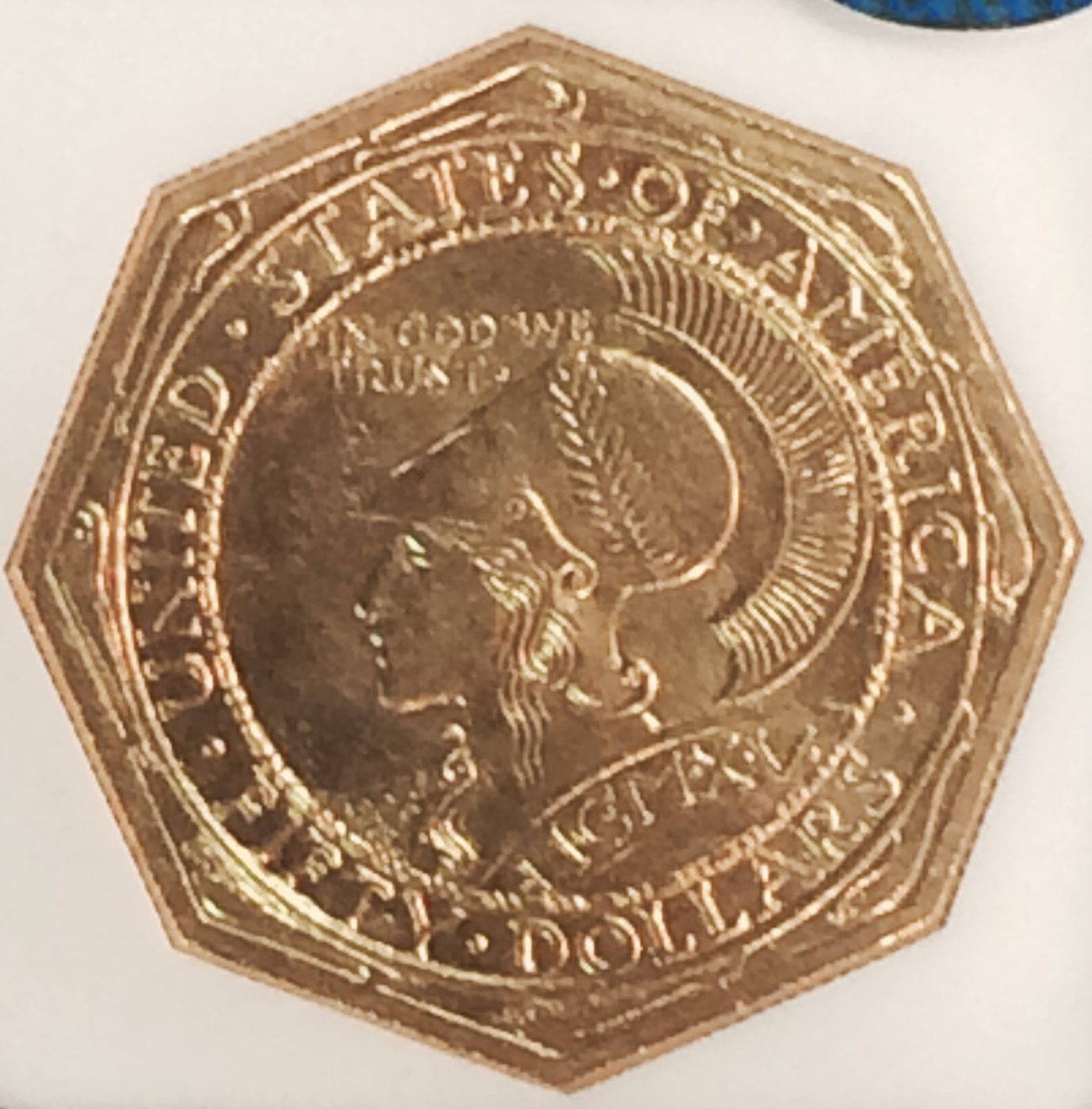
Coin designed by Robert Aitken; photograph by Wikimedia user Wehwalt · public domain · source

In 1915 the U.S. Mint struck a gold coin so large and so expensive that it almost no one would buy it. It had eight sides — the only American coin ever issued that isn't round — and most of them went straight back into the furnace. Fewer than 650 of the octagonal version survive.

The story behind the coin

San Francisco had something to prove. In 1906 an earthquake and fire had leveled much of the city. Less than a decade later it threw a party to announce it was back — the Panama–Pacific International Exposition, a world's fair held from February to December 1915. The official reason for the party was the opening of the Panama Canal, the engineering marvel that had just joined the Atlantic and Pacific oceans. The unofficial reason was civic pride, and the will to show the world that San Francisco was whole again.

Congress let the fair raise money the way the Roman emperors once did — by selling coins. President Woodrow Wilson signed the authorizing act on January 16, 1915, clearing the way for five different commemorative coins: a silver half dollar, a gold dollar, a gold quarter eagle ($2.50), and two enormous $50 gold pieces — one round, one octagonal. The U.S. Mint made them at its San Francisco branch, which is why every one carries the tiny "S" mint mark — the small letter that says where a coin was struck.

The $50 pieces were the crown jewels, and the gamble. They were the highest-denomination and largest coins the U.S. Mint had ever made — and would remain so until the gold bullion eagles of 1986, seventy-one years later. At $100 apiece in 1915 money, they were also the gamble that didn't pay off.

The design — Minerva, an owl, and the ghost of the Gold Rush

The Mint handed the job to Robert Ingersoll Aitken, a San Francisco sculptor, and he reached for ancient Rome. The obverse — the heads side — shows Minerva, the Roman goddess of wisdom, in a crested helmet pushed back off her face to signal peace, not war. The reverse — the tails side — shows her sacred bird, an owl, perched on a branch of western pine heavy with cones. Wisdom, and a nod to California's own forests, on the same coin.

Then Aitken did something no other circulating U.S. coin has done before or since on the octagonal version: he made it eight-sided. In the eight angles around the rim he set dolphins, swimming nose to tail — a quiet symbol of the Atlantic and Pacific finally joined by the canal. The round version carries the same Minerva and owl but drops the dolphins and the corners.

The eight sides weren't a whim. They were a deliberate echo of the octagonal $50 "slugs" that private assayer Augustus Humbert struck in San Francisco during the California Gold Rush of 1851. Sixty years on, Aitken's coin tied the fair's new gold to the old gold that built the state — the Gold Rush, the canal, and classical myth folded into one heavy disc.

Key facts

Years struck
1915 (single year), at San Francisco
Designer
Robert Ingersoll Aitken
Obverse / reverse
Helmeted Minerva / owl on a pine branch
Two versions
Round and octagonal (octagonal adds eight dolphins)
Composition
90% gold, 10% copper
Weight
≈83.59 g (about 2.42 troy oz of pure gold)
Diameter
44.9 mm octagonal · 43 mm round
Octagonal — struck / distributed
1,509 struck · ~645 sold (the rest melted)
Round — struck / distributed
1,510 struck · ~483 sold (the rest melted)
Original price
$100 each in 1915
Distinction
Only octagonal US coin; largest US coin until the 1986 gold eagles

Collecting it — why the survivors are so scarce

The math tells the whole story. The Mint struck about 1,500 of each version (1,509 octagonal, 1,510 round, counting a handful of extras). But a $50 coin in 1915 was a fortune — more than most workers earned in a month — and at $100 to buy one, sales collapsed. When the selling stopped in 1916, the unsold coins were melted back into bullion: roughly 855 of the octagonal pieces and over 1,000 of the round ones went into the furnace.

What's left is tiny. Around 645 octagonal and 483 round pieces survive — and the octagonal, oddly, is the more common of the two. Buyers in 1915 found the eight-sided coin the more striking souvenir, so they bought it more often; the plainer round version actually sold worse and is the rarer survivor today.

A few terms help when you read listings. Mint State means a coin that never circulated — no wear from being handled or spent. Because these were sold as souvenirs and tucked away, most survivors are Mint State; the grade then turns on how clean the surfaces are and how sharp the strike (how completely the design transferred from die to metal). Both versions are heavyweights of any U.S. type set, and a complete five-coin Pan-Pac set in its original hammered-copper Shreve & Co. frame — half dollar, gold dollar, quarter eagle, and both $50s — is one of the great prizes in American commemoratives. Collectors say fewer than a dozen of the ten-coin "double sets" (two of each) were ever sold; finding a complete set still in its frame today is genuinely rare.

Questions collectors ask

Why is the Panama-Pacific $50 octagonal?

Designer Robert Aitken deliberately echoed the octagonal $50 'slugs' that private assayer Augustus Humbert struck in San Francisco during the 1851 Gold Rush. The eight dolphins set in the corners symbolize the Atlantic and Pacific oceans joined by the new Panama Canal. It remains the only octagonal — non-round — coin the U.S. Mint has ever issued.

How many Panama-Pacific $50 gold pieces still exist?

Of about 1,500 struck of each version, only the coins that actually sold survived — the rest were melted in 1916. Roughly 645 of the octagonal and 483 of the round pieces remain. The octagonal is the more common of the two because buyers in 1915 preferred its unusual shape.

What's the difference between the round and octagonal versions?

Both share Aitken's design — Minerva on the front, an owl on the back. The octagonal version adds eight dolphins in the corners and is slightly larger (44.9 mm vs. 43 mm). The round version is plainer and, despite a near-identical mintage, the rarer survivor today.

Was the $50 the biggest US coin ever made?

It was the largest and highest-denomination coin the U.S. Mint had ever struck — and stayed that way for 71 years, until the one-ounce $50 American Gold Eagle bullion coins debuted in 1986. At about 83.6 grams it contains roughly 2.42 troy ounces of gold.

What does the 'S' mint mark mean?

It marks the San Francisco Mint, where every Panama-Pacific coin was struck — fittingly, since the fair was a San Francisco event. The mint mark is the small letter on a coin that records which facility made it.

Sources