US coin · series

The 1992 Olympic Half Dollar

A gymnast caught mid-flight on fifty cents — and a coin Congress designed to pay for Team USA.

The 1992 Olympic Half Dollar
www.usmint.gov (U.S. Mint) · public domain · source

In 1992, the U.S. Mint sold a fifty-cent piece that was never meant to jingle in your pocket. Every coin carried a built-in donation to the athletes headed for Barcelona and Albertville — you paid a few dollars for a half dollar, and the extra went to the team.

The story behind the coin

Olympic teams cost money, and in the United States nobody pays for them out of taxes. The U.S. Olympic Committee has always had to raise its own — and in the late 1980s Congress found a clever way to help: sell collectors a coin and skim a donation off the top of every sale.

That's what the 1992 Olympic Commemorative Coin Act (Public Law 101–406) set in motion. It authorized three coins for the 1992 Games — a copper-nickel half dollar, a silver dollar, and a gold five-dollar piece — released together on January 17, 1992. The half dollar was the entry point: the cheapest of the three, the one a casual fan could afford.

Here's the part that surprises people. A commemorative like this is legal tender — it really is worth fifty cents — but the Mint never put it into circulation. You couldn't get one as change. You bought it directly from the Mint for several dollars, and the gap between that price and the coin's face value was the whole point. Part of it covered the Mint's costs; a surcharge — an extra fee baked into the price — went to the U.S. Olympic Committee to train American athletes, under the authority of the Amateur Sports Act of 1978.

So this is a coin with a job. It wasn't made to buy anything. It was made to raise money for the people who would carry the flag into a stadium that summer.

The design

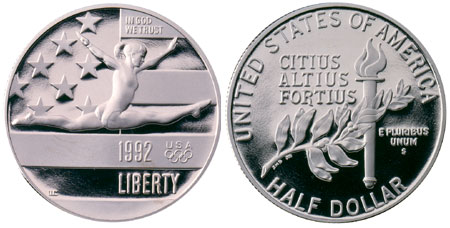
The obverse — the heads side — does something coins rarely manage: it shows motion. A gymnast is frozen at the top of a leap, body arched, against a backdrop of the American flag and the five Olympic rings. There's no portrait of a president here, no stern profile. It's pure athletic energy held still in metal. The artist was William Cousins, and the gymnast has become the coin's nickname among collectors — many simply call it the "Olympic gymnast half dollar."

Flip it over. The reverse — the tails side, by Steven M. Bieda — keeps a single olive branch crossing an Olympic torch, wrapped in the ancient motto CITIUS, ALTIUS, FORTIUS — Latin for "Faster, Higher, Stronger." The olive branch nods to the peace of the original Greek games; the torch to the relay that lights every modern one. Around the rim run the usual legends: UNITED STATES OF AMERICA, E PLURIBUS UNUM, HALF DOLLAR.

The coin itself is plain old "clad" — the same sandwich the Mint has used for circulating coins since 1965: a copper core faced on both sides with copper-nickel. That keeps it affordable. The silver and gold went into the higher-denomination Olympic coins; the half dollar was meant to be the people's version.

Key facts

Denomination
Half dollar (50 cents)
Year
1992
Honors
The 1992 Olympic Games (Albertville winter, Barcelona summer)
Authorizing act
1992 Olympic Commemorative Coin Act (Pub. L. 101–406)
Released
January 17, 1992
Obverse designer
William Cousins — gymnast in motion
Reverse designer
Steven M. Bieda — olive branch and torch
Composition
Copper-nickel clad (91.67% Cu / 8.33% Ni over a copper core)
Weight
11.34 g
Diameter
30.61 mm
Edge
Reeded
1992-P (uncirculated)
161,607 struck — Philadelphia
1992-S (proof)
519,645 struck — San Francisco
Surcharge beneficiary
U.S. Olympic Committee (athlete training)

Collecting it

This is an affordable, accessible coin — which is exactly why it's a good first commemorative. There's no rare key date hiding in the series. There are two coins to know, and they differ by finish and mint, not by scarcity in the lottery sense.

The 1992-P is the uncirculated version, struck in Philadelphia (the P mint mark), with a normal satin surface. The 1992-S is the proof — struck in San Francisco from polished dies onto polished blanks, which gives it mirror-like fields and frosted devices. Proofs are made slowly and carefully for collectors; an uncirculated coin is a regular production strike. Counterintuitively, the proof has the higher mintage here: about 519,645 against the uncirculated's 161,607. More people wanted the shinier one.

Because both were sold straight from the Mint in protective packaging, finding a pristine example isn't hard — and that's the catch for value. With modern commemoratives, condition and certification do the heavy lifting. A common coin in an ordinary grade sells for a modest premium; a top-population example in a graded holder — judged near-flawless on the 70-point scale and slabbed by a grading service — is where the real interest concentrates. The coin to chase isn't a date. It's a grade.

One honest note for newcomers: most 1992 Olympic half dollars trade close to their original issue price, sometimes below it. You're buying a small piece of Olympic and minting history, and a clean design, more than a sure investment.

Questions collectors ask

What is the 1992 Olympic half dollar made of?

It's a clad coin — a copper core faced on both sides with copper-nickel (91.67% copper, 8.33% nickel), the same construction as ordinary circulating coins since 1965. It weighs 11.34 grams and measures 30.61 mm across. The silver and gold went into the companion Olympic dollar and five-dollar coins; the half dollar was the affordable option.

Who designed the 1992 Olympic half dollar?

The obverse, with the gymnast leaping against the flag and Olympic rings, is by William Cousins. The reverse, with an olive branch crossing the Olympic torch and the motto CITIUS, ALTIUS, FORTIUS, is by Steven M. Bieda.

What do the P and S mint marks mean?

P is Philadelphia, which struck the uncirculated coin (161,607 made). S is San Francisco, which struck the proof — the mirror-finish collector version (519,645 made). Same design, different finish and mint.

Why was the coin sold for more than fifty cents?

By design. It's a commemorative, never released into circulation. The Mint sold it directly to collectors, and a surcharge built into the price went to the U.S. Olympic Committee to help train American athletes. The coin's purpose was to raise money, not to spend.

Is the 1992 Olympic half dollar rare or valuable?

It isn't rare — hundreds of thousands were made of each version, and most survive in excellent shape. Values usually sit near the original issue price. The exception is a top-grade, certified example: when a coin grades near-perfect on the 70-point scale, collectors pay a premium for it.

Sources