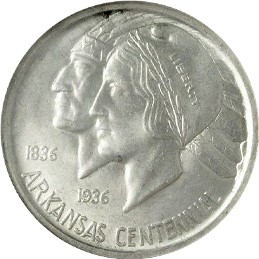
The story behind the coin
Arkansas joined the Union on June 15, 1836. To mark the centennial, Congress authorized a commemorative half dollar by an act of May 14, 1934 — a coin the state could sell above face value to fund its celebrations.
That much is ordinary. What happened next is the story.
The first coins were struck in Philadelphia in 1935 — a full year before the actual centennial. They sold out by September. So the sponsors came back the next year, and the next. From 1935 through 1939, the same coin was struck every single year at all three mints — Philadelphia, Denver, and San Francisco — in deliberately small, near-identical batches. Each year-and-mint combination became a fresh thing to sell to collectors who wanted the complete set.
The math was the point. A coin that exists in dozens of small batches is a coin you can sell over and over. Arkansas was one of several "serial" commemoratives doing exactly this in the 1930s — the Oregon Trail half ran from 1926 to 1939 the same way. In 1936 alone, Congress approved 21 different commemorative programs. The flood crashed the market, annoyed the Roosevelt administration, and pushed Congress to shut the whole practice down in 1939. The Arkansas Centennial half dollar is a prime exhibit in how a good idea got milked to death.