US coin · series

The 1997 Jackie Robinson Silver Dollar

A coin for the man who broke baseball's color line — and a sleeper that almost no one bought.

The 1997 Jackie Robinson Silver Dollar
United States Mint (usmint.gov) — U.S. Government work, public domain · public domain · source

In 1947 Jackie Robinson stepped onto a major-league field and changed America. Fifty years later the U.S. Mint put him on a silver dollar — and barely anyone bought the plain version. That accident of indifference turned it into one of the scarcest modern commemoratives in the country.

The story behind the coin

On April 15, 1947, Jackie Robinson walked onto Ebbets Field as a Brooklyn Dodger and became the first Black player in the modern major leagues. He did it under a torrent of abuse, and he did it brilliantly — Rookie of the Year that season, a Hall of Famer by 1962. His debut is one of the hinge moments of 20th-century American life, as much a civil-rights story as a baseball one.

Fifty years on, Congress decided that anniversary deserved a coin. The United States Commemorative Coin Act of 1996 (Public Law 104-329) authorized a Jackie Robinson program: a five-dollar gold piece and this silver dollar, struck in 1997. A surcharge built into each coin's price was directed to the Jackie Robinson Foundation, which funds college scholarships for minority students — so buying the coin was, in part, paying it forward to the cause Robinson championed.

Here's the twist. Congress capped the whole silver-dollar program at 200,000 coins — the lowest authorized ceiling of any modern silver commemorative. It needn't have worried. Collectors bought a healthy 110,002 of the mirror-finish proof version (a proof is a specially polished collector strike), but only 30,180 of the plain uncirculated coin. That tiny number, born of pure market indifference, is why this otherwise quiet coin is now chased.

The design

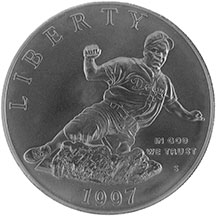
The obverse — the heads side — shows Robinson in motion, sliding into a base. The Mint tied the image to a moment fans still talk about: Robinson stealing home in the 1955 World Series against the Yankees, the kind of audacious, game-bending baserunning that was his signature. It's an unusual choice for U.S. coinage, which tends toward static portraits; here the subject is caught mid-play. The work is by Mint sculptor-engraver Alfred Maletsky, with the standard "LIBERTY," "IN GOD WE TRUST," and the 1997 date.

The reverse — the tails side — by sculptor-engraver Thomas James Ferrell, carries the logo of the Jackie Robinson Foundation, ringed by two milestones that bracket his career: "Rookie of the Year 1947" and "Hall of Fame 1962," along with "UNITED STATES OF AMERICA," "E PLURIBUS UNUM," and the "ONE DOLLAR" denomination. The pairing is deliberate — the player on one face, the legacy and the foundation that carries his name on the other.

Key facts

Denomination
Silver dollar ($1)
Year struck
1997
Honors
50th anniversary of Jackie Robinson breaking baseball's color barrier
Obverse designer
Alfred Maletsky
Reverse designer
Thomas James Ferrell
Composition
90% silver, 10% copper (about 0.7736 oz silver)
Weight / diameter
26.73 g / 38.1 mm, reeded edge
Mint
San Francisco (S mint mark)
Proof mintage
110,002
Uncirculated mintage
30,180 — among the lowest of any modern commemorative
Authorized by
United States Commemorative Coin Act of 1996 (Public Law 104-329)
Surcharge beneficiary
Jackie Robinson Foundation

Collecting it

For most modern commemoratives, the uncirculated coin is the common one and the proof is the prize. The Jackie Robinson dollar flips that. With just 30,180 uncirculated pieces struck against 110,002 proofs, the plain coin is more than three times scarcer than its polished sibling — the opposite of what collectors usually expect, and the whole reason this issue gets attention.

The scarcity bites hardest at the top of the grading scale. A coin's grade — its condition on the 70-point Sheldon scale, where 70 is flawless — drives value steeply here. Ordinary uncirculated examples are findable, but pristine, high-grade survivors of that small mintage are genuinely tough, and that's where the real premiums sit. The proof, by contrast, is plentiful and trades much closer to its silver content.

A practical note for newcomers: the gold five-dollar Jackie Robinson coin from the same 1997 program is a separate, scarcer, and far more valuable issue — don't confuse the two. This page is about the silver dollar.

Questions collectors ask

Why is the uncirculated 1997 Jackie Robinson dollar so scarce?

Only 30,180 uncirculated coins were sold — collectors strongly favored the proof, of which 110,002 were struck. That low, accidental number makes the uncirculated version more than three times scarcer than the proof and one of the lowest-mintage modern U.S. commemoratives.

What does the obverse design show?

Jackie Robinson sliding into a base. The Mint connected the image to his famous steal of home in the 1955 World Series — a dynamic action scene rather than the usual coin portrait. It was sculpted by Alfred Maletsky.

Was this coin made for circulation?

No. It's a commemorative — sold by the Mint to collectors at a premium, never released into pocket change. A surcharge on each coin went to the Jackie Robinson Foundation, which funds scholarships.

Is the silver dollar the same as the Jackie Robinson gold coin?

No. The 1997 program also produced a five-dollar gold coin with its own design. The gold piece is rarer and far more valuable. This page covers the 90% silver dollar.

How much silver is in it?

It's 90% silver and 10% copper, weighing 26.73 grams — roughly 0.7736 troy ounce of pure silver.

Sources