US coin · series

The Bald Eagle Recovery Silver Dollar

A 2008 commemorative for a bird that came back from the edge.

The Bald Eagle Recovery Silver Dollar
United States Mint (source: U.S. Mint commemorative coins program) · public domain · source

In 1963 there were barely 400 nesting pairs of bald eagles left in the lower 48 states. In 2008 the U.S. Mint struck a silver dollar to celebrate the fact that there were thousands. This is the coin of a comeback.

The story behind the coin

The national bird of the United States almost didn't make it.

By the early 1960s, the bald eagle had nearly vanished from the lower 48 states — poisoned by the pesticide DDT, which thinned eggshells until they cracked under the weight of a nesting parent. Counts found only a few hundred breeding pairs left. The bird on the country's Great Seal was disappearing from its own skies.

Then the law stepped in. DDT was banned in 1972, and the Endangered Species Act of 1973 gave the eagle real protection. Slowly, the population climbed back. In 2007 the bald eagle was removed from the threatened-and-endangered list — a rare, full recovery.

The next year, Congress marked the moment with money. The American Bald Eagle Recovery and National Emblem Commemorative Coin Act — Public Law 108-486, signed December 23, 2004 — ordered a three-coin set for 2008: a $5 gold piece, this silver dollar, and a clad half dollar. The timing honored the 35th anniversary of the Endangered Species Act and the bird's return. A surcharge on every coin — $10 on each silver dollar — went to the American Eagle Foundation of Tennessee to fund eagle protection. This was a coin with a job to do.

The design

The obverse — the "heads" side — shows a mature bald eagle in full flight, wings stretched wide, a mountain range behind it. It is the bird at its most free: not a heraldic emblem, but a living animal in open air. The design came from Joel Iskowitz, a Master Designer in the Mint's Artistic Infusion Program, and was sculpted by U.S. Mint sculptor-engraver Don Everhart. Their initials — "JI" and "DE" — sit on the coin beside the date.

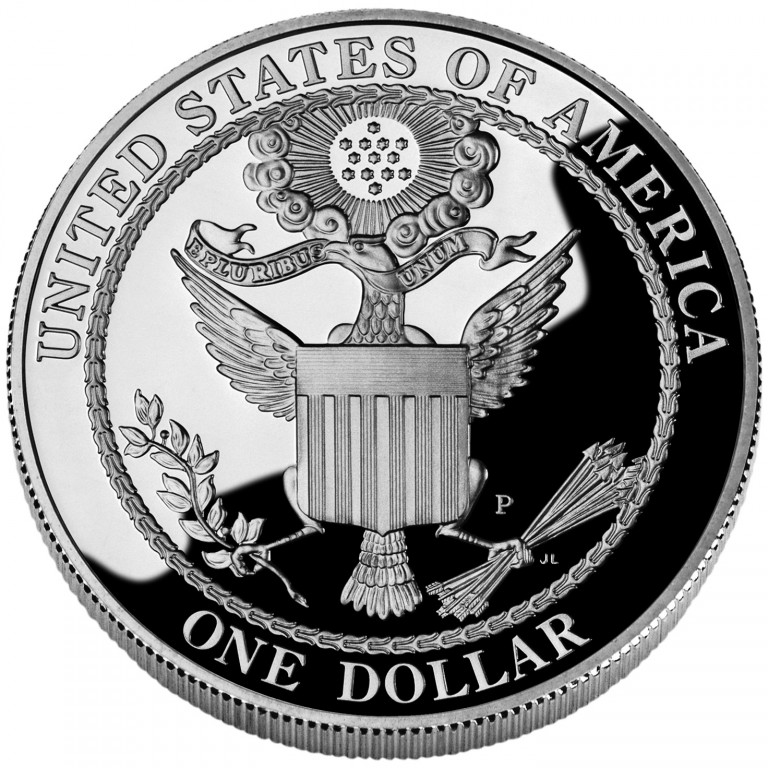
The reverse — the "tails" side — reaches back into history. It reproduces the first Great Seal of the United States, the version in use from 1782 to 1841, sculpted by Mint medallic sculptor Jim Licaretz. So the two sides hold a quiet conversation: the living eagle on one face, the founding emblem it inspired on the other. A symbol almost lost, and the symbol it stands for.

Key facts

Year struck
2008 (one year only)
Denomination
Silver dollar ($1)
Mint
Philadelphia (P)
Obverse designer
Joel Iskowitz (sculpted by Don Everhart)
Reverse sculptor
Jim Licaretz (first Great Seal, 1782–1841)
Composition
90% silver, 10% copper
Weight / diameter
26.73 g / 38.1 mm
Edge
Reeded
Mintage limit
500,000 (all silver dollar options)
Proof mintage
294,601
Uncirculated mintage
119,204
Surcharge
$10 per coin → American Eagle Foundation

Collecting it

This is a modern commemorative, struck for collectors rather than for pockets, so it does not carry the dramatic rarities of a 19th-century issue. The whole run is one year, one mint. That makes the collecting choices simple — and a little more about quality than scarcity.

The first fork is finish. The Mint sold the dollar two ways: a proof (struck on polished dies for a mirror-and-frost look, mintage 294,601) and an uncirculated version (a standard business-strike finish, mintage 119,204). The uncirculated is the scarcer of the two by a wide margin — fewer than half as many were made.

The second fork is grade. Because these coins came straight from the Mint in protective packaging, high grades are common; the population of near-perfect examples is large. The value lives at the very top. A coin certified PF70 or MS70 — flawless under magnification — commands a premium over a PF69 or MS69 that almost no one can tell apart with the naked eye. For a coin this young, condition is the game.

One more anchor: the silver itself. With 90% silver content, the dollar carries a real bullion floor that rises and falls with the metal price — a base value beneath the collector premium.

Questions collectors ask

Why was the 2008 Bald Eagle silver dollar made?

It celebrated the recovery of the American bald eagle and the 35th anniversary of the Endangered Species Act of 1973. The bird had nearly gone extinct in the lower 48 states from DDT poisoning; by 2007 it had recovered enough to be removed from the endangered list. Congress authorized a 2008 commemorative set to mark the comeback.

Who designed the Bald Eagle silver dollar?

The soaring-eagle obverse was designed by Joel Iskowitz, a Mint Artistic Infusion Program designer, and sculpted by U.S. Mint sculptor-engraver Don Everhart. The reverse — a reproduction of the first U.S. Great Seal (used 1782–1841) — was sculpted by medallic sculptor Jim Licaretz.

Is the 2008 Bald Eagle dollar real silver?

Yes. It is struck in 90% silver (10% copper), weighs 26.73 grams, and measures 38.1 mm. It contains roughly three-quarters of a troy ounce of pure silver, which gives it a bullion floor on top of its collector value.

What is the rarest version of the coin?

The uncirculated (business-strike) version is scarcer than the proof — 119,204 struck versus 294,601 proofs. Within either finish, the value concentrates in flawless top grades (MS70 / PF70), since most surviving coins are already high grade.

Did buying the coin support eagle conservation?

Yes. Every silver dollar carried a $10 surcharge that was paid to the American Eagle Foundation of Tennessee to fund its eagle-protection work. The program as a whole raised millions in surcharges for the cause.

Sources