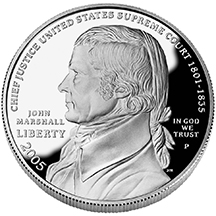
The story behind the coin
John Marshall is the most important American most people have never heard of. He was the fourth Chief Justice of the United States, and he held the job for 34 years — longer than anyone before or since. When he took the bench in 1801, the Supreme Court was an afterthought: it had no building, little prestige, and no clear power. When he died in 1835, the Court was a full third branch of government.
The turning point was a single case. In Marbury v. Madison (1803), Marshall ruled that a law passed by Congress conflicted with the Constitution — and that when they clash, the Constitution wins and the Court gets to say so. That principle is called judicial review, the power of courts to strike down laws that break the Constitution. It is not written anywhere in the Constitution itself. Marshall reasoned it into existence, and it has anchored American government ever since.
So why a coin in 2005? The year marked the 250th anniversary of Marshall's birth on September 24, 1755. Congress passed the John Marshall Commemorative Coin Act (Public Law 108-290) on August 6, 2004, authorizing a single silver dollar for the occasion. The proceeds had a fitting destination — see "Collecting it" below — and the Mint had exactly one calendar year, 2005, to strike and sell it.