US coin · series

The 1984 Olympic Dollar That Lost Its Head

Two headless athletes, a gateway, and the sculptor who designed both the coin and the real arch it copies.

The 1984 Olympic Dollar That Lost Its Head
US Mint (U.S. Department of the Treasury) — public domain, no attribution required · public domain · source

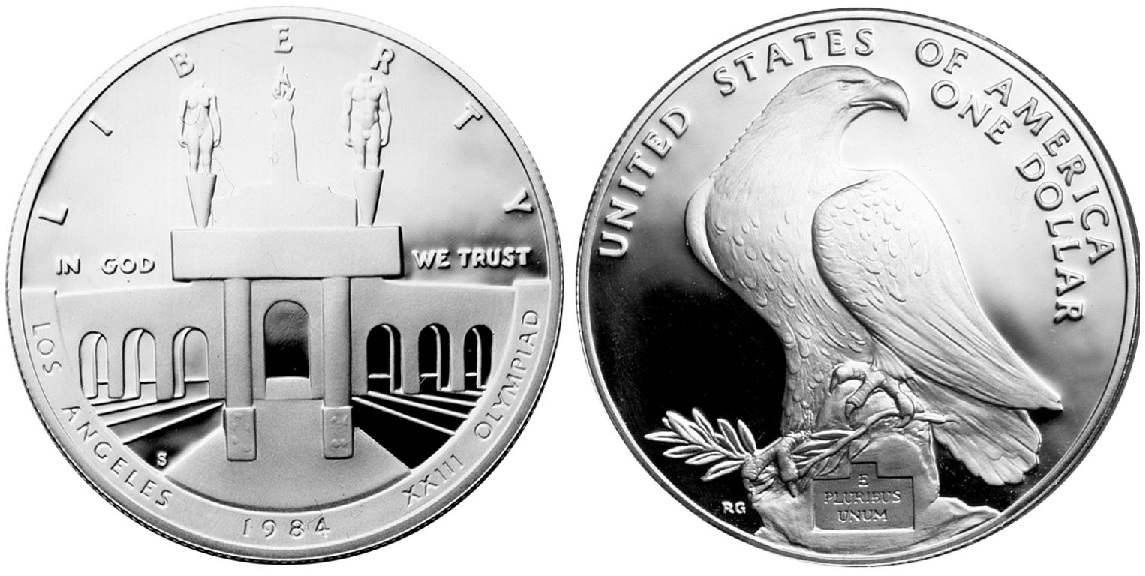
When the 1984 Los Angeles Olympic dollar was unveiled, collectors were not charmed — they were stunned. Front and center stood two nude athletes, male and female, with no heads at all. The artist said it was the point.

The coin that shocked collectors

In 1984, the U.S. Mint put two headless people on a silver dollar — on purpose — and a lot of collectors hated it.

The coin honored the Games of the XXIII Olympiad, the 1984 Summer Olympics in Los Angeles. Its obverse — the "heads" side, which here had no heads — shows the Olympic Gateway at the entrance to the Los Angeles Memorial Coliseum: two nude athletes, one man and one woman, flanking the Olympic flame, both cut off cleanly at the neck. Numismatic press of the day records that the collecting public was genuinely shaken by it.

To understand why a coin like this even existed, you have to know what came just before it. The United States had stopped making commemorative coins in 1954 after decades of scandal — promoters had turned the program into a money-printing racket. For nearly thirty years, the Mint made none. The revival began in 1982 with a half dollar for George Washington's 250th birthday. The Olympic coins were the very next act — and the first U.S. commemorative silver dollar in more than eighty years. After a long silence, the Mint came back swinging, and it picked a fight over art on its second pitch.

A sculptor's argument, struck in silver

The man behind the controversy was Robert Graham, an American sculptor — and the same artist who built the real Olympic Gateway that stands at the Coliseum in Los Angeles. He didn't just illustrate a monument for the coin; he designed both the monument and the coin that depicts it. That is rare. Most commemorative designers interpret someone else's landmark. Graham minted his own.

The headlessness was the whole idea. Graham's answer to the outcry was that leaving off the faces let the figures stand for every athlete rather than any one. Strip the identity and you get the body in motion — the universal Olympian, not a portrait. You can decide whether that holds up. But it was an argument, not an accident.

The reverse — the "tails" side — is calmer and more familiar: a bald eagle perched with an olive branch, its head turned back over its shoulder. Graham designed and engraved both sides, an unusually complete authorship for a modern commemorative.

There were actually two different Olympic dollars in this program. The 1983-dated dollar, designed by Mint Chief Engraver Elizabeth Jones, shows a classical Greek discus thrower. This page is about the 1984-dated dollar — the Coliseum Gateway, the one with the missing heads. Same Olympics, different coin, different artist.

Key facts

Date struck
1984
Denomination
Silver dollar ($1, legal tender)
Honors
Games of the XXIII Olympiad — 1984 Summer Olympics, Los Angeles
Designer
Robert Graham (obverse and reverse)
Obverse
Olympic Gateway at the LA Memorial Coliseum — two headless athletes flanking the flame
Reverse
Bald eagle with olive branch
Composition
90% silver, 10% copper
Weight
26.73 g
Diameter
38.1 mm
Edge
Reeded
Mint marks
P (Philadelphia), D (Denver), S (San Francisco)
Uncirculated mintage
451,304 total — 1984-P 217,954; 1984-D 116,675; 1984-S 116,675
Proof mintage
1,801,210 (1984-S)
Authorizing law
Public Law 97-220, signed July 22, 1982
Surcharge
Funds raised supported the US Olympic Committee and the LA Olympic Organizing Committee

Collecting the 1984 Olympic dollar

For a coin so divisive, the 1984 dollar is one of the easier classic-era commemoratives to own. The Mint struck nearly 1.8 million proofs at San Francisco and about 451,000 uncirculated pieces across the three mints — so raw examples are plentiful and affordable. This is not a rarity story. It's a condition and completeness story.

The interesting wrinkle is how the coins were sold. The 1984-P uncirculated dollar and the 1984-S proof were available on their own. But the 1984-D and 1984-S uncirculated dollars were sold only inside a three-coin set — one dollar from each mint, three different mint marks. (A mint mark is the small letter — P, D, S — telling you which facility struck the coin.) The Los Angeles Olympic dollars of 1983 and 1984 are the modern commemoratives offered this way, which is why collectors prize a complete P-D-S run.

The other place value lives is the very top of the grading scale. A coin in pristine, as-struck condition — graded MS70 or PR70, the perfect grades on the 70-point scale — can command far more than its melt or its common-grade price. Plenty of these dollars exist; flawless ones do not.

Questions collectors ask

Why does the 1984 Olympic dollar have headless figures?

Sculptor Robert Graham designed the two nude athletes without heads deliberately. His stated reasoning was that removing the faces let the figures represent all athletes rather than any single person. Many collectors disliked it at the time, but it was an intentional artistic choice, not a minting error.

What is the difference between the 1983 and 1984 Olympic silver dollars?

They commemorate the same 1984 Los Angeles Olympics but are different coins. The 1983-dated dollar, by Elizabeth Jones, shows a Greek discus thrower. The 1984-dated dollar, by Robert Graham, shows the Coliseum's Olympic Gateway with the two headless athletes. This page covers the 1984 design.

Is the 1984 Olympic silver dollar rare or valuable?

It is not rare. The Mint made about 1.8 million proofs and roughly 451,000 uncirculated coins. Most examples are modest. The value lives in top-grade pieces (MS70 / PR70) and in completing the three-mint-mark P-D-S uncirculated set, since the D and S uncirculated dollars were sold only inside that set.

How much silver is in a 1984 Olympic dollar?

It is 90% silver, 10% copper, weighing 26.73 grams — the same silver standard as classic US silver dollars. That gives it a real bullion floor underneath any collector premium.

Who designed the 1984 Olympic dollar?

American sculptor Robert Graham. Unusually, he designed both sides of the coin and also created the actual Olympic Gateway sculpture at the LA Memorial Coliseum that the coin depicts.

Sources