US coin · series

The 1987 Constitution Silver Dollar

A commemorative whose surcharge was aimed straight at the national debt.

The 1987 Constitution Silver Dollar
United States Mint (usmint.gov) · public domain · source

In 1987 the U.S. Mint sold a silver dollar with a built-in tax on itself. Seven dollars from every coin was earmarked to help pay down the national debt — a coin meant not just to honor the Constitution, but to quietly chip away at the country's bills.

The story behind the coin

On September 17, 1787, thirty-nine men signed a document that began with three words: "We the People." Two hundred years later, the United States wanted to throw a birthday party — and pay it forward.

Congress authorized the coin in the Act of October 29, 1986 (Public Law 99–582), pushed through largely by Representative Frank Annunzio of Illinois, a tireless champion of commemorative coinage. The law cleared the Mint to strike up to 10 million silver dollars and one million $5 gold pieces to mark the Constitution's bicentennial.

Here is the twist that makes this coin worth a second look. Every dollar carried a $7 surcharge — a markup baked into the price — and that money was earmarked to reduce the federal debt. A commemorative coin, in other words, designed to help pay the government's bills. The program raised tens of millions of dollars toward that goal. It is one of the rare moments where a collector's keepsake doubled as a tiny act of national bookkeeping.

The design

The Mint did something unusual to find the design: it held a contest. Treasury Secretary James A. Baker III opened a competition in which eleven outside sculptors were invited to compete alongside six Mint engravers, each paid $2,000 to submit four sketches whether or not their work was chosen.

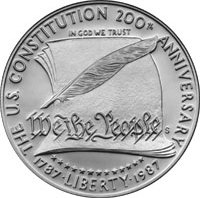
The winner was Patricia Lewis Verani, a New Hampshire sculptor and graduate of the Boston Museum School. Her obverse — the heads side — is quiet and literal: a quill pen laid across a sheaf of parchment, with the words "We the People" running along the bottom in the bold script of the document itself. It is the act of writing the Constitution, frozen in metal.

The reverse — the tails side — widens the lens. It shows a cross-section of Americans drawn from different eras, a visual argument that "We the People" was never a fixed group but a growing one. The relief — the raised depth of the design — is restrained and modern, in keeping with the coin's plainspoken theme.

Key facts

Denomination
$1 (silver dollar)
Year struck
1987
Commemorates
200th anniversary of the U.S. Constitution (signed 1787)
Designer
Patricia Lewis Verani (both sides)
Composition
90% silver, 10% copper
Weight
26.73 g (0.859 troy oz)
Diameter
38.1 mm
Edge
Reeded
Uncirculated (1987-P)
451,629 struck
Proof (1987-S)
2,747,116 struck
Surcharge
$7 per coin, earmarked to reduce the national debt
Authorizing act
Public Law 99–582 (Oct. 29, 1986)

Collecting it

This is an accessible coin, and that is part of its charm — a genuine 90% silver dollar from a one-year program, available without a treasure hunt.

Two versions exist, separated by mint and finish. The 1987-P is the uncirculated (business-strike) coin from Philadelphia, with 451,629 made — the scarcer of the two. The 1987-S is the proof — a coin struck twice on polished dies to give mirror-like fields and frosted devices — from San Francisco, with 2,747,116 made. Proofs were the runaway seller; collectors gravitated to the shinier presentation.

Because mintages are healthy and the coins were carefully packaged by the Mint, top-grade survivors are common, and most examples carry modest premiums over their silver content. The collector's interest here is less about rarity and more about completeness: this dollar is a fixture in any run of modern commemoratives, and the open-contest design plus the national-debt surcharge give it a story most one-ounce silver pieces can't match. Watch condition closely — in a series where high grades are plentiful, the eye-appeal of a flawless proof is what separates one example from the next.

Questions collectors ask

What does the 1987 Constitution silver dollar commemorate?

The 200th anniversary of the signing of the U.S. Constitution on September 17, 1787. Congress authorized the coin in 1986 (Public Law 99–582) to mark the bicentennial.

Who designed the coin?

Patricia Lewis Verani, a New Hampshire sculptor, designed both sides. Her work was chosen through an open design competition run by the Treasury. The obverse shows a quill pen on parchment with 'We the People'; the reverse depicts a cross-section of Americans across history.

Why did the coin cost more than a dollar of silver?

Each coin carried a $7 surcharge on top of its silver value, and that surcharge was earmarked to help reduce the national debt. The program raised tens of millions of dollars toward that purpose.

What's the difference between the 1987-P and 1987-S?

The 1987-P is the uncirculated coin from Philadelphia (451,629 struck). The 1987-S is the proof from San Francisco (2,747,116 struck) — struck on polished dies for a mirror finish. The proof was by far the better seller.

Is the 1987 Constitution dollar valuable?

It contains about 0.77 troy ounces of pure silver, and most examples trade at a modest premium over that metal value. It's a popular, affordable entry into modern U.S. commemoratives rather than a rarity.

Sources