US coin · series

The 1994 Prisoner of War Silver Dollar

An eagle breaking its chain — and a coin that paid to build a museum at Andersonville.

The 1994 Prisoner of War Silver Dollar
United States Mint (credit: usmint.gov commemorative coins program) · public domain · source

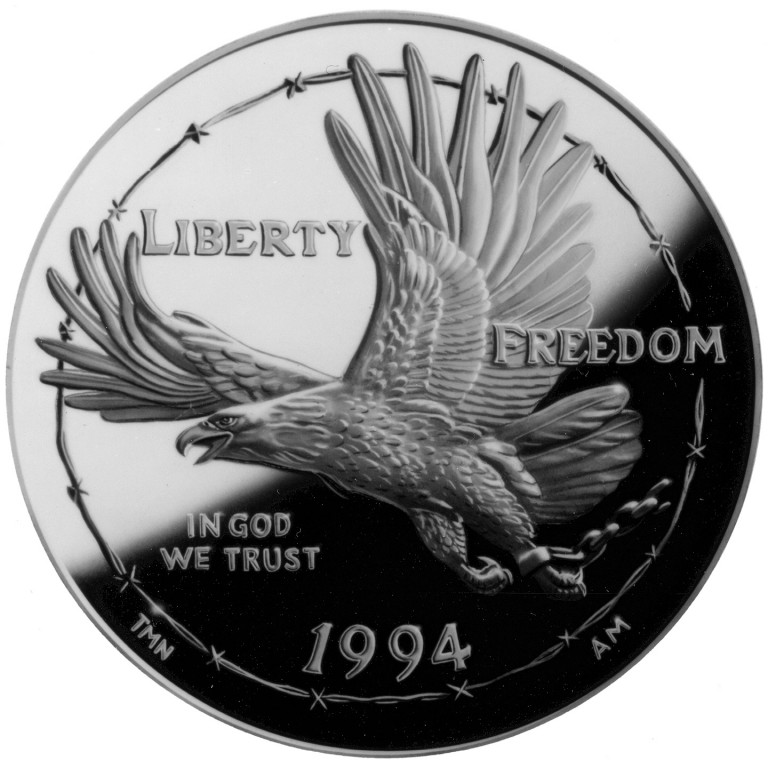
In 1994 the U.S. Mint struck a dollar showing an eagle tearing free through barbed wire, its chain snapped. Far fewer people bought the uncirculated version than expected — and that quiet failure turned it into one of the most sought-after commemoratives of the modern era.

The story behind the coin

Some coins exist to celebrate. This one exists to build something.

In 1994 the U.S. Mint released three silver dollars at once, a package known as the Veterans Program: one for the Vietnam Veterans Memorial, one for the women who served in the military, and this one — for American prisoners of war. They came out of a single law, the United States Veterans Commemorative Coin Act of 1993 (Public Law 103-186), signed on December 14, 1993.

The Prisoner of War dollar had a job to do. On top of the coin's price, buyers paid a surcharge — an extra amount baked into the sale that the Mint hands to a designated cause. Congress directed the first $3 million raised this way to the Secretary of the Interior, to help build the National Prisoner of War Museum at the Andersonville National Historic Site in Georgia. Andersonville is hallowed ground in this story: it was the Civil War's most notorious Confederate prison camp, where thousands of Union soldiers died. The museum that the coin helped fund opened there in 1998, dedicated to all Americans who have endured captivity in war.

So when you hold this dollar, you're holding a small piece of how that museum got paid for.

What it shows

The obverse — the heads side — is the one people remember. An American eagle bursts upward through a ring of barbed wire, a broken chain still hanging from one leg. The whole composition reads as a single motion: captivity left behind, flight toward freedom. The word LIBERTY arcs above it; FREEDOM is worked into the design below.

That side was designed by Tom Nielsen and sculpted by U.S. Mint engraver Alfred Maletsky. (On a coin, the artist who draws the design and the artist who cuts it into the metal die — the steel stamp that strikes the blank — are often two different people.)

The reverse — the tails side — carries the proposed design of the National Prisoner of War Museum itself, wrapped in the legend NATIONAL PRISONER OF WAR MUSEUM, with E PLURIBUS UNUM, UNITED STATES OF AMERICA, and ONE DOLLAR. It was the work of Mint sculptor-engraver Edgar Z. Steever IV. The coin essentially put a picture of the building it was funding right onto its own back.

Key facts

Year struck
1994
Denomination
Silver dollar ($1)
Obverse design
Tom Nielsen (designer), Alfred Maletsky (sculptor)
Reverse design
Edgar Z. Steever IV
Composition
90% silver, 10% copper
Weight
26.73 g (0.7734 troy oz silver)
Diameter
38.1 mm (1.5 in)
Edge
Reeded
Proof
1994-P, Philadelphia — 224,449 struck
Uncirculated
1994-W, West Point — 54,893 struck
Maximum authorized
500,000 (across both versions)
Authorizing law
Public Law 103-186 (Dec 14, 1993)
Surcharge purpose
First $3M to build the National POW Museum, Andersonville, GA

Collecting it

Here's what makes this coin interesting to collectors: it nearly flopped.

Congress allowed up to 500,000 coins. The Mint came nowhere close. The proof version — the polished, mirror-finish coins made for collectors, struck at Philadelphia and carrying a P mint mark (the small letter showing which mint made it) — sold a healthy 224,449. But the uncirculated version from West Point, with its W mint mark, sold just 54,893. For a modern commemorative, that is a strikingly small number.

That gap is the whole story. The 1994-W uncirculated POW dollar became one of the lowest-mintage silver commemoratives of the modern era (the program that began in 1982). Buyers who skipped the plain-finish coin in 1994 created a scarcity that collectors have chased ever since. The proof is common and affordable; the uncirculated coin — especially in top grade, with sharp, unworn surfaces — is the one that commands a premium.

A practical note: every example was sold by the Mint to collectors, never released into pocket change. So a worn, circulated POW dollar is unusual — most survive in pristine condition, often still in original Mint packaging.

Questions collectors ask

Why is the 1994 Prisoner of War dollar considered rare?

The proof version (1994-P) sold a normal 224,449 coins, but the uncirculated version (1994-W) sold only 54,893 — far below the 500,000 the Mint was allowed to make. That low uncirculated mintage makes it one of the scarcest silver commemoratives of the modern era, and it's the version collectors pay up for, especially in high grade.

What's the difference between the 1994-P and 1994-W POW dollars?

The 1994-P is the proof — a collector finish with mirror-like fields, struck in Philadelphia. The 1994-W is the uncirculated (business-strike-style) finish, struck at West Point. The letter is the mint mark. The W coin is far scarcer; the P coin is common.

How much silver is in the coin?

It's 90% silver and 10% copper, weighing 26.73 grams — about 0.7734 troy ounces of pure silver. That gives it a baseline 'melt' value from the metal, separate from any collector premium.

What did buying this coin pay for?

A surcharge on each sale went toward the National Prisoner of War Museum at the Andersonville National Historic Site in Georgia. Congress directed the first $3 million raised to the Secretary of the Interior to help build it. The museum opened in 1998.

Did this coin ever circulate?

No. Like all modern U.S. commemoratives, it was sold directly to collectors by the Mint and never entered general circulation. That's why nearly all surviving examples are in collector-grade condition.

Sources