US coin · series

The 1986 Statue of Liberty Silver Dollar

A birthday coin for Lady Liberty — and the money to fix her.

The 1986 Statue of Liberty Silver Dollar
U.S. Mint; obverse engraver John Mercanti (struck at the San Francisco Mint) · public domain · source

In 1986 the Statue of Liberty turned 100. She also needed urgent repairs. This silver dollar did both jobs at once: it celebrated the centennial and helped pay the bill — millions of them sold to finance her restoration.

The story behind the coin

By the early 1980s, the most famous statue in America was falling apart. A century of salt air had eaten at her iron skeleton and copper skin. The torch leaked. The whole monument needed a top-to-bottom overhaul, and the bill ran into the hundreds of millions of dollars.

So Congress turned to an old idea: let the coin pay for itself. The Statue of Liberty–Ellis Island Commemorative Coin Act — Public Law 99-61, signed in 1985 — authorized a three-coin set timed to the statue's 100th birthday in 1986. A copper-nickel half dollar, this 90% silver dollar, and a small gold five-dollar piece. Every coin carried a built-in surcharge — a markup on top of the coin's face and metal value — and that money went straight to the Statue of Liberty–Ellis Island Foundation.

The plan worked on a scale nobody had seen before. The program was sold through roughly 16,000 bank branches and 3,500 department stores — Sears and K-Mart among them — backed by television and print ads. Gross sales reached about $292.8 million, and the surcharges brought in roughly $78 million for the restoration. People were not just buying a coin. They felt like they were chipping in to save the statue.

The design

The dollar was the work of John Mercanti, a U.S. Mint sculptor-engraver who in that very same year was finishing the design that made him famous: the reverse of the American Silver Eagle. (Mercanti would later become the Mint's Chief Engraver.) The reverse here is credited to Mercanti with assistance from Matthew Peloso.

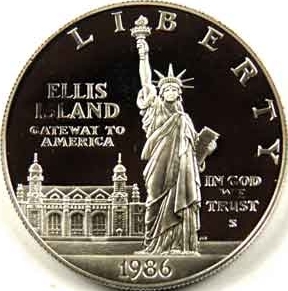
The obverse — the heads side — shows the full Statue of Liberty in the foreground, with the Main Immigration Building on Ellis Island rising behind her. It is a deliberate pairing: the statue that greeted newcomers, and the hall where they were processed into a new country.

The reverse — the tails side — closes in on Liberty's raised hand and torch, with rays streaming from the flame. Wrapped around it is the most famous line ever attached to the statue, from Emma Lazarus's 1883 poem The New Colossus: "GIVE ME YOUR TIRED, YOUR POOR, YOUR HUDDLED MASSES YEARNING TO BREATHE FREE." The poem was not carved on the real statue until 1903, decades after she was dedicated — but by 1986 the words and the monument were inseparable, and the coin treats them as one.

Key facts

Year struck
1986
Denomination
$1 (silver dollar)
Designer
John Mercanti (reverse with Matthew Peloso)
Composition
90% silver, 10% copper
Weight / diameter
26.73 g / 38.1 mm
Mints
Philadelphia (P, uncirculated) · San Francisco (S, proof)
Uncirculated mintage
723,635 (1986-P)
Proof mintage
6,414,638 (1986-S)
Authorizing act
Public Law 99-61 — Statue of Liberty–Ellis Island Commemorative Coin Act (1985)
Surcharges raised (program)
≈ $78 million toward the restoration
Occasion
100th anniversary of the Statue of Liberty (1886–1986)

Collecting it

Here is the thing to understand before you buy one: this coin is common, and that is the whole point. The program was a runaway commercial success, so the Mint struck millions. More than 7 million silver dollars were sold — over 6.4 million of them proofs (specially polished coins struck on mirror-finish dies for collectors), plus about 724,000 uncirculated business-style strikes. There is no rare date, no scarce mint mark, no famous error driving the market.

What that means is simple. For most collectors, the value of a 1986 dollar tracks its silver content far more than any numismatic premium. You are buying roughly three-quarters of an ounce of silver in a beautifully designed package, not a trophy rarity.

Where it does get interesting is at the very top of the grading scale. With a mintage in the millions, common grades are everywhere — but a perfect coin is not. A proof graded PR70 (flawless under magnification) or an uncirculated coin in the highest mint-state grades is genuinely scarce, because perfection is rare even when the coin is not. That is where the slabbed, high-grade examples earn a premium over the melt-value crowd.

Questions collectors ask

Is the 1986 Statue of Liberty silver dollar rare or valuable?

No — it is one of the most common modern U.S. commemoratives. Over 7 million silver dollars were sold. For ordinary examples, the value follows the silver price (the coin is 90% silver, about three-quarters of an ounce) rather than rarity. The exception is top-grade certified coins, where a flawless proof or a very high mint-state example can carry a real premium.

How much silver is in it?

The coin is 90% silver and 10% copper, weighing 26.73 grams. That works out to roughly 0.76 troy ounces of pure silver.

Who designed the coin and what does it show?

John Mercanti — the Mint sculptor who also designed the American Silver Eagle reverse that debuted in 1986. The obverse shows the full statue with the Ellis Island immigration building behind it; the reverse shows Liberty's torch with the line 'Give me your tired, your poor…' from Emma Lazarus's poem The New Colossus.

What's the difference between the 1986-P and 1986-S dollars?

The mint mark and the finish. The 1986-P (Philadelphia) is the uncirculated strike, with about 723,635 made. The 1986-S (San Francisco) is the proof — a mirror-finish collector coin — with about 6,414,638 made. The proof is more common despite looking more 'special.'

Where did the money from these coins go?

Each coin carried a surcharge on top of its price, paid to the Statue of Liberty–Ellis Island Foundation. Across the whole 1986 program — half dollar, silver dollar, and gold $5 — surcharges raised roughly $78 million toward restoring the statue and Ellis Island.

Sources