US coin · series

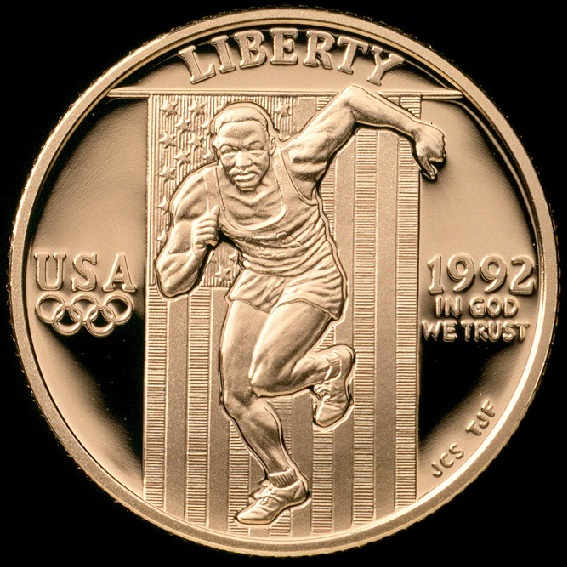
The 1992 $5 Olympic Gold — a sprinter cast in gold to fund Team USA

A West Point half eagle whose every sale put $35 in the hands of American athletes.

The 1992 $5 Olympic Gold — a sprinter cast in gold to fund Team USA
US Mint (usmint.gov) · public domain · source

In 1992 the U.S. Mint struck a small gold coin with a runner frozen mid-stride — and attached a price tag with a purpose. Every one sold sent $35 to the athletes about to compete in Barcelona and Albertville. It is the gold piece in a three-coin Olympic set, and the rarer of its two finishes is the one most people never bought.

The story behind the coin

1992 was a double Olympic year. The Winter Games opened in Albertville, France, in February; the Summer Games followed in Barcelona, Spain, that July. The United States wanted to send its athletes in force — and Congress found a way to help pay for it without a single dollar of taxpayer money.

The tool was a commemorative coin. Under Public Law 101-406, signed on October 3, 1990, the Mint was authorized to strike a three-coin Olympic set: a copper-nickel clad half dollar, a silver dollar, and this small gold piece — a "half eagle," the old name for the five-dollar gold denomination. Collectors would pay a premium over the metal; the premium would go to the team.

Here is the clever part. Each coin carried a built-in surcharge — a fixed amount baked into the price and handed straight to the U.S. Olympic Committee. The gold $5 carried the largest of them: $35 per coin, on top of metal and minting cost. The silver dollar added $7; the half dollar, $1. Buy the gold coin and you weren't just buying gold. You were buying a runner a plane ticket.

What it depicts

The obverse — the heads side — is pure motion. A sprinter leans into a burst of speed, the Stars and Stripes streaming vertically behind him, the five Olympic rings tucked into the field. It was designed by James M. Sharpe, an illustrator brought in from outside the Mint, and it reads exactly as it was meant to: an American athlete in the act of giving everything.

The reverse — the tails side — was designed by James M. Peed, a Mint staff artist. It brings two emblems together: the American bald eagle and the Olympic rings, the national symbol and the international one sharing a single face. It is a quiet design after the obverse's drama, and that contrast is the point — the effort on one side, the institutions backing it on the other.

The coin is small and dense: just 21.6 millimeters across — barely wider than a U.S. nickel — but struck in 90% gold, the same fineness the United States used for its circulating gold a century earlier. The "W" mint mark marks it as a product of West Point, the Mint's gold and silver facility in New York.

Key facts

Denomination
$5 (gold half eagle)
Year / mint
1992-W (West Point)
Honors
XXV Olympiad — 1992 Barcelona & Albertville Games
Obverse designer
James M. Sharpe (sprinter)
Reverse designer
James M. Peed (eagle & Olympic rings)
Composition
90% gold, 10% alloy
Weight / diameter
8.359 g / 21.6 mm; reeded edge
Uncirculated mintage
27,732
Proof mintage
77,313
Maximum authorized
500,000
Surcharge
$35 per coin to the U.S. Olympic Committee
Authorizing act
Public Law 101-406 (Oct 3, 1990)
Released
January 17, 1992

Collecting it

Two versions exist, and the surprise is which one is scarce. The Mint sold both an uncirculated coin (a standard finish, sold mostly as a single piece) and a proof — a mirror-finish coin struck with polished dies and extra care, sold mainly inside multi-coin Olympic sets. Most modern commemoratives sell more uncirculated pieces than proofs. This one flipped: the proof outsold the uncirculated nearly three to one.

The result is that the uncirculated 1992-W, with just 27,732 struck, is the harder coin to find — the opposite of what a newcomer might guess. Neither was a runaway seller. Congress authorized up to 500,000 of these half eagles; the Mint struck barely over 105,000 across both finishes combined. The 1992 Olympic program landed in a crowded year for U.S. commemoratives, and buyers simply didn't bite as hard as the Mint had hoped.

That makes the appeal here threefold. There's the gold — about a quarter ounce of it, giving the coin a real floor under its value. There's the low survival of pristine examples, especially in the top grades collectors chase. And there's the design: a clean, energetic piece of early-1990s commemorative art with a clear job to do. For a first gold commemorative, it is an approachable, affordable place to start.

Questions collectors ask

What does the 'W' on the 1992 Olympic gold coin mean?

It's the mint mark for West Point, New York — the U.S. Mint facility that struck the coin. All 1992 Olympic $5 gold pieces carry the W.

Why is the uncirculated version scarcer than the proof?

Most buyers wanted the proof, which was sold inside the multi-coin Olympic sets. Only 27,732 uncirculated coins were struck versus 77,313 proofs — the reverse of the usual pattern, which makes the uncirculated the harder one to find today.

How much gold is in the coin?

It's 90% gold and weighs 8.359 grams, which works out to roughly a quarter troy ounce of pure gold. That metal content sets a baseline under the coin's value.

What was the $35 surcharge for?

Every coin sold sent $35 directly to the U.S. Olympic Committee to support American athletes. The silver dollar in the same program added $7, and the half dollar $1.

Which Olympics does it commemorate?

The XXV Olympiad of 1992 — both the Summer Games in Barcelona, Spain, and the Winter Games in Albertville, France, which were held in the same year.

Sources