US coin · series

The Franklin 'Scientist' Dollar — a kite, a key, and a cut-up snake

America's 300th-birthday gift to its first great inventor, struck in silver in 2006.

The Franklin 'Scientist' Dollar — a kite, a key, and a cut-up snake
United States Mint (www.usmint.gov) · public domain · source

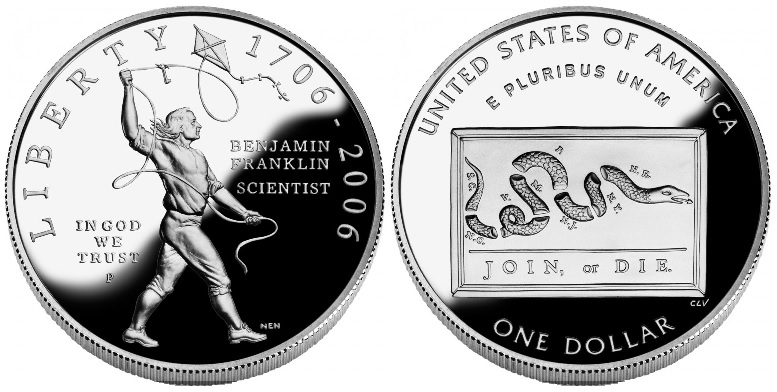
In 2006 the U.S. Mint put a kite-flying young Benjamin Franklin on one face of a silver dollar — and on the other, the chopped-up snake from the first political cartoon ever printed in America. One coin, two ideas Franklin gave the country: how to think, and how to unite.

The story behind the coin

January 17, 2006 marked 300 years since Benjamin Franklin was born in Boston. Congress decided the printer-turned-scientist-turned-diplomat deserved a birthday coin — and not just one.

The Benjamin Franklin Commemorative Coin Act (Public Law 108-464, signed December 21, 2004) authorized two silver dollars for the tercentenary, each telling a different chapter of his life. One, the "Founding Father," shows a mature Franklin and the early American currency he helped design. The other — this one — is the "Scientist," and it goes back to the curious young man who reached up into a thunderstorm to ask a question.

The law capped each design at 250,000 coins and tacked a $10 surcharge onto every sale. That money was earmarked for the Franklin Institute in Philadelphia, the science museum that carries his name — funding its work for the Benjamin Franklin Tercentenary Commission. A coin honoring a scientist, paying for science. Franklin would have liked the symmetry.

What the coin shows

The obverse — the "heads" side — was sculpted by U.S. Mint engraver Norman E. Nemeth. It shows a youthful Franklin holding a kite, with a key on the string. This is the famous June 1752 experiment, the one every schoolchild half-remembers: Franklin flew a kite in a storm to test whether lightning was electricity. (The reckless version of the legend — Franklin nearly electrocuting himself — is mostly embroidery; he understood the danger and is thought to have insulated himself. The point of the design is the idea, not the danger: a man treating the sky like a laboratory.)

Flip it over and the mood changes completely. The reverse, by sculptor Charles L. Vickers, reproduces "Join, or Die" — a snake chopped into segments, each labeled for a colony or region. Franklin drew it for his Pennsylvania Gazette on May 9, 1754, and it is widely called the first American political cartoon. The grim joke rode on an old folk belief that a severed snake could come back to life if its pieces were reunited before sunset. Franklin's message: the scattered colonies had to band together or perish. The image outlived its moment and became a symbol of American unity for decades.

So one dollar carries two of Franklin's gifts. The front is his science; the back is his politics, drawn in a single unforgettable picture.

Key facts

Year struck
2006 (Philadelphia, mint mark P)
Denomination
Silver dollar (commemorative, $1)
Obverse designer
Norman E. Nemeth — young Franklin with kite and key
Reverse designer
Charles L. Vickers — Franklin's 1754 'Join, or Die' cartoon
Composition
90% silver, 10% copper (0.7735 troy oz pure silver)
Weight / diameter
26.73 g / 38.1 mm
Mintage
58,000 uncirculated; 142,000 proof
Authorized maximum
250,000 across all options (per design)
Surcharge
$10 per coin to the Franklin Institute (Tercentenary Commission)
Authorizing law
Benjamin Franklin Commemorative Coin Act — Public Law 108-464 (2004)

Collecting it

Modern commemoratives like this one were never meant for your pocket. The Mint sold them straight to collectors in 2006, in protective packaging, at roughly $35 apiece. So nearly every example survives in pristine shape — the question for collectors isn't whether a coin is uncirculated, but how perfect the strike and surfaces are.

The numbers tell the real story. The Mint reports about 142,000 proofs — the mirror-finish version, struck with polished dies on polished blanks for sharp, frosted detail — and only about 58,000 uncirculated business strikes. That makes the plain uncirculated "Scientist" the scarcer of the two finishes, which surprises newcomers who assume proofs are always rarer. Both came in well under the 250,000 the law allowed, so the whole program is genuinely low-mintage by modern standards.

For graded coins, the chase is the top of the scale. A common date in an ordinary holder is one thing; the same coin certified at the highest grades — a flawless proof (PR70) or a top-tier uncirculated (MS70) — is where the premiums live, because perfection is scarce even when the coin itself isn't. As a two-design birthday set, many collectors want the "Scientist" and "Founding Father" together; one without the other feels unfinished.

Questions collectors ask

What is the 2006 Franklin 'Scientist' silver dollar?

It's a U.S. commemorative silver dollar struck in 2006 for the 300th anniversary of Benjamin Franklin's birth. The obverse shows a young Franklin with a kite and key (his electricity experiment); the reverse reproduces his 1754 'Join, or Die' cartoon. It was one of two Franklin dollars issued that year — the other is the 'Founding Father' design.

How many were made?

The U.S. Mint reports roughly 58,000 in uncirculated finish and about 142,000 in proof. The authorizing law capped each design at 250,000 coins across all options, so the program came in well below its ceiling.

Is it real silver, and how much?

Yes. It's 90% silver and 10% copper, weighs 26.73 grams, and contains about 0.7735 troy ounces of pure silver. That silver content sets a price floor for the coin.

What does the snake on the back mean?

It's 'Join, or Die,' a cartoon Franklin published in 1754 — widely considered the first American political cartoon. The snake is cut into segments, one per colony or region, playing on a folk belief that a severed snake could revive if reassembled. Franklin's point: the colonies had to unite or fall apart.

Why did the coin cost more than a dollar?

Commemoratives are sold by the Mint to collectors, not released into circulation, and they're priced to cover the silver plus a surcharge. The Franklin 'Scientist' carried a $10 surcharge per coin, which went to the Franklin Institute for the tercentenary.

Is the 'Scientist' or the 'Founding Father' rarer?

They're close, but the 'Scientist' uncirculated coin (about 58,000) is among the lower-mintage pieces of the program. Many collectors pursue both designs as a matched pair.

Sources