US coin · series

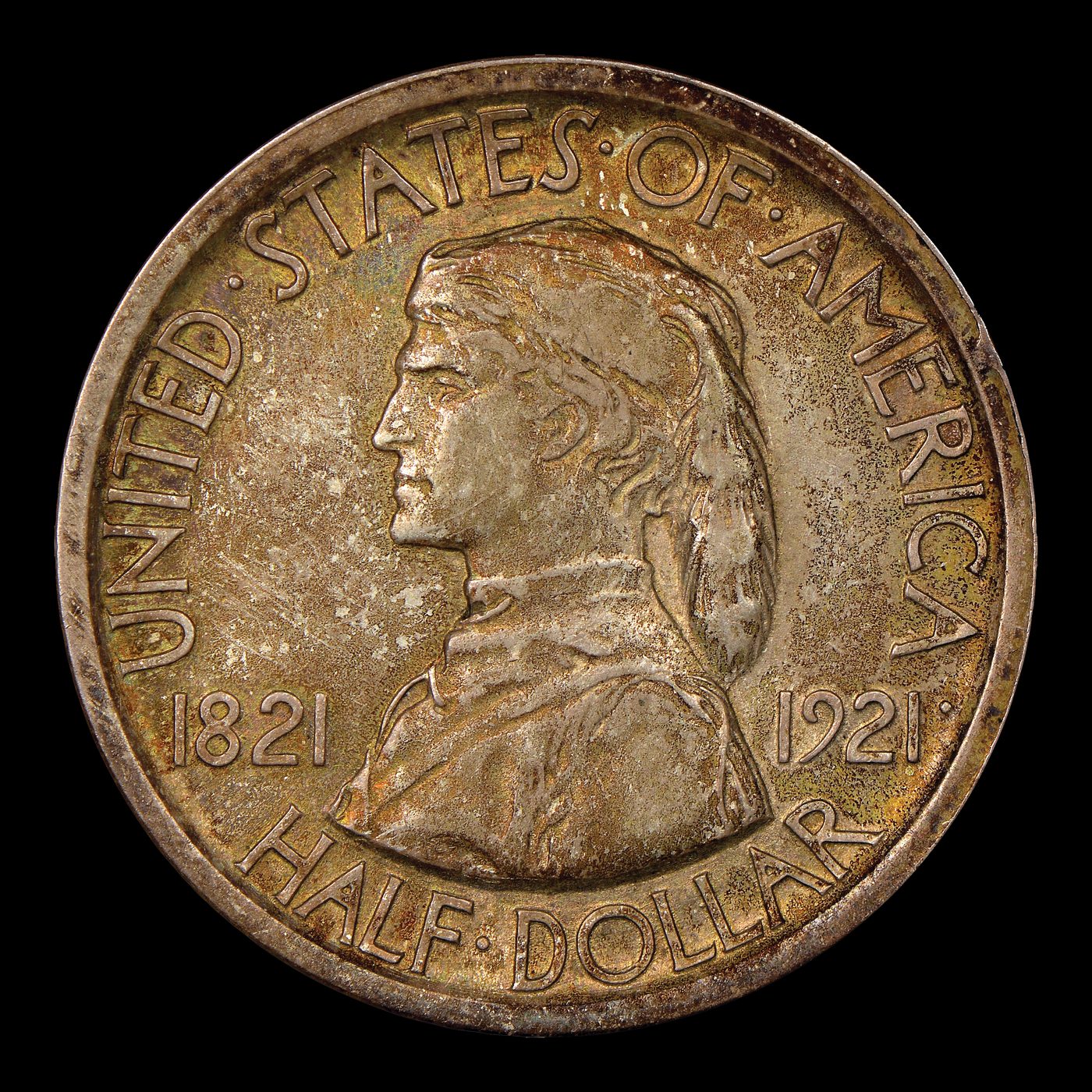
The 1921 Missouri Centennial Half Dollar

A coin for a celebration almost nobody bought — so they burned most of it.

The 1921 Missouri Centennial Half Dollar
Image: Heritage Auctions; coin designed by Robert Aitken. Credit: Newman Numismatic Portal (https://nnp.wustl.edu/library/ImageDetail/559125), via… · public domain · source

In 1921, Missouri turned a hundred. To mark it, the U.S. Mint struck 50,000 silver half dollars showing Daniel Boone. Then the recession hit, the crowds stayed home, and nearly 30,000 of them went back to the Mint to be melted. What survived became one of the most coveted coins in American commemorative collecting.

The story behind the coin

Missouri entered the Union on August 10, 1821 — the deal at the heart of the Missouri Compromise, the bargain that let one slave state and one free state in together and held a fracturing country together a little longer. A hundred years later, the state wanted a party.

The plan was a grand exposition in Sedalia, and a souvenir to sell at it: a commemorative half dollar. Congress agreed. The authorizing bill passed without recorded opposition, and President Warren G. Harding signed it into law on March 4, 1921 — his inauguration day.

Here is the part that still stings collectors a century on. The coins were struck. The exposition came and went in August 1921. And the country was in the grip of the sharp postwar Recession of 1921, with little advance publicity for the sale. Souvenir half dollars at a dollar apiece — twice face value — were a hard sell to a half-empty fairground. The unsold coins went back to the Philadelphia Mint and into the furnace. By the end, almost 60% of the plain coins had been returned and melted. The survivors are the coin we chase today.

The design

The Mint turned to Robert Ingersoll Aitken, the sculptor who had already given American coinage the spectacular Panama-Pacific $50 gold pieces of 1915. He reached for Missouri's founding myth: Daniel Boone, the frontiersman.

The obverse — the heads side — is Boone in a deerskin jacket and coonskin cap. The reverse stages the whole frontier idea in one scene: Boone, rifle and powder horn in hand, gesturing a Native American figure westward, ringed by 24 stars. It is unmistakably a monument to westward expansion told from the settlers' side, the way 1921 understood the story. Aitken tucked his "RA" monogram near the rifle butt, and "SEDALIA" sits in the exergue — the flat space below the design — naming the town that hosted the celebration.

Then there is the gimmick that made the coin famous. On a portion of the run, a tiny "2★4" was punched into the obverse field — a 2, a star, a 4. It reads "twenty-fourth," because Missouri was the 24th state admitted to the Union. The organizers meant to sell these marked pieces at a premium to cover costs. They became, instead, the prize variety of the whole series.

Key facts

Years struck
1921 (single year, Philadelphia)
Occasion
Centennial of Missouri statehood (admitted 1821)
Designer
Robert Ingersoll Aitken
Obverse / reverse
Daniel Boone bust / Boone directing a Native American westward, 24 stars, 'SEDALIA'
Authorized
Up to 250,000 (act signed March 4, 1921)
Total struck
50,028 (28 reserved for assay)
Net distribution (Plain)
≈11,400 — nearly 60% returned and melted
Net distribution (2★4)
Disputed: ≈5,000 (Swiatek–Breen) to ≈9,400 (Yeoman); some sources ~10,000
Issue price
$1.00 each (sold via the Sedalia Trust Company)
Composition
90% silver, 10% copper
Weight / diameter
12.5 g / 30.61 mm, reeded edge
Silver content
0.36169 troy oz

Collecting it

The Missouri Centennial is a two-coin set hiding inside one issue. The "Plain" coin is the base type; the "2★4" — the one with the punched marking — is the variety collectors prize. Both are scarce because so few were sold and so many were destroyed, which is why the Missouri sits among the genuinely tough keys of the classic commemorative half dollar series (the long run of silver souvenir 50-cent pieces struck between 1892 and 1954).

A wrinkle worth knowing: the exact 2★4 mintage is unsettled. Older references (Swiatek and Breen) put it near 5,000; others have argued for roughly 10,000; the more recent Red Book (Yeoman) estimate is about 9,400, against roughly 11,400 plain coins. The honest answer is that nobody can pin the surviving number precisely — and that uncertainty is part of why the variety is so closely watched.

Condition tells the rest of the story. These coins were handled, carried, and pocketed as souvenirs, so high-grade survivors with full, original luster are far scarcer than the raw distribution numbers suggest. The jump in desirability — and price — from a circulated example to a crisp mint-state coin is steep, and steeper still for the 2★4.

Questions collectors ask

What does the 2★4 mean on a Missouri half dollar?

It reads 'twenty-fourth.' Missouri was the 24th state admitted to the Union, so the organizers punched a small '2, star, 4' into the obverse of part of the run. Those marked coins were meant to sell at a premium — and today the 2★4 is the prized variety of the issue.

Why is the Missouri Centennial half dollar so scarce?

It sold badly. The 1921 recession and thin publicity left most of the run unsold at the Sedalia exposition, so nearly 60% of the plain coins were shipped back to the Philadelphia Mint and melted. Only about 11,400 plain coins and a disputed few thousand 2★4 coins reached collectors.

Who is on the coin?

Daniel Boone, the frontiersman tied to Missouri's settlement myth. He appears on the obverse in a coonskin cap and again on the reverse, gesturing a Native American figure westward — a settler's-eye view of westward expansion, sculpted by Robert Aitken.

How many Missouri Centennial half dollars were actually made?

The Philadelphia Mint struck 50,028 in July 1921 (28 were held back for the Assay Commission). But total struck is not the same as total surviving — after melting, the net distribution was roughly 11,400 plain and an uncertain number of 2★4 coins, estimated anywhere from about 5,000 to 10,000 depending on the source.

Is it real silver?

Yes. It's 90% silver, 10% copper — 12.5 grams, 30.61 mm across, with about 0.362 troy ounce of silver. But its value comes from its rarity as a commemorative, not from its metal.

Sources