US coin · series

The Columbia, South Carolina Sesquicentennial Half Dollar

A planned capital's 150th birthday, struck three times over — and never enough to go around.

The Columbia, South Carolina Sesquicentennial Half Dollar
U.S. Mint (coin); Heritage Auctions (image) — Heritage Auctions Lot 4971, 8 January 2020 · public domain · source

In 1936 a city built from scratch on the banks of the Congaree turned 150, and it minted a coin to mark it. Fewer than 9,007 came out of any one mint, every piece sold, and the matched three-coin set has chased collectors ever since.

The story behind the coin

Most American cities just happen. Columbia, South Carolina was drawn. In 1786, with the Revolution barely over, the state legislature decided Charleston sat too exposed on the coast and too far from the up-country farmers. So they laid out a brand-new capital on a grid in the middle of the state and named it for Christopher Columbus — one of the first planned capital cities in the country.

A century and a half later, in the depths of the Great Depression, Columbia threw itself a 150th birthday party — its sesquicentennial (that's just the Latin-rooted word for a 150th anniversary). And in the 1930s, the way a proud American town marked a milestone was to lobby Congress for its own commemorative coin.

It worked. On March 18, 1936, an act of Congress authorized up to 25,000 commemorative half dollars for the celebration. The local Sesqui-Centennial Commission would buy them from the Mint at face value and resell them above face — the markup was the whole point, a tidy way to fund the festivities without raising a tax. Dozens of towns and causes were playing this game in 1936, and Congress was waving most of them through.

The design

The commission handed the job to a hometown talent: Abraham Wolfe Davidson, a 32-year-old sculptor connected to Clemson College. It did not go smoothly. The federal Commission of Fine Arts — the panel that signs off on coin and monument designs — looked at Davidson's first models and recommended replacing him with a more experienced medallist. A compromise was struck: Davidson would revise his work under the eye of the commission's own sculptor-member, Lee Lawrie (the man behind the famous Atlas at New York's Rockefeller Center). The reworked models were approved on July 22, 1936.

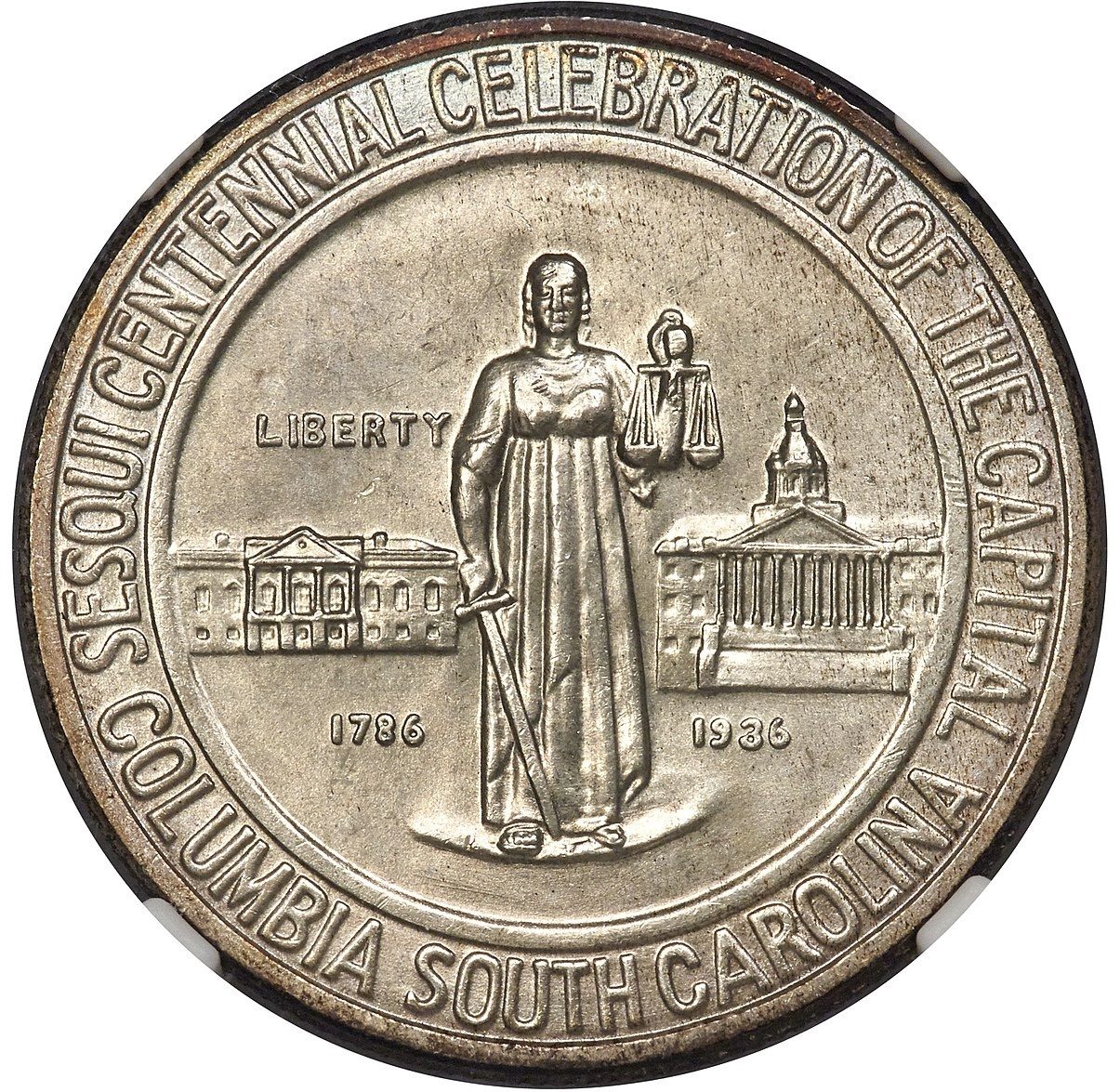
The obverse — the "heads" side — shows a standing figure of Justice with a sword in one hand and the scales in the other. She stands between two buildings: the old State House to her left, dated 1786, and the new State House to her right, dated 1936. It is the whole anniversary in one image — a century and a half of government, then and now, with Columbia itself as the through-line.

The reverse — the "tails" side — is pure South Carolina: a palmetto tree, the state's emblem, ringed by thirteen stars for the original colonies. Crossed arrows are tied to the trunk, and broken oak branches lie at its base. The palmetto is no accident. In 1776, a fort built of spongy palmetto logs on Sullivan's Island absorbed British cannon fire and helped repel an attack on Charleston Harbor — and the palmetto has stood for South Carolina's defiance ever since. One quirk a sharp eye will catch: Davidson's initials never made it onto the finished coin.

Key facts

Year struck
1936
Denomination
Half dollar (50¢)
Designer
Abraham Wolfe Davidson (revised under Lee Lawrie)
Composition
90% silver, 10% copper
Weight / diameter
12.5 g / 30.6 mm, reeded edge
Mintage — Philadelphia
9,007 (no mint mark)
Mintage — Denver
8,009 (D)
Mintage — San Francisco
8,007 (S)
Total net mintage
~25,000 — none returned or melted
Authorizing act
March 18, 1936 (up to 25,000 coins)
Original price
$2 local · $2.15 by mail · $6.45 per three-coin set

Collecting it

Here is what makes this one special: scarcity by design, not by accident. A mint mark is the small letter that tells you which branch of the Mint struck a coin — none for Philadelphia, D for Denver, S for San Francisco. The Columbia half was struck at all three, but only about 8,000 to 9,000 of each came out. That is tiny.

Crucially, the commission sold them all. Many 1930s commemoratives flopped — leftover coins went back to the Mint and were melted, which is why some have higher net mintages on paper than actually survive. Columbia's didn't. The full run found buyers, so the survival rate is high and the population is genuinely small across the board. To get the full set, you need all three mint marks — and the matched three-coin set, often still in its original holder, is the prize most collectors chase.

Distribution was almost charmingly fair. Locals could buy at $2 a coin, mail orders went out at $2.15, and the three-coin set cost $6.45 postpaid. For the first stretch of the sale, only Columbia residents could buy — the hometown got first claim on its own coin.

Because nearly every piece was carefully tucked away by a collector rather than spent, well-struck, lightly handled examples are common enough that condition is everything. The leap in value comes at the top of the grading scale, where a coin shows almost no contact marks and, often, the deep natural toning these silver halves develop in old albums.

Questions collectors ask

Why is the Columbia, South Carolina half dollar considered scarce?

The total mintage was small — roughly 9,007 at Philadelphia, 8,009 at Denver, and 8,007 at San Francisco — and, unusually for a 1930s commemorative, none were returned to the Mint and melted. The whole run sold, so the surviving population is genuinely low at every mint.

What does the palmetto tree on the reverse mean?

It's South Carolina's state emblem. The symbolism traces to 1776, when a fort built of palmetto logs on Sullivan's Island shrugged off British cannon fire defending Charleston Harbor. The crossed arrows and broken oak branches on the coin nod to that Revolutionary-War defense.

Why are the two buildings on the front dated 1786 and 1936?

The obverse shows the figure of Justice between Columbia's old State House (1786, the founding year) and the new State House (1936, the anniversary year) — a century and a half of the capital in a single image.

What is a three-coin set, and why does it matter for this coin?

The Columbia half was struck at three mints — Philadelphia (no mint mark), Denver (D), and San Francisco (S). A complete 'set' is one example from each. The matched three-coin set, sold together in 1936 for $6.45, is what most collectors aim to assemble or buy intact.

Who designed the Columbia Sesquicentennial half dollar?

Abraham Wolfe Davidson, a young sculptor tied to Clemson College. After the Commission of Fine Arts rejected his first models, he revised them under the guidance of sculptor Lee Lawrie. His initials do not appear on the finished coin.

Sources