US coin · series

The Leif Ericson Millennium Silver Dollar

A Viking who reached America 500 years before Columbus — on a coin the United States and Iceland struck together.

The Leif Ericson Millennium Silver Dollar
United States Mint · public domain · source

In the year 2000, the U.S. Mint did something it had never done before: it made a coin in partnership with a foreign country. The subject was Leif Ericson, the Norse explorer who set foot in North America around the year 1000 — half a millennium before Columbus.

The story behind the coin

Around the year 1000, a Norse sailor named Leif Ericson stepped onto a coastline he called Vinland — almost certainly in what is now Newfoundland. He beat Christopher Columbus to the Americas by roughly 500 years. For most of the centuries since, the rest of the world barely noticed.

The year 2000 marked the millennium of that landing. To honor it, Congress passed the Leif Ericson Millennium Commemorative Coin Act, signed into law on December 6, 1999 (Public Law 106-126). The law called for a silver dollar "emblematic of the millennium of the discovery of the New World by Leif Ericson."

Here is what made it genuinely new. The same act tied the U.S. coin to a matching silver coin from Iceland — a 1,000-króna piece struck on the same blank, at the same Philadelphia Mint, at the same time. It was the first time the United States issued a commemorative coin jointly with another nation. Two countries, one anniversary, two coins minted under one roof. That had never happened before in American coinage.

What the coin depicts

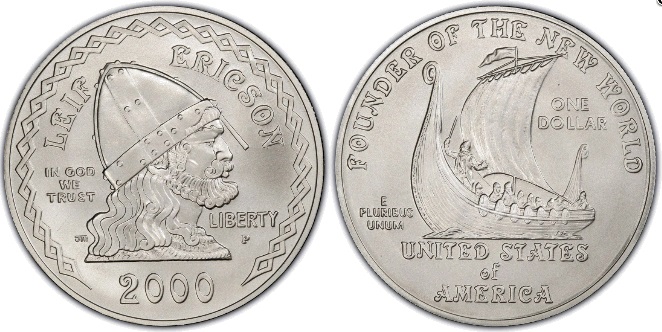
The obverse — the heads side — carries a portrait of Leif Ericson rendered in a traditional Icelandic style, helmeted and bearded, gazing off to the side. It was designed by John Mercanti, then a sculptor-engraver at the U.S. Mint and the man behind the Silver Eagle's reverse. The legends read LEIF ERICSON, LIBERTY, IN GOD WE TRUST, and the date 2000.

Turn it over and you get the better story. The reverse, by Mint sculptor-engraver T. James Ferrell, shows a Viking longship under sail with Ericson at the helm, cutting across open water. The inscription beneath it makes a bold historical claim: FOUNDER OF THE NEW WORLD. It is the ship, not the man, that gives the coin its drama — the low hull, the single square sail, the sense of a tiny crew gambling everything on the horizon.

The Icelandic companion coin took a different tack. Its obverse drew on Stirling Calder's famous statue of Leif Ericson; its reverse gathered the four guardians of Iceland's coat of arms — eagle, dragon, bull, and giant. Both Icelandic sides were designed by Throstur Magnusson. (Iceland's coin is its own catalog entry, not this one — but the two were always meant to be seen as a pair.)

Key facts

Year struck
2000
Mint
Philadelphia (P mint mark)
Obverse designer
John Mercanti — portrait of Leif Ericson
Reverse designer
T. James Ferrell — Viking longship
Composition
90% silver, 10% copper
Weight / diameter
26.73 g · 38.1 mm · reeded edge
Authorizing act
Public Law 106-126, signed Dec 6, 1999
Authorized mintage
Up to 500,000 silver dollars
Proof mintage
≈144,748 (figure widely cited; see FAQ)
Uncirculated mintage
28,150
Surcharge
$10 per coin to the Leifur Eiríksson Foundation
Sale period
June 21, 2000 – February 28, 2001

Collecting it

The Mint was allowed to strike up to 500,000 of these dollars. It struck nowhere near that many. The proof version (the mirror-finish collector strike) is the one most people own; the uncirculated business-strike version is much scarcer, with only 28,150 made. That mismatch is the first thing a collector notices: the everyday-looking coin is the rarer one.

Because the program ran for less than a year and total sales came to roughly $8.9 million, this was a modest seller in its day — not a runaway like the 1986 Statue of Liberty issues. For collectors that cuts two ways. The coin is affordable and easy to find in proof. But the low uncirculated mintage, and the once-only "joint issue with Iceland" backstory, give it a quiet significance that some modern commemoratives lack.

Most surviving examples are in high grade — these coins went straight from Mint packaging into collections, not into pockets. The premium examples are flawless proofs and top-graded uncirculated pieces, especially those still paired with the original two-coin U.S.–Iceland set.

Questions collectors ask

Why is the Leif Ericson dollar called a 'joint' coin?

It was the first U.S. commemorative struck in partnership with a foreign country. The same 1999 law that authorized the U.S. silver dollar paired it with a matching Iceland 1,000-króna silver coin, both struck at the Philadelphia Mint and sold as a two-coin set.

Did Leif Ericson really reach America before Columbus?

Yes. Norse explorers led by Leif Ericson reached North America around the year 1000 — roughly 500 years before Columbus. Archaeological remains of a Norse settlement at L'Anse aux Meadows in Newfoundland confirm the Vinland voyages.

Which version is rarer, proof or uncirculated?

The uncirculated (business-strike) version, with 28,150 minted, is much scarcer than the proof. The proof is the one most collectors own.

What was the surcharge for?

Each coin carried a $10 surcharge that went to the Leifur Eiríksson Foundation, which funds graduate-level student exchanges between the United States and Iceland.

What does the proof mintage figure of 144,748 mean?

That is the figure cited by PCGS, Numista, and major dealers for the proof silver dollar. One reference (Wikipedia) lists a notably lower number; the higher figure is far better corroborated and is consistent with the program's reported total sales, so we use it here while noting the discrepancy.

Sources