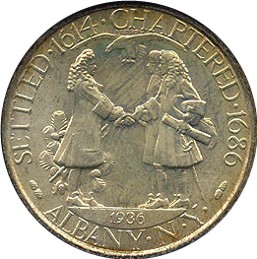
The story behind the coin
On July 22, 1686, the British governor of New York handed the frontier fur-trading town of Albany a charter — a legal document that turned a cluster of Dutch settlers into a chartered city. Two and a half centuries later, in 1936, Albany decided that anniversary deserved a coin.
This was the high tide of America's commemorative coin craze. Through the mid-1930s, towns and committees across the country lined up to get Congress to authorize a half dollar in their honor — coins struck by the U.S. Mint but sold by local sponsors above face value, with the markup funding a celebration or a monument. Albany got its turn: Congressman Parker Corning introduced the bill, and President Franklin Roosevelt signed it on June 16, 1936, authorizing up to 25,000 half dollars.
There was just one wrinkle, and it's a good one. The law itself got the history wrong — it referred to the anniversary of Albany's "founding" rather than its charter. The town was settled long before 1686. The coin commemorates the charter; the act that created it muddled the very fact it was celebrating.