US coin · series

The Half Dollar That Flew North

A 1925 commemorative struck in San Francisco, missing its mint mark, and delivered by airplane — most of which never sold.

The Half Dollar That Flew North
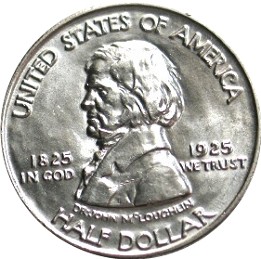
Photograph by Wikimedia/Wikipedia user Bobby131313 (coin design is a U.S. Government work, ineligible for copyright) · public domain · source

In the summer of 1925, an Army pilot loaded 1,462 pounds of silver half dollars into his plane and flew them from San Francisco to Washington State in a single day. The coins honored a century-old fur-trading fort — and most of them came right back to be melted.

The story behind the coin

In 1825, the Hudson's Bay Company built a wooden stockade on the north bank of the Columbia River and called it Fort Vancouver. It became the commercial heart of the Pacific Northwest — a fur-trading post that fed, supplied, and effectively governed a region the United States and Britain were still arguing over. A hundred years later, the city that grew up around it wanted a coin to mark the anniversary.

Getting one was a fight. Washington's Representative Albert Johnson and Senator Wesley Jones pushed for a commemorative half dollar, but Congress was lukewarm — lawmakers first tried to fob them off with a medal instead. The backers held out for a real coin. President Calvin Coolidge signed the authorizing act on February 24, 1925, clearing the way for the Mint to strike up to 300,000 pieces.

That ceiling turned out to be wildly optimistic. The whole point of a commemorative was that a sponsor bought the coins from the Mint at face value and resold them to the public at a premium — here, $1 each — to raise money for the celebration. The math only works if people buy. Fort Vancouver's organizers bet big and lost.

The design

The obverse — the heads side — carries a portrait of Dr. John McLoughlin, the Hudson's Bay Company "chief factor" who ran Fort Vancouver from its founding until 1846. He was the fort's defining figure, later remembered as the "Father of Oregon." On the reverse — the tails side — a buckskin-clad frontiersman stands rifle in hand before the fort's stockade, with Mount Hood rising in the distance.

The artist was Laura Gardin Fraser, one of the finest American medallic sculptors of her day — but she wasn't the first choice. The local Centennial Corporation had hired Portland artist Sidney Bell, whose models the federal Commission of Fine Arts found "interesting" yet not up to coinage standard, judging that the job needed an experienced medalist. Fraser was brought in to redo the work. Her initials, "LGF," sit at the lower right of the reverse.

There's a quirk that trips up newcomers: the coins were struck at the San Francisco Mint, yet they carry no mint mark — no little "S." By the standard account, the mark was simply left off, and the omission was never corrected. So a coin minted in San Francisco looks, at a glance, like a Philadelphia product.

Key facts

Years struck
1925 only
Designer
Laura Gardin Fraser (after rejected models by Sidney Bell)
Mint
San Francisco — struck with no mint mark
Composition
90% silver, 10% copper
Weight
12.5 g
Diameter
30.6 mm
Maximum authorized
300,000
Struck
50,028 (incl. 28 for the Assay Commission)
Melted
35,034
Net distributed
≈14,994
Original issue price
$1 each

Collecting it

This is one of the scarcer classic US commemoratives, and the reason is in the numbers. The Mint struck 50,028 coins, but the public bought only a fraction. A staggering 35,034 went back to be melted, leaving roughly 14,994 in collectors' hands — among the lowest survival figures of any silver commemorative of the era. (You'll see the net figure quoted as both 14,994 and 14,966; the 28-coin difference is just whether the Assay Commission pieces are counted.)

Scarcity is only half the story for the collector — condition is the other half. Fraser's design has high points in high relief, especially the frontiersman, and those points took the brunt of handling. Coins rubbed against each other in bags and pockets, wearing the trapper's detail flat. As a result, sharply struck, fully detailed examples are genuinely hard to find, and gem grades — the top of the Mint State scale — are elusive. Because the coin is valuable, counterfeits exist too; the fakes are known to mimic bag marks with telltale depressions.

A "Mint State" or "MS" coin, for the newcomer, is one that never circulated — it left the Mint, went to a collector, and stayed pristine. With Fort Vancouver, even Mint State pieces often show weakness on the trapper, which is exactly why the rare needle-sharp ones command attention.

Questions collectors ask

Why is the Fort Vancouver half dollar so scarce?

Sales flopped. The Mint struck 50,028 coins, but the public bought far fewer than hoped, so 35,034 were returned and melted. That left only about 14,994 — one of the lowest survival counts among classic US silver commemoratives.

Why doesn't the coin have an 'S' mint mark if it was made in San Francisco?

The coins were struck at the San Francisco Mint, but the mint mark was left off. By the standard account it was simply an omission that was never corrected, so a San Francisco coin carries no mint mark at all.

Who designed the Fort Vancouver half dollar?

Laura Gardin Fraser, a leading American medallic sculptor. Portland artist Sidney Bell was hired first, but the federal Commission of Fine Arts rejected his models, and Fraser was brought in to complete the work. Her initials 'LGF' appear at the lower right of the reverse.

Who is the man on the front of the coin?

Dr. John McLoughlin, the Hudson's Bay Company chief factor who ran Fort Vancouver from 1825 to 1846. He's often called the 'Father of Oregon.'

Is it true the coins were delivered by airplane?

Yes. In 1925 an Army Air Service pilot, Lieutenant Oakley Kelly, flew the entire 1,462-pound shipment from San Francisco to Vancouver, Washington as a publicity stunt — reported as a record single-day round trip to the Bay Area.

Sources