US coin · series

The Silver Dollar That Chose Mercy Over Glory

In 1995, the U.S. Mint put a moment of battlefield kindness on a coin — and almost nobody bought the everyday version.

The Silver Dollar That Chose Mercy Over Glory
United States Mint · public domain · source

Most war coins celebrate the charge. This one shows a soldier kneeling to give water to a wounded enemy. It was struck to save the ground where the Civil War actually happened — and its plain uncirculated version is now one of the harder modern commemoratives to find.

The story behind the coin

By the 1990s, America's Civil War battlefields were vanishing under shopping malls and subdivisions. Gettysburg, Antietam, Manassas — the places where the country nearly tore itself apart were being paved over. A century after the war, the fight had become one to save the land itself.

Congress answered with money, in the way it often does for a cause: a coin. The Civil War Battlefields Commemorative Coin Act of 1992 (Public Law 102-379) was signed by President George H. W. Bush on October 5, 1992. It authorized a three-coin program — a copper-nickel half dollar, this 90% silver dollar, and a $5 gold piece — to mark the 100th anniversary of the preservation effort, not the war.

Here's the clever part. Every coin carried a surcharge — an extra charge baked into the price, above the coin's metal and minting cost. The dollar added $7, and that surcharge was earmarked for a foundation set up to buy and protect endangered battlefield land. Buy the coin, save the ground. The coins went on sale March 31, 1995.

What it shows

The obverse — the heads side — is the whole reason this coin lingers in memory. It shows an infantryman raising a canteen to the lips of a wounded foe. Not a hero on horseback. A small act of mercy between enemies. The artist was Don Troiani, one of the most respected Civil War painters in America, known for getting every button and buckle historically right.

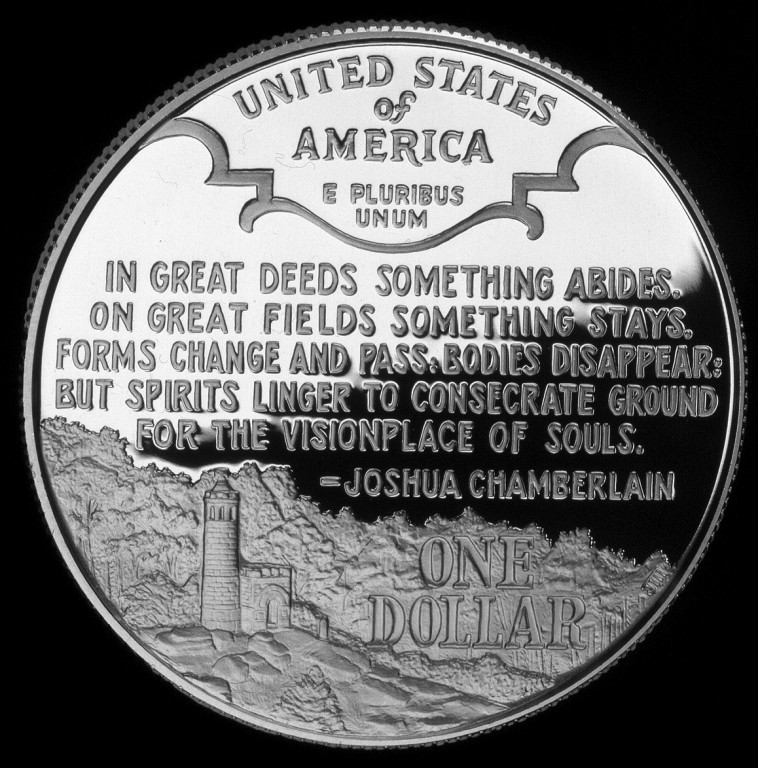
The reverse — the tails side — turns to Gettysburg. John Mercanti, the Mint's Chief Engraver (and the man who designed the Walking Liberty on the Silver Eagle), engraved the slope of Little Round Top, the hill where the Union line nearly broke on the war's second day. Around it runs a line from Joshua Lawrence Chamberlain, the Maine college professor who held that hill and lived to write about it: "In great deeds something abides... spirits linger to consecrate ground for the visionplace of souls."

It is, in other words, a coin built entirely around an idea: that the ground is sacred, and worth saving. The art argues the same case the surcharge was funding.

Key facts

Year struck
1995
Denomination
$1 (silver dollar)
Obverse designer
Don Troiani — soldier giving water to a wounded enemy
Reverse designer
John Mercanti — Little Round Top, Gettysburg, with a Chamberlain quote
Composition
90% silver, 10% copper
Weight
26.73 g (about 0.76 oz silver)
Diameter
38.1 mm
Uncirculated mintage
45,866 (1995-P, Philadelphia)
Proof mintage
437,114 (1995-S, San Francisco)
Maximum authorized
1,000,000 — never reached
Surcharge
$7 per coin, for Civil War battlefield preservation
Authorizing act
Civil War Battlefields Commemorative Coin Act of 1992

Collecting it

The number that matters is 45,866 — the uncirculated 1995-P mintage. That's tiny for a modern commemorative, and it's the key to the whole series. The proof version (the polished, mirror-finish 1995-S) sold far better at 437,114, because proofs were what most buyers wanted. So the plain version, the one struck for everyday brilliant-uncirculated finish, is the one that turns up far less often today.

Why did so few sell? Timing. In 1995 and 1996 the Mint flooded the market — the Atlanta Olympics program alone ran to dozens of separate coins, plus Special Olympics and others, all competing for the same collectors at once. The Civil War program got lost in the crush, and its mintages came in well under the million-coin ceiling Congress allowed. A government review later flagged the whole stretch as a case of too many coins chasing too few buyers.

For a collector, that glut is now a gift. A coin almost nobody wanted in 1995 became genuinely scarce. The uncirculated dollar in a high grade — and the matching half dollar and $5 gold piece, which sold even worse — reward anyone willing to chase the version the crowd skipped.

Questions collectors ask

What is the 1995 Civil War silver dollar worth?

It varies with the silver price and the coin's grade, so we don't quote a fixed figure here — check live listings. What drives value is which version you have: the uncirculated 1995-P (only 45,866 struck) is much scarcer than the proof 1995-S (437,114 struck), and a high, certified grade matters most for the uncirculated coin.

Why is the uncirculated version rarer than the proof?

Most buyers in 1995 wanted the polished proof finish, so the Mint sold far more of those. The plain brilliant-uncirculated coin sold poorly — only 45,866 — which is why it's the harder one to find in nice condition today.

Who designed the 1995 Civil War silver dollar?

Don Troiani, a leading Civil War painter, designed the obverse — a soldier giving water to a wounded enemy. John Mercanti, the Mint's Chief Engraver, designed the reverse showing Little Round Top at Gettysburg with a quote from Joshua Lawrence Chamberlain.

What does the quote on the back mean?

It's from Joshua Lawrence Chamberlain, the Union officer who held Little Round Top at Gettysburg: 'In great deeds something abides... spirits linger to consecrate ground for the visionplace of souls.' It frames the battlefield ground itself as sacred — the same cause the coin's surcharge was funding.

What was the surcharge for?

Each dollar added a $7 surcharge earmarked for preserving historically significant Civil War battlefields — buying and protecting endangered land. Buying the coin helped fund the preservation effort the coin commemorated.

Sources