Designer
Ed Dwight
The first Black American trained for spaceflight, who later carved a forgotten chapter of the Revolution onto a silver dollar.
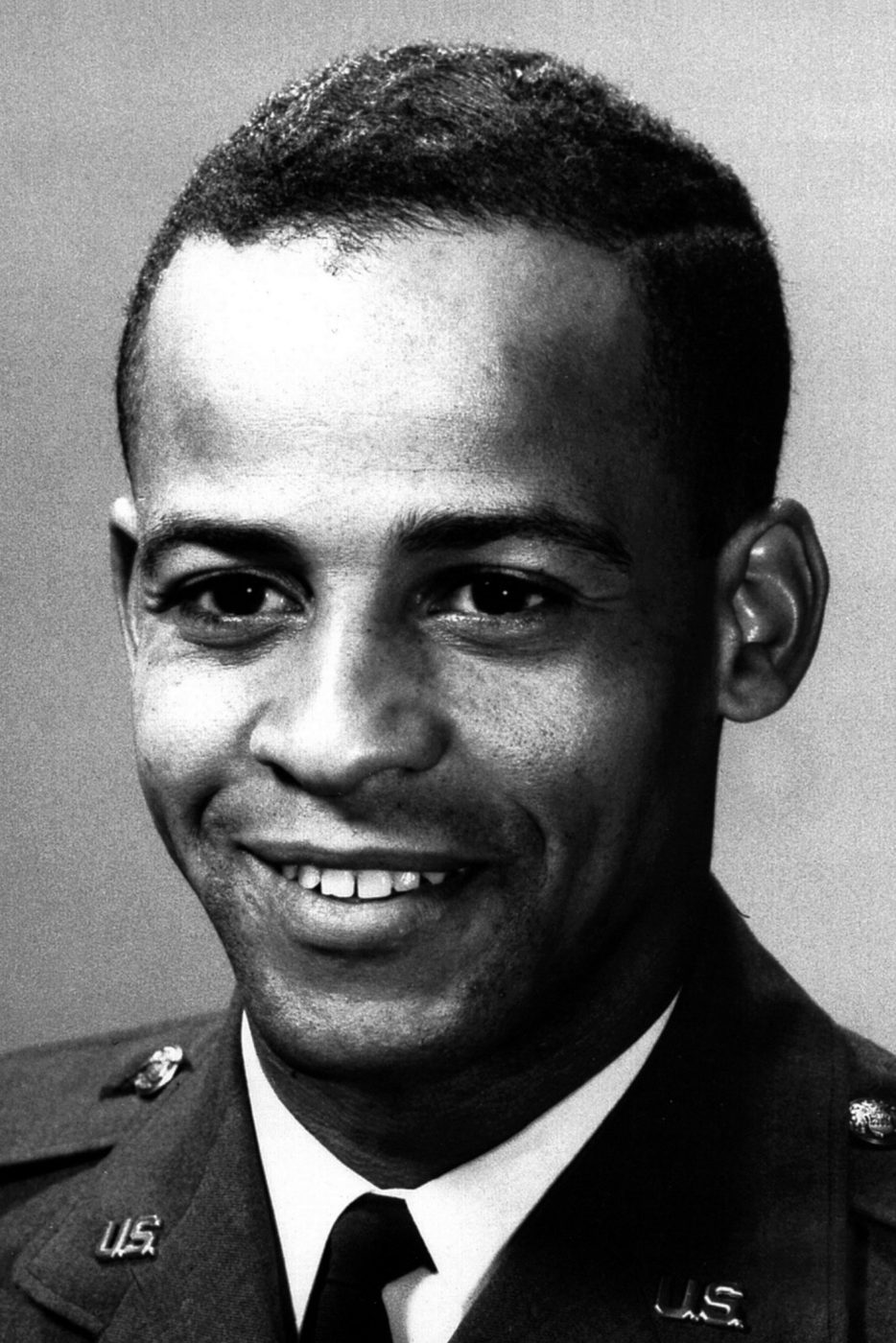
In 1961, President Kennedy's administration set Ed Dwight on a path to become the first Black astronaut. He never flew — not for sixty-three years. But in 1998, a sculpture he made put a Black Revolutionary War family on a United States silver dollar.
Who he was
Ed Dwight has lived several lives, and any one of them would fill a biography.
He was born in Kansas City, Kansas, on September 9, 1933, the son of a Negro Leagues second baseman. As a boy he was pulled in two directions at once — toward airplanes and toward art. He finished his first oil painting at eight. He earned a degree in aeronautical engineering, cum laude, from Arizona State University in 1957, and flew jets for the United States Air Force.
Then, in 1961, the Kennedy administration chose him to train as the country's first Black astronaut candidate. He entered the Air Force's elite test-pilot school and rose to within reach of NASA's third astronaut group. He placed eighth on the contender list in late 1963. NASA took seven.
He did not make the cut, and he later spoke openly of the racism he met along the way. "The day the president got killed," Dwight said of Kennedy's assassination, "my life changed." He resigned from the Air Force in 1966 as a captain — and turned, eventually, to the chisel.
The craft — the sculptor's road to the Mint
Dwight did not pick up sculpture as a hobby. He earned a Master of Fine Arts in sculpture from the University of Denver in 1977, in his forties, after one life had ended and another was beginning.
What followed was a body of work built almost entirely around Black American history — the people and stories that monuments had long left out. He has made memorials to the Underground Railroad, to jazz, to the Black pioneers of the American West, to figures across the long arc from slavery to the presidency. By his own late count the tally runs past 130 memorial sculptures and more than 20,000 gallery pieces.
That mission is exactly why the U.S. Mint came calling. In 1998 the Mint issued a silver dollar honoring the Black Revolutionary War Patriots, and Dwight designed its reverse — the "tails" side. He was, by one account, only the second Black artist to design for the United States Mint. The Mint's own engraver, Thomas D. Rogers, translated Dwight's design into the dies that struck the coin; John Mercanti designed the obverse portrait of Crispus Attucks.
Dwight's reverse is not a generic emblem. It is a detail lifted straight from a much larger work he had designed — the bronze for a proposed Black Patriots Memorial in Washington, D.C. — showing a Black Revolutionary-era family. It put the people who supported the fight, not just the men who died in it, onto legal-tender money.
There is a quiet ache to that coin. The memorial it was meant to fund was never built — the project collapsed before it broke ground, and the surcharge dollars never raised the statue. So for many people, this little silver disc is the closest the memorial ever got to being real.
Key facts
- Born
- September 9, 1933, Kansas City, Kansas
- Nationality
- American
- Training
- Aeronautical engineering, Arizona State (1957); MFA in sculpture, University of Denver (1977)
- Air Force
- 1953–1966; resigned as captain
- Astronaut program
- First Black astronaut candidate, selected 1961; not chosen for NASA
- U.S. coin
- Reverse, 1998 Black Revolutionary War Patriots silver dollar
- Spaceflight
- Flew on Blue Origin NS-25, May 19, 2024 — oldest person in space, age 90
Career timeline
- 1933Born in Kansas City, Kansas.
- 1957Earns a degree in aeronautical engineering from Arizona State University.
- 1961Selected as the first Black astronaut candidate, under the Kennedy administration.
- 1963Completes Air Force test-pilot training; placed eighth on the NASA Group 3 contender list. Seven are chosen.
- 1966Resigns from the Air Force as a captain.
- 1977Earns an MFA in sculpture from the University of Denver.
- 1998Designs the reverse of the U.S. Black Revolutionary War Patriots silver dollar.
- 2024Flies to the edge of space on Blue Origin's NS-25, becoming the oldest person ever in space at 90.
Questions people ask
What coin did Ed Dwight design?
He designed the reverse of the 1998 Black Revolutionary War Patriots silver dollar. The image — a Black Revolutionary-era family — was a detail from his design for a proposed Black Patriots Memorial in Washington, D.C. The Mint's Thomas D. Rogers engraved the dies; John Mercanti designed the obverse portrait of Crispus Attucks.
Was Ed Dwight an astronaut?
He was the first Black American trained as an astronaut candidate, selected in 1961, but NASA did not choose him. He finally reached space decades later — in May 2024, at age 90, on a Blue Origin suborbital flight, becoming the oldest person ever to fly in space.
Was he the first Black artist to design a U.S. coin?
By one widely cited account he was the second Black artist to design for the United States Mint, not the first. What is not in dispute is that almost his entire artistic career has been devoted to Black American history.
Does the silver dollar feature Ed Dwight's portrait?
No. The coin's obverse shows Crispus Attucks, generally considered the first man killed in the 1770 Boston Massacre. Dwight designed the reverse, not a self-portrait.
Sources
- Ed Dwight — Wikipedia
- Ed Dwight | Biography — Encyclopaedia Britannica
- Ed Dwight (1933– ) — BlackPast.org
- Black Revolutionary War Patriots Silver $1 — U.S. Mint
- 1 Dollar (Black Revolutionary War Patriots) — Numista
- Ed Dwight, the First Black Astronaut Candidate, Finally Travels to Space at 90 — Smithsonian Magazine
- How efforts to get a statue honoring black soldiers crumbled — The Washington Post