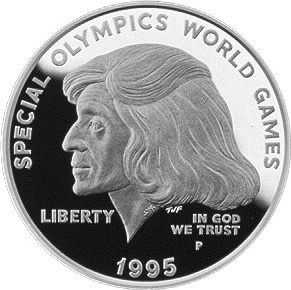
The rule it broke
For most of its history, the U.S. Mint kept the living off its coins. The instinct went back to the founders, who had watched kings stamp their own faces on money and wanted no part of it. Real Americans waited until they were dead to appear on a coin.
The 1995 Special Olympics dollar broke that rule. Its obverse — the heads side — carries the portrait of Eunice Kennedy Shriver, and when the coin was struck, she was very much alive. It was the first U.S. coin to portray a living woman.
Shriver earned it. In 1962 she opened a day camp for children with intellectual disabilities in her own backyard in Maryland — at a time when those children were routinely hidden away in institutions. That camp grew into the Special Olympics: by 1995 it filled stadiums. The coin was timed to the 1995 Special Olympics World Summer Games in New Haven, Connecticut, where more than 7,000 athletes from over 140 nations competed and President Bill Clinton opened the games at the Yale Bowl.