US coin · series

The Coin That Honors Two Men Arguing in the Woods

In 2016, the U.S. Mint put Theodore Roosevelt and John Muir on a $5 gold coin — for the agency their famous Yosemite camping trip helped inspire.

The Coin That Honors Two Men Arguing in the Woods
United States Mint (usmint.gov) · public domain · source

In 1903 a president and a wild-eyed naturalist slipped away from the press and went camping in Yosemite. Thirteen years later the country built an agency to protect places like it. A century after that, the Mint struck this small gold coin to remember all of it — and almost nobody bought one.

The story behind the coin

The picture on this coin starts with a real camping trip. In 1903, President Theodore Roosevelt ducked his official schedule to spend three nights in Yosemite with John Muir — the Scottish-born naturalist whose writing had helped make the valley famous. They slept under the sequoias, woke up under five inches of fresh snow, and argued about what wild land was for. Roosevelt left convinced the country had to protect places like this on purpose.

It took the rest of the nation a while to catch up. For decades America's parks were a scattered, unguarded patchwork — protected on paper, but with no single agency to run them. That changed on August 25, 1916, when President Woodrow Wilson signed the law creating the National Park Service: one bureau, inside the Interior Department, charged with keeping the parks "unimpaired for the enjoyment of future generations."

This coin marks that agency's 100th birthday. Congress ordered it through the National Park Service 100th Anniversary Commemorative Coin Act — signed into law on December 19, 2014, as Public Law 113-291. The law authorized a small three-coin set: a clad half dollar, a silver dollar, and this $5 gold piece. A commemorative coin is one Congress approves for a single occasion — sold by the Mint at a premium, not handed out as change. You were never going to find this in your pocket.

The design

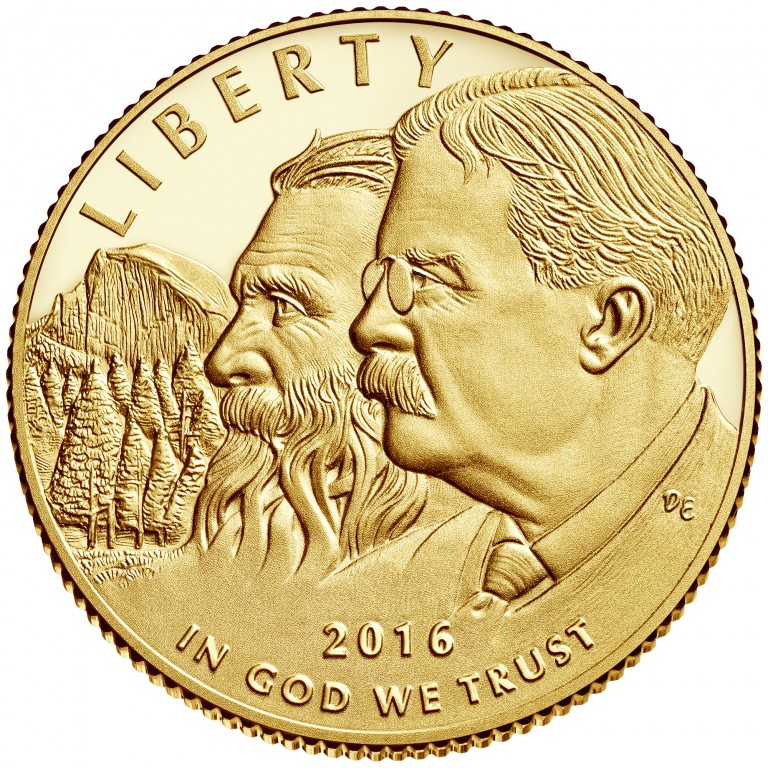
The obverse — the heads side — puts Roosevelt and Muir together in a jugate portrait, two profiles overlapping and facing left, the way old coins paired emperors and consorts. Behind them rises Half Dome, the sheer granite face that towers over Yosemite Valley. It's the camping trip, frozen in metal: the president and the naturalist, with the very rock that brought them together looking over their shoulders.

The reverse — the tails side — is quieter and instantly familiar to anyone who has driven into a park. It shows the National Park Service's arrowhead emblem hanging from a signpost, with a sweeping mountain prairie opening up behind it. One side is the idea; the other is the agency that carries it out.

Both sides were designed and sculpted by Don Everhart, a longtime U.S. Mint sculptor-engraver whose work appears across the modern commemorative program. Every one of these gold coins was struck at the West Point Mint in New York — which is why each carries a small W mint mark, the tiny letter that tells you which Mint facility made the coin.

Key facts

Denomination
$5 gold (commemorative)
Year
2016
Honors
100th anniversary of the National Park Service (founded 1916)
Designer / sculptor
Don Everhart (both sides)
Obverse
Jugate busts of Theodore Roosevelt and John Muir, with Yosemite's Half Dome
Reverse
National Park Service arrowhead emblem on a signpost, over a mountain prairie
Mint
West Point (W mint mark)
Composition
.900 gold / .100 alloy
Weight
8.359 g
Diameter
21.59 mm
Edge
Reeded
Authorizing law
Public Law 113-291 (signed Dec 19, 2014)
Maximum authorized mintage
100,000 across all finishes
Reported mintage
~19,506 proof; 5,150 uncirculated (final audited)
Surcharge
$35 per gold coin, to the National Park Foundation
Released
March 24, 2016

Collecting it

Here's the surprising part. Congress allowed up to 100,000 of these gold coins. The Mint came nowhere close to selling that many. The coin was offered in two finishes — a proof (the mirror-bright version struck on polished dies for collectors) and an uncirculated (a softer, matte business-quality strike) — and demand was thin for both. By the time the books closed, the Mint reported roughly 19,506 proofs and just 5,150 uncirculated coins. That uncirculated figure is one of the lowest in the entire modern $5 gold commemorative series.

That scarcity is the whole collecting story. Modern commemoratives often sell briskly, then settle into bullion-driven prices. The NPS gold coin did the opposite: it sold poorly when new, which left so few in existence that the surviving coins — especially the uncirculated version — are genuinely hard to find. For a relatively recent issue, that's unusual, and it's why this coin turns up on "lowest-mintage modern gold" lists.

A note on grades. Because nearly every one of these coins went straight from the Mint to a careful buyer, top-grade examples are common relative to the modern coins of the 1980s and 90s. The scarcity here is in the raw number that exist at all, not in finding a pristine one. When you compare two listings, the finish (proof vs. uncirculated) and the population at the top grades matter more than for most coins of its era.

Part of what you paid also did real work. Every gold coin carried a $35 surcharge — an extra charge written into the law — that went to the National Park Foundation, the Park Service's official nonprofit partner, to help fund park projects. Buying the coin was, by design, a small donation to the thing it celebrates.

Questions collectors ask

Who are the two people on the National Park Service gold coin?

President Theodore Roosevelt and the naturalist John Muir. Their 1903 camping trip in Yosemite helped galvanize the conservation movement, and the coin places them in front of Yosemite's Half Dome.

Why is the 2016-W National Park Service $5 gold coin considered scarce?

Congress authorized up to 100,000, but the Mint reported only about 19,506 proofs and 5,150 uncirculated coins actually sold. That uncirculated figure is among the lowest in the modern $5 gold commemorative series, so very few exist.

Did this coin ever circulate?

No. It is a commemorative, sold by the U.S. Mint at a premium to collectors. It was never released into circulation, so you would not find one in change.

What does the W mint mark mean?

It identifies the West Point Mint in New York, where every one of these gold coins was struck.

Where did the surcharge money go?

Each gold coin carried a $35 surcharge that the law directed to the National Park Foundation, to support projects across the national parks.

Sources