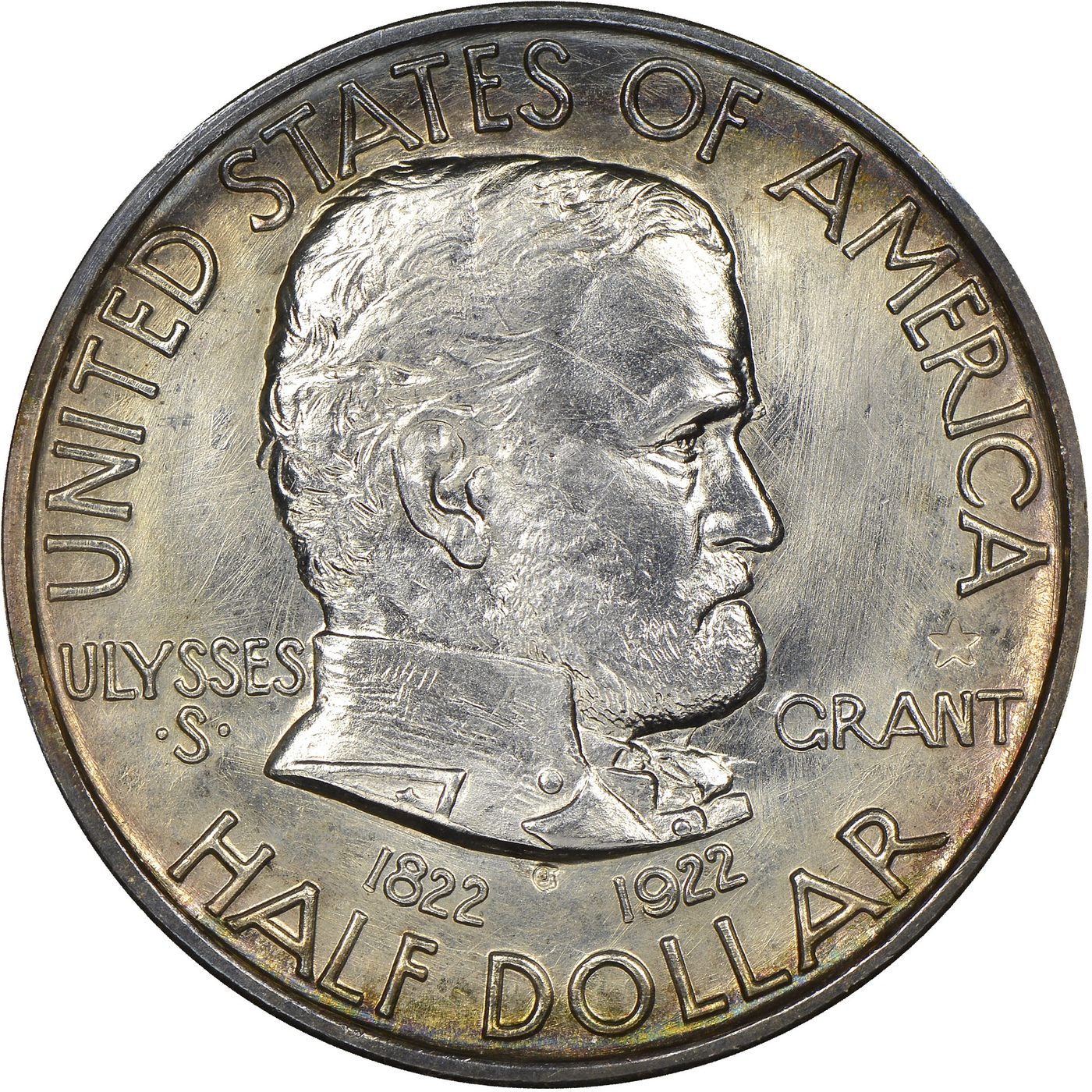
US coin · series

The 1922 Grant Half Dollar — and the star that wasn't supposed to be there

A single recessed star, added to boost sales, split one coin into two — and turned a fundraiser into a chase.

The 1922 Grant Half Dollar — and the star that wasn't supposed to be there
United States Mint / Laura Gardin Fraser (designer) · public domain · source

In 1922 the Mint struck a half dollar for Ulysses S. Grant's hundredth birthday. Then it quietly punched a tiny star into a few thousand of them — a mark with no meaning, meant only to sell more coins. That star is why collectors still hunt this coin a century later.

The story behind the coin

Ulysses S. Grant was born on April 27, 1822, in a small frame house in Point Pleasant, Ohio. By his hundredth birthday he was already a giant of American memory — the general who won the Civil War, the country's 18th president — and a group of Ohioans wanted to mark the centennial in his home state.

That group was the Ulysses S. Grant Centenary Memorial Association, chaired by Hugh L. Nichols, a former chief justice of the Ohio Supreme Court. Their plan was ambitious: community buildings as memorials in Georgetown and Bethel, and a five-mile "General Grant Memorial Highway" running to Point Pleasant. To pay for it, they did what commemorative organizers of the era always did — they asked Congress for coins.

A commemorative coin is legal tender struck to honor a person or event, then sold to the public above face value, with the markup — the surcharge — handed to a sponsoring cause. On February 2, 1922, President Warren G. Harding signed the act authorizing the Grant coinage: up to 250,000 silver half dollars and 10,000 gold dollars. The Association would buy them at face and resell them at a premium to fund its memorials.

The memorials, as it turned out, never got built. The buildings and the highway came to nothing. What survives is the coin — and a strange little wrinkle the Mint added at the last minute.

The design

The Grant half dollar was the work of Laura Gardin Fraser, one of the finest American medallic sculptors of her generation. She designed both the silver half and the gold dollar, and signed them with a single initial — "G," for her birth surname, Gardin.

The obverse — the heads side — shows Grant in a military coat, facing right, modeled on a Mathew Brady photograph from the war. The reverse — the tails side — depicts his birthplace, the modest frame house in Point Pleasant. (Treasury Secretary Andrew Mellon, in his 1922 report, mistakenly called it a log cabin — confusing it with a different cabin Grant built in his thirties near St. Louis. The coin shows the frame house, correctly.)

There is a quiet footnote to the single-initial signature. The numismatist Arlie Slabaugh suggested Fraser may have kept her name discreet on purpose: her husband, the sculptor James Earle Fraser — designer of the Buffalo nickel — sat on the Commission of Fine Arts that reviewed coin designs, and a full signature might have invited charges of favoritism. That reading is plausible and often repeated, but it is an interpretation, not a documented fact.

Key facts

Years struck
1922 (one year only)
Honors
Centennial of Ulysses S. Grant's birth (1822–1922)
Authorized
Act of February 2, 1922 — up to 250,000 half dollars
Designer
Laura Gardin Fraser
Mint
Philadelphia
Composition
90% silver, 10% copper
Weight
12.5 g
Diameter
30.6 mm
With Star — net mintage
4,256 (5,006 struck, 750 melted)
No Star — net mintage
67,405 (95,055 struck, 27,650 melted)
Issue price (April 1922)
$1.50 with star; $1.00 without

Collecting it

This is really two coins wearing one design. The split is the whole game.

The Grant Commission had asked the Mint to put a small star on half of the 5,000 gold dollars — purely as a selling gimmick, a way to make collectors buy a second example. The Mint went further than asked and stamped stars into a batch of half dollars too, which (in the words of the historical record) "greatly surprised the committee." The star sits in the obverse field, above the "N" in GRANT. It means nothing. Its only job was to sell more coins.

It worked, eventually — just not in the way anyone planned. Far fewer star halves were made, and slow initial sales sent thousands of unsold coins back to the Mint to be melted. After the melting, the math is stark: about 67,405 half dollars without a star survive, against roughly 4,256 with one. The star variety is more than fifteen times scarcer, and it carries the premium to match.

That gap also bred fraud — and a great cautionary tale. By the 1930s, as the star coin's value climbed, a counterfeiter (collectors tell the story of a Bronx dentist) bought quantities of cheap no-star halves and punched fake stars into the field to fake the rare variety. So with this coin, authentication matters more than usual: a star is only worth chasing if it left the Mint that way. This is exactly the kind of coin the third-party grading holder exists for — the slab is the difference between a genuine 1922-with-star and a doctored common one.

Questions collectors ask

What is the star on the 1922 Grant half dollar?

A small recessed star in the obverse field, above the N in GRANT. It has no symbolic meaning. It was added purely to give collectors a second variety to buy — a sales gimmick. Far fewer star coins were struck, so the star version is the scarce, valuable one.

How many Grant with Star half dollars exist?

About 4,256 net. The Mint struck 5,006 and melted 750 that went unsold. By contrast, roughly 67,405 no-star coins survive (95,055 struck, 27,650 melted) — making the star variety more than fifteen times scarcer.

Who designed the Grant Memorial half dollar?

Laura Gardin Fraser, a leading American sculptor. She designed both the silver half dollar and the companion gold dollar and signed them with a single initial, G, for her birth surname Gardin.

Why does it show a house instead of a log cabin?

The reverse depicts Grant's actual birthplace — a frame house in Point Pleasant, Ohio. Treasury Secretary Mellon called it a log cabin in an official 1922 report, but that was an error; he confused it with a different cabin Grant later built near St. Louis.

Are fake star coins a real concern?

Yes. Because the star variety became so much more valuable, counterfeiters have punched stars into common no-star coins. A star is only worth a premium if the coin left the Mint with it — which is why genuine examples are bought certified in a grading holder.

Sources