US coin · series

The 1936 Bridgeport Half Dollar

The only U.S. coin to honor the greatest showman who ever lived.

The 1936 Bridgeport Half Dollar
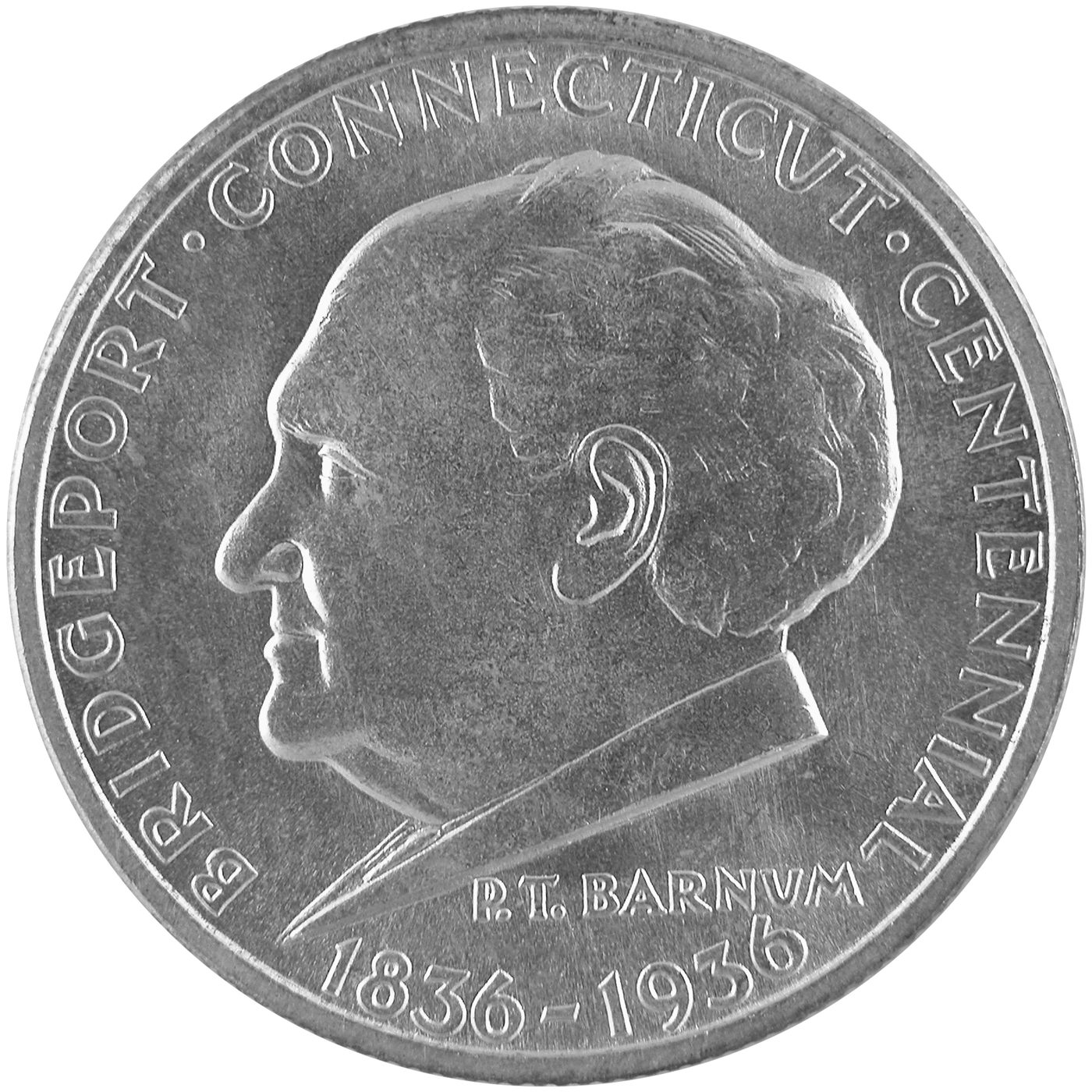
United States Mint / Henry Kreis · public domain · source

In 1936, Connecticut put P. T. Barnum — the circus king, the hoax artist, the man who reportedly never said "there's a sucker born every minute" — on a half dollar. Then it gave the coin an eagle so strange that critics called it a shark.

The story behind the coin

In 1836, the harbor town of Bridgeport, Connecticut, became a city. A hundred years later, it wanted a coin to mark the date — and it knew exactly whose face belonged on it.

Phineas Taylor Barnum had made Bridgeport his home. He served as its mayor. He gave the city Seaside Park, helped build its streets and industry, and was buried in its soil. He was also, by then, the most famous American showman who had ever lived — the man behind the circus, the museum of curiosities, the spectacular humbug. Putting Barnum on the coin was an easy call.

The path to a commemorative was the path every town took in the 1930s. A local committee — Bridgeport Centennial, Inc. — lobbied Congress for the right to a special half dollar it could sell to collectors at a markup, with the profit funding the celebration. Senator Augustine Lonergan of Connecticut introduced the bill on March 10, 1936. President Franklin Roosevelt signed it on May 15, 1936, authorizing "not fewer than 25,000 half dollars."

That was the system, and 1936 was its peak. Dozens of cities and causes won their own coins that year, each sold by its own committee. To collectors it became a glut. To Bridgeport it was simply a birthday.

The design

The Mint handed the job to Henry Kreis, a Connecticut sculptor who had already designed the state's 1935 Tercentenary half dollar. He delivered both sides.

The obverse — the heads side — is Barnum in profile, facing left, his portrait a strong likeness of the showman as an older man. It is competent, dignified work. The reverse is where the trouble started.

Kreis gave the back of the coin a stylized eagle, swept forward into a sharp, near-abstract wedge of metal — a thoroughly modern bird for 1936. Some admirers saw boldness. Critics saw something else entirely: they compared it to an airplane, and to a shark. The dealer B. Max Mehl, writing in 1937, called it "the biggest joke as a specimen of our noble bird," and could not resist tying the design to Barnum's reputation for fooling the public. Decades later the art historian Cornelius Vermeule took the opposite view, praising "a thrusting eagle of conceptual, metallic style." The argument never really settled — which is part of why the coin is still fun to look at.

Key facts

Year struck
1936
Denomination
Half dollar (50 cents)
Designer
Henry Kreis (obverse and reverse)
Obverse
Portrait of P. T. Barnum
Reverse
Stylized modern eagle
Authorized
Act of May 15, 1936
Mint
Philadelphia (no mint mark)
Mintage
25,015 struck — 15 reserved for assay
Composition
90% silver, 10% copper
Weight
12.5 g
Diameter
30.61 mm
Silver content
0.36169 troy oz
Edge
Reeded
Original issue price
$2.00 each

Collecting it

Only 25,000 of these coins were ever sold to the public, which sounds scarce — and by the standards of a circulating coin, it is. But by the standards of 1930s commemoratives it is a middle-of-the-pack number, and that shapes everything about how the Bridgeport trades today.

There is only one date and one mint. No rare variety hunts here, no key date that costs ten times the rest. Bridgeport Centennial, Inc. sold the coins for $2 apiece — four times face value — mostly through local banks and mail orders handled by the First National Bank of Bridgeport, with each buyer limited to five. They sold well, but several thousand went unsold. Dealers bought the remainder, and those leftovers kept the coin easy to find on the secondary market into the 1970s.

Because so many were saved by collectors rather than spent, the coin survives mostly in high grade. That flips the usual logic: a worn Bridgeport is unusual, and the value lives at the top of the scale. The premium you pay is for sharpness of strike and the absence of bag marks on Barnum's cheek and the eagle's flat, modern surfaces — exactly the places that show every nick. In choice mint state the coin trades in the low hundreds of dollars; truly exceptional pieces have reached well past a thousand.

Questions collectors ask

Who is on the Bridgeport half dollar?

P. T. Barnum — the circus impresario and showman — appears in profile on the obverse. Barnum lived in Bridgeport, served as its mayor, donated Seaside Park to the city, and is buried there, which made him the natural face for the city's 1936 centennial coin. It is the only U.S. coin to depict him.

Why does the eagle look so strange?

Designer Henry Kreis gave the reverse a deliberately modern, swept-forward eagle. Contemporary critics — including dealer B. Max Mehl — mocked it, comparing the bird to an airplane or a shark. Later art historians admired its bold, metallic style. Whether you love it or hate it, the modern eagle is what makes the coin instantly recognizable.

How many Bridgeport half dollars were made?

The Philadelphia Mint struck 25,015 in September 1936, with 15 set aside for routine assay testing and later destroyed. So roughly 25,000 reached the public — a moderate mintage for a 1930s commemorative.

Is the Bridgeport half dollar rare or valuable?

It is not rare in the way a key date is — there is one date, one mint, and no scarce variety. Most survive in high grade because collectors saved them. Choice mint-state examples trade in the low hundreds of dollars, with standout pieces selling for much more. Worn, circulated examples are actually the unusual ones.

Sources