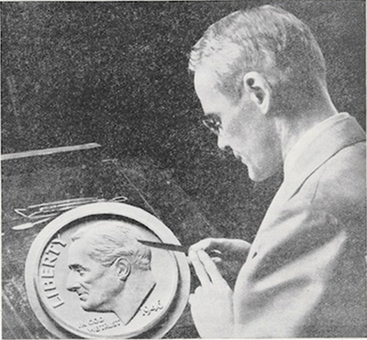
Designer

John R. Sinnock: the engraver behind the dime in your pocket

His two letters on a coin once made Americans whisper about Soviet spies.

John R. Sinnock: the engraver behind the dime in your pocket
The Numismatic Scrapbook Magazine · public domain · source

Look at a dime. Down near the base of Roosevelt's neck are two tiny letters: JS. They stand for John Sinnock, the Mint engraver who designed the coin. In 1946, a lot of frightened Americans were sure they stood for Joseph Stalin.

The man behind the initials

In 1946, the United States put a freshly designed dime into circulation — and a rumor spread that a Soviet agent had signed it.

The dime honored Franklin Delano Roosevelt, who had died the year before. Down near the cutoff of his neck sat two small letters: JS. They were the initials of the man who designed the coin — John Ray Sinnock, the Mint's chief engraver. But the Cold War was just beginning. Americans were looking for communists everywhere. And so a story took hold that the "JS" was a hidden signature from Joseph Stalin, smuggled onto American money by a spy inside the U.S. Mint.

It was nonsense. The rumor was so persistent the Mint had to keep swatting it down into the 1950s. But it tells you something about the strange position Sinnock occupied: a quiet government craftsman whose work landed in every pocket in America, at the exact moment the country was at its most paranoid.

Sinnock was born on July 8, 1888, in Raton, New Mexico — a railroad town in the high desert. He trained at the Pennsylvania Museum School of Industrial Art in Philadelphia, won the A.W. Mifflin Award for study abroad, and spent about a decade teaching art before he turned to metal full time. In 1917 he joined the Philadelphia Mint as an assistant engraver and medalist. Eight years later, in 1925, he became its eighth Chief Engraver — the person responsible for turning a sculptor's clay model into the hardened steel dies (the stamps that press a design into a coin blank) that strike millions of coins.

The craft, and the fights

A Mint engraver's job is mostly invisible. The good ones make a portrait look effortless on a surface the size of a fingernail, in relief so shallow it can still survive a billion trips through a cash register. Sinnock spent twenty-two years at it. Most of that work — the dies, the medals, the endless technical fixes — left no signature at all.

The work that did carry his name attracted argument.

His first big commemorative came in 1926, for the 150th anniversary of American independence: a half dollar and a gold quarter eagle, both struck in extremely shallow relief — so shallow the design can be hard to read, which made high-grade survivors genuinely scarce. For decades Sinnock got full credit. Then, forty years later, the numismatic writer Don Taxay uncovered that the half dollar had been worked up from a sketch by the artist John Frederick Lewis — adapted by Sinnock without crediting Lewis.

The bigger fight was over the dime. After it appeared, the sculptor Selma Burke — an African American artist who had modeled a bronze relief of Roosevelt unveiled in Washington in 1945 — said Sinnock's portrait looked unmistakably like her own. Some agreed, including one of Roosevelt's sons. Sinnock denied it flatly. He said his portrait was "a composite of two studies that he made from life in 1933 and 1934," backed by photographs and the advice of two relief sculptors. The Mint never credited Burke; the Smithsonian American Art Museum later did. The truth is genuinely disputed — and a century on, it's still argued over.

His last great design, the Franklin half dollar, he never got to finish. Mint Director Nellie Tayloe Ross, a devoted Franklin admirer, had set him to it in 1947. He died that May, before the reverse was done; his successor, Gilroy Roberts, completed it. When it launched in 1948, the Commission of Fine Arts grumbled that the little eagle on the back — added only because federal law required an eagle on coins above a dime — was "insignificant," and fretted that showing the crack in the Liberty Bell invited cheap jokes. The Treasury overruled them. The coin ran until 1963.

Key facts

Born
July 8, 1888 — Raton, New Mexico
Died
May 14, 1947 — Staten Island, New York (aged 58)
Nationality
American
Role
8th Chief Engraver, U.S. Mint (1925–1947)
Trained at
Pennsylvania Museum School of Industrial Art
Signature coins
Roosevelt dime (1946), Franklin half dollar (1948)
Initials on coin
JS (dime); JRS (Franklin half)
Succeeded by
Gilroy Roberts

A career in metal

  1. 1888Born July 8 in Raton, New Mexico.
  2. 1917Joins the Philadelphia Mint as assistant engraver and medalist.
  3. 1925Becomes the 8th Chief Engraver of the U.S. Mint, succeeding George T. Morgan.
  4. 1926Designs the Sesquicentennial half dollar and gold quarter eagle for the 150th anniversary of independence.
  5. 1946The Roosevelt dime enters circulation on January 30 — Roosevelt's birthday. The 'JS = Stalin' rumor follows.
  6. 1947Dies May 14, before finishing the Franklin half dollar; Gilroy Roberts completes it.
  7. 1948The Franklin half dollar is released, carrying his initials 'JRS'.

In his own words

The dime portrait, Sinnock said, was "a composite of two studies that he made from life in 1933 and 1934" — his answer to those who claimed he had copied Selma Burke's relief of Roosevelt.

Questions collectors ask

Who designed the Roosevelt dime?

John R. Sinnock, the eighth Chief Engraver of the U.S. Mint. His initials, JS, appear at the base of Roosevelt's neck. The dime was released on January 30, 1946 — Roosevelt's birthday — and replaced the Mercury (Winged Liberty Head) dime.

Do the JS initials on the dime really stand for Joseph Stalin?

No. They are John Sinnock's initials. The Stalin story was a Cold War rumor that spread during the Second Red Scare and was never true. The Mint had to deny it repeatedly into the 1950s.

Did Sinnock copy Selma Burke's portrait of Roosevelt for the dime?

It's disputed and never settled. Sculptor Selma Burke, who made a 1945 bronze relief of Roosevelt, said the dime resembled her work. Sinnock denied it, calling his portrait a composite of studies he made from life in 1933 and 1934. The Mint credited Sinnock; the Smithsonian American Art Museum has credited Burke.

What else did Sinnock design?

His best-known coins are the Roosevelt dime (1946) and the Franklin half dollar (1948), the latter finished after his death by Gilroy Roberts. He also modeled the 1926 Sesquicentennial half dollar and gold quarter eagle, and sculpted medals including the Purple Heart.

Why is Roosevelt on the dime specifically?

Roosevelt was closely tied to the March of Dimes, the campaign that raised money to fight polio — a disease he himself had. After his death, Congress put him on the dime as a fitting tribute.

Sources