US coin · series

The 1995 Track & Field Silver Dollar

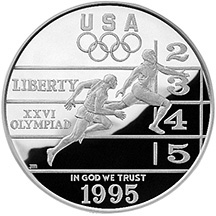
Two runners at the tape — and one coin in the biggest, most crowded commemorative program the U.S. Mint ever ran.

The 1995 Track & Field Silver Dollar
United States Mint · public domain · source

To mark a century of the modern Olympics, the U.S. Mint did something it had never done before — and never did again: it issued sixteen different coins for a single event. The 1995 Track & Field dollar was one of them. So many coins, sold so fast, that collectors simply ran out of appetite — which is exactly why some of them are scarce today.

The story behind the coin

In 1996, Atlanta hosted the Centennial Olympic Games — a hundred years after the first modern Olympics in Athens. The U.S. Mint wanted to mark the occasion in coin. It did not hold back.

Congress authorized not one coin, not a small set, but sixteen — four gold $5 pieces, eight silver dollars, and four copper-nickel half dollars — under the 1996 Atlanta Centennial Olympic Games Commemorative Coin Act (Public Law 102-390). It was the largest U.S. commemorative coin program ever attempted. The coins were dated across two years, 1995 and 1996, each honoring a different sport or Olympic theme. The Track & Field dollar, dated 1995, was one of the first wave.

There was a money motive behind the art. Every coin carried a surcharge — an extra amount baked into the price, above the coin's metal and minting cost. For each silver dollar, that surcharge was $10, and it flowed (through an entity called Atlanta Centennial Olympic Properties) to the Atlanta Committee for the Olympic Games and the United States Olympic Committee. In plain terms: buy the coin, help pay for the Games.

The ambition backfired in an interesting way. Sixteen coins, released close together at collector prices, was simply more than the market wanted to absorb. Sales came in low — among the lowest of any modern commemoratives — and the Mint reportedly took a multimillion-dollar loss on the program. The unhappy ending for the Mint became a quiet gift to collectors: many of these coins ended up with surprisingly small mintages, which is the whole reason a few of them are chased today.

The design

The obverse — the heads side — puts you at the finish line. Two sprinters lean for the tape, mid-stride, beneath the inscription "XXVI OLYMPIAD." It was designed by John M. Mercanti, then a sculptor-engraver at the U.S. Mint and later its twelfth Chief Engraver — the same hand behind the eagle on the American Silver Eagle bullion coin. The motion is the point: this is a coin about the instant a race is won.

The reverse — the tails side — shifts from competition to camaraderie. Two hands clasp beneath an Olympic torch, an image meant to read as brotherhood and the team spirit of the Games, ringed with "ATLANTA" and "ONE DOLLAR." The reverse was designed by William Krawczewicz and sculpted by T. James Ferrell, another Mint engraver. Together the two sides tell the Olympic story in shorthand — the strain to win, and the bond underneath it.

By law, the designs weren't chosen in a vacuum. The Treasury Secretary selected them after consulting the Commission of Fine Arts, the American Numismatic Association, and the Atlanta organizers — the usual gauntlet a modern U.S. commemorative passes through before a single die is cut.

Key facts

Denomination
Silver dollar ($1)
Date
1995 (1996 Atlanta Olympics program)
Obverse designer
John M. Mercanti — two sprinters at the finish
Reverse
Designed by William Krawczewicz, sculpted by T. James Ferrell — clasped hands beneath a torch
Composition
90% silver, 10% copper (.900 fine)
Weight / diameter
26.73 g, 38.1 mm, reeded edge
Proof mintage
1995-P — 136,935
Uncirculated mintage
1995-D — 24,976
Authorizing act
1996 Atlanta Centennial Olympic Games Commemorative Coin Act (Public Law 102-390)
Surcharge
$10 per dollar, to the Atlanta and U.S. Olympic committees

Collecting it

Here is the quirk worth knowing. This coin comes in two forms, and they are not equally common.

The 1995-P is a proof — a specially struck coin with mirror-like fields and frosted devices, made for collectors and sold at a premium. Its mintage of 136,935 is modest but not rare. The 1995-D is the uncirculated (sometimes called "business strike") version — and only 24,976 were made. That is a small number for a modern coin, and it makes the uncirculated Track & Field dollar the harder of the pair to find.

That pattern repeats across the whole 1996 Atlanta program, and it's why collectors pay attention to it. Because so many coins were released so quickly, the uncirculated versions in particular saw tiny mintages — some sister coins in the program dropped under 16,000, and the rarest gold pieces fell near 9,000. The Track & Field dollar isn't the scarcest of the set, but it lives in that same low-mintage neighborhood. As always with silver commemoratives, condition matters: top-grade certified examples (a grade is a 1-to-70 score of preservation) command the strongest premiums.

One honest caveat: low mintage does not automatically mean high value. The Atlanta coins are scarce on paper, but demand for the full program has been uneven over the years. The uncirculated 1995-D is the version where scarcity and collector interest line up best.

Questions collectors ask

Is the 1995 Track & Field dollar rare?

It's scarce rather than rare. The proof (1995-P) had a mintage of 136,935; the uncirculated (1995-D) had just 24,976. The 1995-D is the harder one to find and the one collectors usually mean when they call the coin scarce.

What's the difference between the 1995-P and the 1995-D?

The 1995-P is a proof — struck for collectors with mirror fields and frosted designs, minted in Philadelphia. The 1995-D is an uncirculated coin struck in Denver, with a much lower mintage. They are the same design but different finishes and very different rarity.

How much silver is in it?

It's a 90% silver coin (.900 fine) weighing 26.73 grams, the same standard the U.S. used for classic silver dollars. That gives it a precious-metal floor on top of any collector premium.

Why were there so many 1996 Atlanta Olympic coins?

Congress authorized sixteen coins for the centennial of the modern Olympics — the largest U.S. commemorative program ever. Surcharges on the coins helped fund the Games. So many coins released at once outran collector demand, which is why several ended up with unusually low mintages.

Who designed the coin?

The obverse, showing two sprinters at the finish, is by John M. Mercanti, later Chief Engraver of the U.S. Mint. The reverse, two clasped hands beneath a torch, was designed by William Krawczewicz and sculpted by T. James Ferrell.

Sources