US coin · series

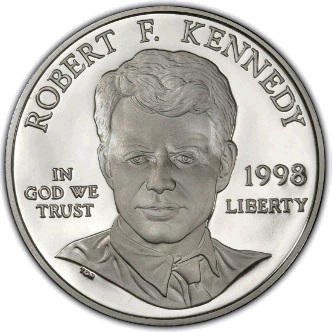
The 1998 Robert F. Kennedy Silver Dollar

A quiet commemorative for a loud decade — outshone by the coin sold beside it.

The 1998 Robert F. Kennedy Silver Dollar
US Mint · public domain · source

In 1998, the U.S. Mint struck a silver dollar for Robert F. Kennedy, thirty years after he was killed. It is a dignified, unremarkable coin. The strange part is what came packaged with it.

The story behind the coin

Robert F. Kennedy was shot in a Los Angeles hotel kitchen on June 5, 1968, hours after winning the California primary. He died the next day. He was 42.

Thirty years later, the U.S. Mint marked that anniversary with a silver dollar. Congress had authorized it back in 1994, in Public Law 103-328 — the same omnibus banking act that, among many other things, cleared this coin. The Mint sold it through 1998, the round number that gave the program its reason to exist.

This is how modern U.S. commemoratives work. Congress picks a person, a place, or an anniversary; authorizes a limited run; and attaches a surcharge — an extra dollar amount baked into the price that flows to a cause tied to the subject. Here, $10 from every coin went to the Robert F. Kennedy Memorial. You weren't just buying silver. You were donating, with a keepsake attached.

So why does a coin honoring one of the most famous Americans of the century feel like a footnote? Because by 1998 the Mint was issuing commemoratives by the fistful, collectors were fatigued, and this one had no gimmick of its own. Fewer than half the coins authorized ever sold. The RFK dollar's real fame, oddly, belongs to the coin standing next to it on the order form.

The design

The obverse — the heads side — carries a portrait of Robert Kennedy by Mint sculptor-engraver Thomas D. Rogers. The name will mean little now, but Rogers was about to become one of the most-handled designers in American history: two years later he drew the soaring eagle on the reverse of the Sacagawea "golden dollar," the coin that landed in millions of cash registers. On the RFK dollar he's working small and serious — a straightforward likeness, "ROBERT F. KENNEDY" arched above.

The reverse — the tails side — is the clever part. It overlaps two government seals: the eagle and shield of the Department of Justice with the seal of the United States Senate. That's a biography in metal. Kennedy was Attorney General under his brother John, then a U.S. Senator from New York. The reverse was designed by James M. Peed and modeled by Rogers, with the single word "JUSTICE" doing a lot of quiet work.

The coin is a classic 90% silver dollar — the old circulating-silver standard, struck here for collectors, never for change. It wears an "S" mint mark for San Francisco, where the Mint made both a proof version (mirror fields, frosted devices, struck on polished blanks for collectors) and an uncirculated version (a normal business-strike finish).

Key facts

Year struck
1998 (San Francisco, 'S' mint mark)
Honoring
Robert F. Kennedy, 30th anniversary of his death (1968)
Authorized by
Public Law 103-328 (1994)
Obverse designer
Thomas D. Rogers (later the Sacagawea dollar reverse)
Reverse designer
James M. Peed; modeled by Thomas D. Rogers
Composition
90% silver, 10% copper
Weight / diameter
26.73 g · 38.1 mm · reeded edge
Mintage — uncirculated
106,422 sold
Mintage — proof
99,020 sold
Authorized ceiling
500,000 coins (fewer than half sold)
Surcharge
$10 per coin to the Robert F. Kennedy Memorial

Collecting it

Here is the twist that makes this page worth your time.

The RFK dollar on its own is common and inexpensive — about 205,000 coins exist between the two finishes, and demand has never been fierce. A nice proof or uncirculated example is an affordable, accessible piece of Kennedy history. Nothing about the dollar itself is scarce.

But the Mint also sold a Kennedy Collector's Set: the uncirculated RFK dollar bundled with a special 1998-S Kennedy half dollar — the John F. Kennedy fifty-cent piece — struck in a rare matte-like finish you couldn't get any other way. That half dollar had an estimated mintage of only about 62,000, the set was offered for roughly $59.95, and it was available to order for just a short window.

Collectors went for it. And the half dollar, not the silver dollar, became the chase. Today the 1998-S matte-finish Kennedy half is treated as a key date of the Kennedy series, often trading for far more than the whole set originally cost — while the RFK dollar it was paired with stays cheap.

So the practical advice runs against the obvious. The famous name is on the dollar; the value is on the companion. If you only want the RFK dollar, top-grade examples (a flawless proof or uncirculated coin) carry a modest premium over silver. If you want the story, you want the intact original set — dollar, matte half, packaging, and certificate together.

Questions collectors ask

Is the 1998 Robert F. Kennedy silver dollar rare?

No. About 106,422 uncirculated and 99,020 proof coins were sold — roughly 205,000 in all, well under the 500,000 the Mint was allowed to make. It's an affordable, easy-to-find modern commemorative. The scarce coin from that program is the matte-finish Kennedy half dollar that was sold bundled with it.

What is the Kennedy Collector's Set, and why does it matter?

It was a U.S. Mint set pairing the uncirculated RFK silver dollar with a special low-mintage 1998-S Kennedy half dollar in a matte-like finish — about 62,000 made, available only in this set during a brief ordering window. That half dollar became a key date and is often worth more than the set's original ~$59.95 price.

Who designed the Robert F. Kennedy dollar?

Mint sculptor-engraver Thomas D. Rogers designed the obverse portrait. The reverse — the Department of Justice seal overlapping the U.S. Senate seal — was designed by James M. Peed and modeled by Rogers. Rogers went on to design the eagle reverse of the 2000 Sacagawea dollar.

Is it real silver?

Yes. It's a 90% silver, 10% copper dollar weighing 26.73 grams — the same alloy as classic U.S. silver dollars — struck only for collectors, never for circulation. It carries an 'S' mint mark for San Francisco.

What does the $10 surcharge mean?

Congress added $10 to the price of each coin, earmarked for the Robert F. Kennedy Memorial. Buyers were effectively making a donation to that cause while receiving the coin.

Sources