US coin · series

The Gold Coin Congress Struck for Its Own 200th Birthday

A West Point half eagle that put the Capitol dome — and a fix for its leaking roof — on a coin.

The Gold Coin Congress Struck for Its Own 200th Birthday
United States Mint (www.usmint.gov) · public domain · source

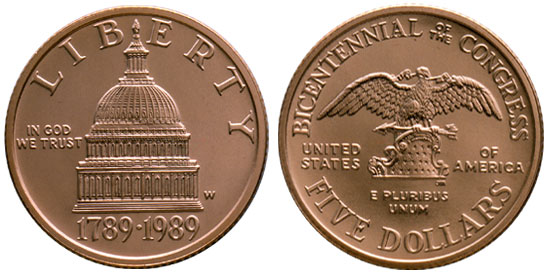
In 1989, the United States Congress turned 200, and it marked the moment the way republics often do: with a gold coin. The $5 Congress Bicentennial half eagle carried the Capitol dome on one side and an eagle from the old Senate chamber on the other — and a slice of every sale went to repair the building it pictured.

The story behind the coin

On a spring day in 1789, the first Congress of the United States finally got down to business in New York City. Two hundred years later, the institution it founded decided to celebrate — and it reached for gold.

The Bicentennial of the United States Congress Commemorative Coin Act, signed as Public Law 100-673, authorized three coins for the anniversary: a copper-nickel half dollar, a silver dollar, and this $5 gold half eagle. ("Half eagle" is the old name for the $5 gold denomination, a holdover from the 1800s when a $10 gold coin was an "eagle.") The first piece was struck on June 14, 1989, at a ceremony outside the Capitol itself.

There was a practical motive folded into the patriotism. Congress sold these coins above their face and metal value, and the extra money — the surcharge — was earmarked. Half of the first $40 million in surcharges was directed to the Capitol Preservation Fund, the account that pays to maintain and restore the Capitol building. The rest went to reducing the national debt. So buyers of a coin showing the Capitol dome were, in a small way, helping to keep that dome standing.

The design

The whole coin is an argument that the building is the institution. Both sides were designed by John M. Mercanti, then a sculptor-engraver at the U.S. Mint and later its twelfth Chief Engraver — the man whose Walking Liberty design fronts the American Silver Eagle.

The obverse — the "heads" side — is the dome of the United States Capitol, framed by LIBERTY, IN GOD WE TRUST, and the twin dates 1789–1989. The reverse takes a detail most visitors never notice: the gilded eagle carved into the canopy above the Senate president's desk in the Old Senate Chamber, the room Congress used before the modern wings were built. Around it run BICENTENNIAL OF THE CONGRESS, E PLURIBUS UNUM, and FIVE DOLLARS.

It is a deliberately interior portrait of Congress — not a flag or a founding father, but the architecture and ornament of the place where the work happens. For a coin made to fund the building's upkeep, that focus reads as more than decoration.

Key facts

Denomination
$5 gold (half eagle)
Year struck
1989
Designer
John M. Mercanti (obverse & reverse)
Mint
West Point — 'W' mint mark
Composition
90% gold, 10% alloy (0.242 oz actual gold weight)
Weight / diameter
8.359 g / 21.6 mm, reeded edge
Proof mintage
164,690
Uncirculated mintage
46,899
Maximum authorized
1,000,000
Authorizing act
Public Law 100-673 (Bicentennial of the United States Congress Commemorative Coin Act)
Surcharge earmark
Capitol Preservation Fund + national debt reduction

Collecting it

This is a one-year, one-mint type: every Congress Bicentennial half eagle is a 1989-W, struck at West Point. That simplicity is part of its appeal — there are no rare date-and-mint-mark hunts here, no major varieties to chase.

What does separate one coin from another is format and grade. The Mint sold it two ways: a proof — struck on polished dies for a mirror finish — and an uncirculated (business-strike) version. The proof was the popular choice, with 164,690 sold; the uncirculated is the scarcer of the pair at 46,899. A grade is the condition score a coin earns when a service like NGC or PCGS examines and seals it in a tamper-evident holder, and on a modern gold commemorative the top grades (think MS70 and PR70, "perfect" with no flaws under magnification) are where the premiums concentrate.

Two numbers tell the bigger story. Total sales came to 211,589 coins against an authorized ceiling of one million — strong for its day, but far short of the cap. And because so much survives in pristine condition, most examples today trade close to the value of the gold inside them rather than as numismatic rarities. The collector's reward here is the history and the Mercanti design, not scarcity.

Questions collectors ask

What anniversary does the 1989 Congress Bicentennial gold coin mark?

It marks 200 years since the first United States Congress convened under the Constitution in 1789. The twin dates 1789–1989 appear on the obverse, and the program also included a silver dollar and a copper-nickel half dollar.

Who designed the Congress Bicentennial $5 gold coin?

John M. Mercanti, a U.S. Mint sculptor-engraver who later became the Mint's twelfth Chief Engraver. He designed both sides — the Capitol dome obverse and the Old Senate Chamber eagle reverse — and is best known for the Walking Liberty design on the American Silver Eagle.

Where was it minted, and how much gold does it contain?

Every example was struck at the West Point Mint and carries a 'W' mint mark. The coin is 90% gold and contains 0.242 troy ounces of actual gold, weighing 8.359 grams overall.

Is the 1989 Congress gold coin rare?

Not especially. Combined proof and uncirculated sales reached 211,589 — high for its era but well under the one-million authorized ceiling. Because so many survive in top condition, most trade near their gold value, with premiums reserved for the highest certified grades.

What did the coin's surcharge pay for?

Buyers paid a surcharge above the coin's price. Half of the first $40 million collected across the program went to the Capitol Preservation Fund for maintaining and restoring the Capitol; the remainder was applied to reducing the national debt.

Sources