US coin · series

The Half Dollar for America's Five-Star Generals

Two wartime commanders, a frontier fort, and a coin struck for a single year in 2013.

The Half Dollar for America's Five-Star Generals
United States Mint · public domain · source

Only five U.S. Army officers ever wore five stars. In 2013 the Mint put two of them — Hap Arnold and Omar Bradley — on a fifty-cent piece, then never struck it again.

The story behind the coin

Five stars is the ceiling. In the entire history of the United States Army, only five officers have worn that rank: George C. Marshall, Douglas MacArthur, Dwight D. Eisenhower, Henry "Hap" Arnold, and Omar N. Bradley. They ran the war that beat Nazi Germany and Imperial Japan, and most of them passed through the same gate in Kansas to learn how.

That gate belongs to the Army Command and General Staff College at Fort Leavenworth — the school where the Army teaches officers to command large formations. All five generals studied or taught there. In 2010 Congress decided to honor them and the school in one stroke, passing the Five-Star Generals Commemorative Coin Act (Public Law 111-262), signed by President Obama on October 8, 2010.

The result was a three-coin program for 2013: a $5 gold coin, a silver dollar, and the clad half dollar described here — the affordable, everyday-denomination entry that let anyone own a piece of the tribute for about twenty dollars. A commemorative is a coin Congress authorizes for a special occasion; it is legal tender but sold to collectors at a premium, not spent at the store.

The design

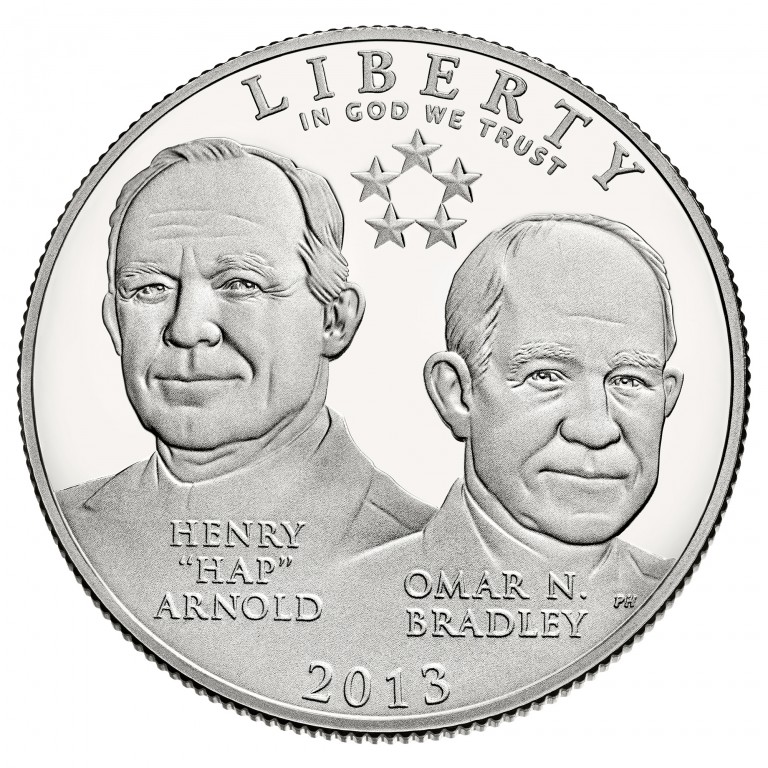
The obverse — the heads side — carries two faces. On the left is Henry "Hap" Arnold, the airman who built the wartime Army Air Forces into a global power and later became the only person to hold five-star rank in two services. On the right is Omar N. Bradley, the steady infantry commander Eisenhower trusted to lead American ground forces in Europe, and the last living five-star general when he died in 1981. Above them float the five stars of the rank itself, with LIBERTY, IN GOD WE TRUST, their names, and the date 2013.

The reverse — the tails side — drops the portraits entirely and shows the heraldic crest of Fort Leavenworth, tying the coin back to the school that links all five honorees. Around it run UNITED STATES OF AMERICA, E PLURIBUS UNUM, and the denomination, HALF DOLLAR.

Both sides are the work of one artist: Phebe Hemphill, a Mint sculptor-engraver, who designed and sculpted the obverse and the reverse. It is a clean, restrained piece — two soldiers and an emblem, no fuss.

Key facts

Year struck
2013 (one year only)
Denomination
Half dollar (50¢), commemorative
Honors
America's five U.S. Army five-star generals
Obverse
Gens. Henry "Hap" Arnold and Omar N. Bradley, with the 5-star insignia
Reverse
Heraldic crest of Fort Leavenworth
Designer / sculptor
Phebe Hemphill (both sides)
Composition
Copper-nickel clad — 91.67% copper, 8.33% nickel
Weight / diameter
11.34 g · 30.61 mm · reeded edge
Mint marks
D — Denver (uncirculated); S — San Francisco (proof)
Authorizing law
Public Law 111-262 (signed Oct 8, 2010)
Surcharge
$5 per coin to the CGSC Foundation
Mintage limit
750,000 (program ceiling)
Final mintage
Uncirculated 38,095 · Proof 47,326

Collecting it

Here is the quiet headline: the Mint was allowed to strike up to 750,000 of these and made fewer than 90,000 in total. The final figures came in at 38,095 uncirculated coins (the Denver "D" pieces) and 47,326 proof coins (the San Francisco "S" pieces) — a proof being a specially struck coin made on polished dies for a mirror-like finish, sold to collectors.

That makes the Five-Star Generals half dollar genuinely scarce by modern commemorative standards, even though it was inexpensive when new. There are no major die varieties or "key dates" to chase here — it is a one-year, two-mint issue. The interest is in the low total mintage and in finding examples in the highest grades. Because these coins went straight from the Mint into collector hands, top-grade survivors (a flawless proof or a pristine uncirculated piece) are the prize, and certification in a graded holder is how the market sorts them.

It also rides the coattails of a famously thin program. Across all three denominations, the 2013 Five-Star Generals coins sold poorly compared with the Mint's hopes — the gold issues in particular posted some of the lowest commemorative mintages of their era — which is exactly why collectors keep an eye on the set today.

Questions collectors ask

Who is on the Five-Star Generals half dollar?

Two of America's five-star generals: Henry "Hap" Arnold, who led the Army Air Forces in World War II, and Omar N. Bradley, who commanded American ground forces in Europe. The five stars of the rank appear above them. The other three honorees — Marshall, MacArthur, and Eisenhower — appear on the program's silver dollar and gold coin.

Why is it called a five-star generals coin?

Five-star (General of the Army) is the highest Army rank ever held in the United States, and only five officers have worn it. The 2013 program honored all five plus the Army Command and General Staff College at Fort Leavenworth, where each of them studied or taught.

Is the half dollar silver?

No. The half dollar is copper-nickel clad — 91.67% copper and 8.33% nickel, the same alloy as a circulating half dollar. The program's silver dollar carries the precious metal; this coin's value comes from its design and low mintage, not its metal.

How rare is it?

Fairly scarce for a modern commemorative. The Mint could have made up to 750,000 but struck only about 38,095 uncirculated and 47,326 proof coins — well under the ceiling. High-grade certified examples are the ones collectors pursue.

What do the D and S mint marks mean?

The mint mark is a small letter showing which facility struck the coin. The uncirculated half dollars were made in Denver (D); the proof versions were made in San Francisco (S).

Sources