Designer
Jo Mora: the cowboy who put a prospector and a bear on a half dollar
A Uruguay-born sculptor, mapmaker, and self-styled Westerner who designed one of the most loved commemorative coins.
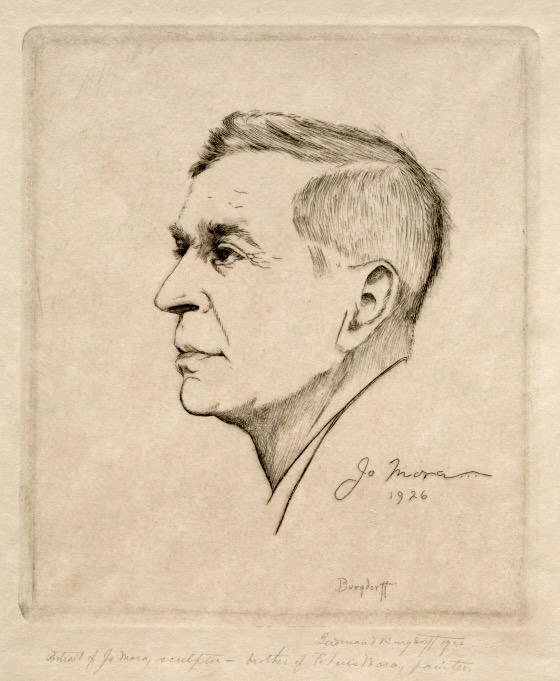
The Mint's own expert called his coin "amateurish" and tried to have him replaced. The committee said no — and Jo Mora's 1925 California half dollar, with its kneeling gold-panner and its grizzly bear, became one of the most admired commemoratives ever struck.
Who he was
Joseph Jacinto Mora was born in Montevideo, Uruguay, on October 22, 1876 — about as far from the American West as a person could start. Yet he grew up to be called the "Renaissance Man of the West," and the title was not flattery. He was a cowboy, a photographer, a cartoonist, a muralist, a sculptor, a mapmaker, and an author, often all in the same decade.
Art was the family trade. His father, Domingo Mora, was a Catalan sculptor; his older brother, F. Luis Mora, became the first Hispanic member of the National Academy of Design. The family left Uruguay during unrest in 1877, passed through Catalonia, and reached the United States around 1880, settling in New Jersey. Young Jo trained at the Art Students League of New York and the Cowles Art School in Boston — and studied under the celebrated painter William Merritt Chase — before paying the bills as a newspaper cartoonist for the Boston Evening Traveller and Boston Herald.
Then he went West and stayed. He reached California in 1903, and the following years he spent in Arizona living among the Hopi and Navajo, learning their languages and documenting their ceremonial life in photographs and paintings. That immersion fed everything after it. He eventually settled on California's Monterey Peninsula — Carmel-by-the-Sea, then Pebble Beach — where he built a home, a studio, and a reputation. He died in Monterey on October 10, 1947, twelve days short of his seventy-first birthday.
The craft — and the fight over the coin
Mora's gift was breadth. He sculpted the cenotaph for Father Junípero Serra at Mission Carmel and the Cervantes monument in San Francisco's Golden Gate Park; he carved bas-reliefs for the Monterey County Courthouse; he built enormous, crowded dioramas — one nearly a hundred feet long, packed with dozens of sculpted figures — for world's-fair pavilions and Western museums. He drew the pictorial maps he is still famous for, dense with cowboys, cattle brands, and tall tales. He wrote and illustrated his own books about the Californios and the cattle country he loved. Whatever the medium, his work was warm, narrative, and a little tongue-in-cheek.
Coins were not his usual stage, which made 1925 a test. To mark California's 75th year of statehood — the "diamond jubilee" — a San Francisco citizens' committee, led by future mayor Angelo Rossi, picked Mora unanimously. He gave them two plain, powerful images. The obverse — the heads side — shows a Gold Rush prospector kneeling to pan for placer gold, the loose flakes that miners washed from streambeds. The reverse — the tails side — carries a grizzly bear, lifted straight from California's Bear Flag. Mora left the fields, the flat background areas, deliberately rough and unpolished, so the figures stand out against texture rather than mirror.
The U.S. Commission of Fine Arts hated it. Its sculptor-member, James Earle Fraser — designer of the Buffalo nickel — dismissed the early sketches outright. He called the bear "entirely too short," and the whole design "inexperienced and amateurish," and pushed to hand the job to a different sculptor. The committee refused to drop Mora. He sharpened his sketches, other commissioners came around, and the coin was approved. History sided with the committee: Mora's two-figure design is now widely judged one of the most successful classic commemoratives, and the very directness Fraser distrusted is what collectors prize.
Key facts
- Full name
- Joseph Jacinto Mora
- Born
- October 22, 1876 — Montevideo, Uruguay
- Died
- October 10, 1947 — Monterey, California
- Nationality
- Uruguayan-born American
- Training
- Art Students League of New York; Cowles Art School, Boston; studied under William Merritt Chase
- Known as
- The 'Renaissance Man of the West'
- Coin design
- 1925 California Diamond Jubilee half dollar (obverse and reverse)
- Other notable works
- Serra cenotaph, Mission Carmel; Cervantes Monument, Golden Gate Park; pictorial maps of the Monterey Peninsula and Yosemite
Career timeline
- 1876Born in Montevideo, Uruguay, into a family of artists.
- c. 1880Family settles in the United States after leaving Uruguay and passing through Catalonia.
- 1903Arrives in California.
- 1904–1906Lives among the Hopi and Navajo in Arizona, documenting their life in photographs and paintings.
- 1915Completes the Cervantes Monument in San Francisco's Golden Gate Park.
- 1921Settles on the Monterey Peninsula at Carmel-by-the-Sea; later moves to Pebble Beach.
- 1925Designs both sides of the California Diamond Jubilee half dollar; overrules a hostile review and sees it struck.
- 1947Dies in Monterey, California.
Questions collectors ask
Who designed the 1925 California Diamond Jubilee half dollar?
The California sculptor Jo Mora (Joseph Jacinto Mora) designed both sides of the coin. A San Francisco citizens' committee chose him unanimously to capture the spirit of California's 75th anniversary of statehood.
What did Jo Mora put on the California half dollar?
The obverse shows a Gold Rush prospector kneeling to pan for gold; the reverse shows a grizzly bear taken from California's Bear Flag. Mora left the background fields unpolished and textured so the two figures stand out.
Why did the Commission of Fine Arts object to Mora's design?
James Earle Fraser, the commission's sculptor-member and designer of the Buffalo nickel, called the early sketches 'inexperienced and amateurish' and said the bear was 'entirely too short.' He pushed to replace Mora, but the citizens' committee kept him and the finished design was approved.
Was Jo Mora a coin designer by trade?
No. He was a sculptor, painter, muralist, cartoonist, author, and pictorial mapmaker — often called the 'Renaissance Man of the West.' The California half dollar was a one-off commission, not part of a coin-design career, which is part of why his success surprised the Mint's critics.
Where was Jo Mora from?
He was born in Montevideo, Uruguay, in 1876, came to the United States as a child, and spent his adult life in the American West — settling on California's Monterey Peninsula.