US coin · series

The 2016 National Park Service Centennial Silver Dollar

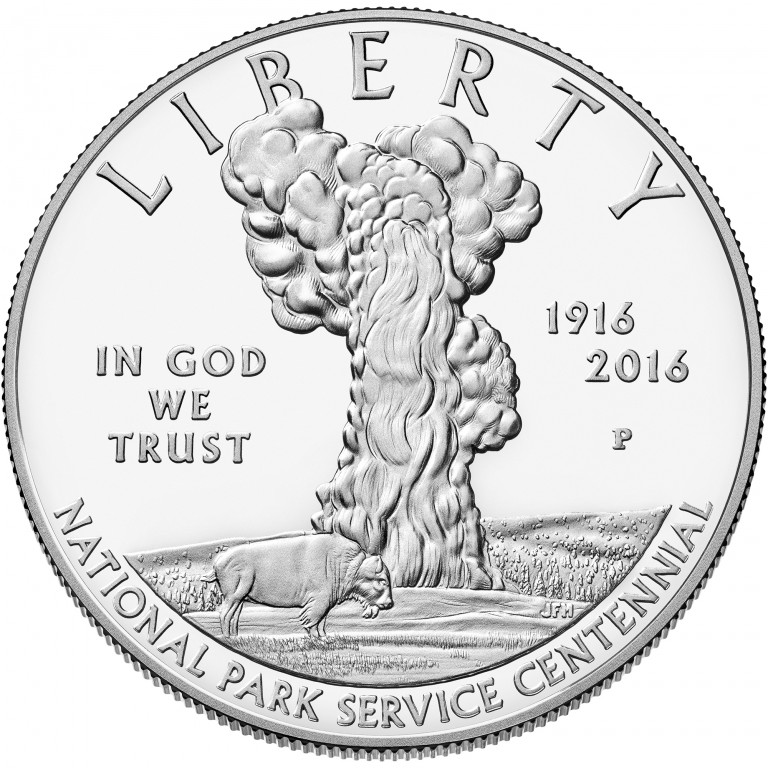
A bison at Old Faithful on one face. A dancer on the other. Collectors are still arguing about why.

The 2016 National Park Service Centennial Silver Dollar
United States Mint · public domain · source

In 2016 the U.S. Mint marked a century of the National Park Service with a silver dollar. One side shows exactly what you'd expect — Yellowstone. The other side shows a woman mid-dance, and it set off an argument that follows the coin to this day.

The story behind the coin

On August 25, 1916, President Woodrow Wilson signed the law that created the National Park Service — a single federal agency to look after the wild places the country had set aside but never quite figured out how to manage. A hundred years later, Congress wanted to mark the date with money you could hold.

So in December 2014, Public Law 113-291 ordered the Mint to strike a three-coin set for the centennial: a $5 gold piece, a copper-nickel half dollar, and the silver dollar on this page. Sales opened on March 24, 2016 — the centennial year itself.

These are commemorative coins, not spending money. The Mint sells them straight to collectors at a premium, and part of that premium — a built-in surcharge — goes to a cause named in the law. On this silver dollar the surcharge was $10 a coin, earmarked for the National Park Foundation, the Park Service's official nonprofit partner. Buy the coin, fund a trail.

The design — and the fight over it

The obverse — the heads side — is the one nobody argued about. Joseph Menna designed and sculpted a bison standing in front of Old Faithful, Yellowstone's famous geyser, with the dual date "1916–2016." Yellowstone is the obvious choice: it became the world's first national park in 1872, decades before the Service existed to run it. The picture says "national parks" in a single glance.

The reverse — the tails side — is where it got interesting. Designer Chris Costello, sculpted by Jim Licaretz, put a Latina Folklórico dancer at the center, holding a ribbon reading "HERITAGE · CULTURE · PRIDE," with the Park Service's familiar arrowhead logo on her dress.

A dancer? On a coin about wilderness? Some collectors were baffled, and the choice — particularly the dancer's Latin heritage — drew real criticism in the numismatic press. The official answer came from the Citizens Coinage Advisory Committee, the panel that reviews Mint designs: the Park Service doesn't only guard geysers and canyons. It also protects hundreds of cultural and historic sites, including places tied to Hispanic and Latino history. The dancer was meant to stand for that half of the agency's job — the part that isn't a mountain.

You can decide for yourself whether the design earns it. But that's the point worth keeping: this is the rare modern U.S. coin where the argument is part of the coin's story.

Key facts

Year
2016 (dual-dated 1916–2016)
Denomination
$1 (silver dollar)
Designer (obverse)
Joseph Menna — design and sculpt
Designer (reverse)
Chris Costello, sculpted by Jim Licaretz
Composition
90% silver, 10% copper
Weight
26.73 g
Diameter
38.1 mm
Edge
Reeded
Mint
Philadelphia (P mint mark)
Finishes
Proof and uncirculated (BU)
Maximum authorized
500,000 across all finishes
Reported mintage
≈77,300 proof; ≈21,000 uncirculated (sources vary slightly)
Surcharge
$10 per coin to the National Park Foundation
Authorizing law
Public Law 113-291 (Dec. 19, 2014)

Collecting it

Because the Mint sold these directly, there's no "circulated" version to hunt — every example started life in a collector's hands. That keeps most surviving coins in high grade.

Both finishes came only from Philadelphia, so they all carry a P mint mark. There are two to know: the proof — struck with polished dies on polished blanks for a mirror finish — and the uncirculated (or BU) version with an ordinary matte-bright finish. The proof outsold the uncirculated by roughly three to one, which makes the uncirculated the scarcer of the two. Neither, though, is rare: the program sold far below its 500,000-coin ceiling, but tens of thousands still exist.

For a graded coin, the value lives almost entirely at the top. A PR70 or MS70 — a flawless coin under magnification, the highest grade the services award — commands a premium over the same coin a point lower. Below that, these trade close to their silver content plus a modest collector margin. The coin's lasting appeal isn't scarcity; it's the story, the design fight, and the silver in your hand.

Questions collectors ask

Why is there a dancer on a National Park Service coin?

The reverse shows a Latina Folklórico dancer to represent the cultural and historic sites the Park Service protects — not just natural wonders. The agency manages hundreds of historic places, including ones tied to Hispanic and Latino history. The design choice was explained by the Citizens Coinage Advisory Committee and drew mixed reactions from collectors.

Is the 2016 National Park Service silver dollar real silver?

Yes. It is 90% silver and 10% copper, weighs 26.73 grams, and measures 38.1 mm — the same specification as classic U.S. silver dollars. It was never meant to circulate; the Mint sold it to collectors.

How many were made?

The law authorized up to 500,000, but sales fell well short. Reported figures are roughly 77,000 proof and 21,000 uncirculated coins; exact totals vary slightly between sources. The uncirculated version is the scarcer of the two.

What was the surcharge, and where did it go?

Each silver dollar carried a $10 surcharge that went to the National Park Foundation, the Park Service's official nonprofit partner, for projects that preserve park resources and support public enjoyment of them.

Where was it minted?

Only at Philadelphia, so every coin — proof and uncirculated alike — carries a P mint mark.

Sources