US coin · series

The New Rochelle Half Dollar: a Coin About a Calf

How a 17th-century rent — one fat calf a year, forever — ended up on a 1938 silver half dollar.

The New Rochelle Half Dollar: a Coin About a Calf
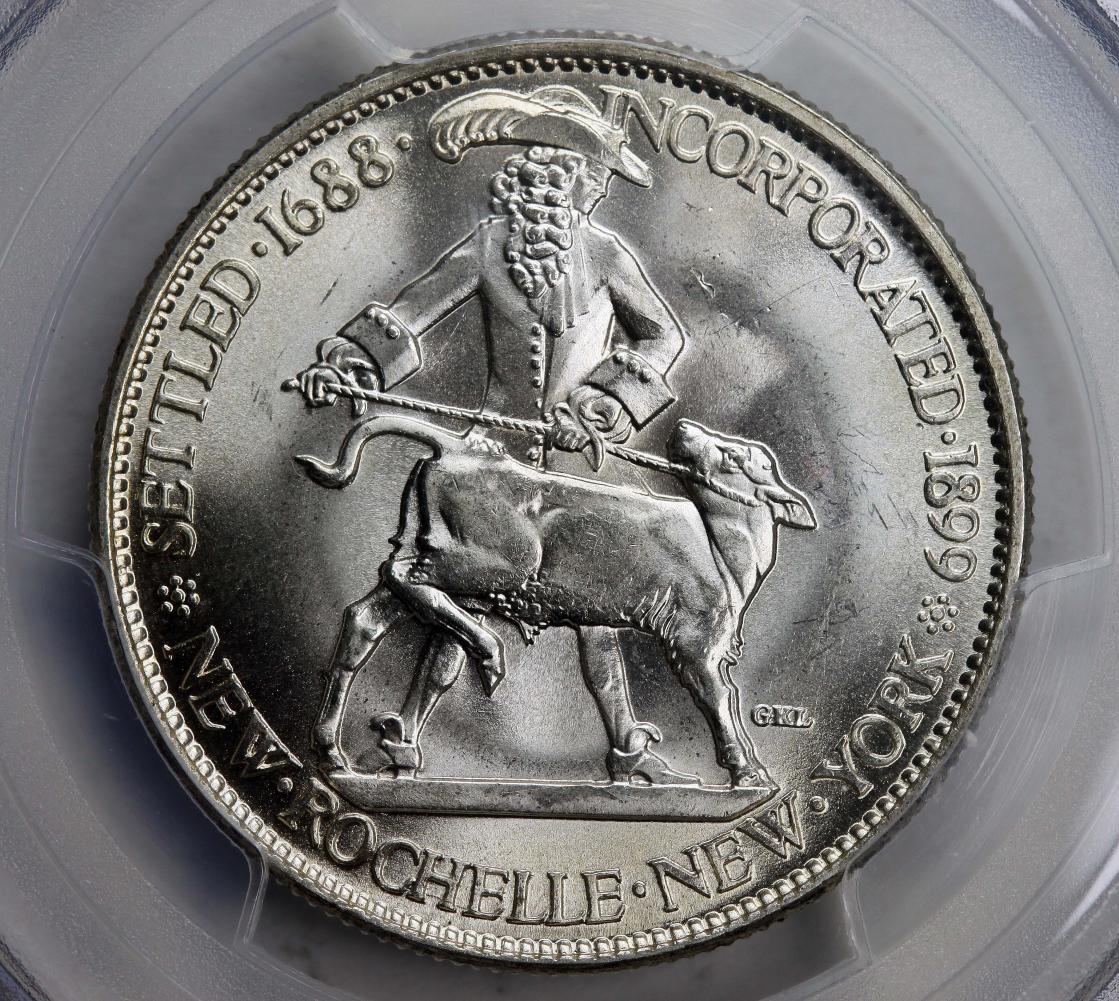
Coin: Gertrude K. Lathrop; Image by Lost Dutchman Rare Coins (credit: http://www.cointalk.com/t226531/) · public domain · source

In 1689 a man bought 6,000 acres of New York land and agreed to pay for it with one fat calf, handed over every June 24th, for as long as anyone asked. Two and a half centuries later, that strange bargain became a coin.

A rent paid in livestock

Here is the bargain at the heart of this coin. In 1689, Jacob Leisler bought roughly 6,000 acres along Long Island Sound from John Pell, lord of the Manor of Pelham. The price was not just money. The deed carried a quit-rent — a small recurring payment that kept the land from reverting to its old owner — and Pell's was charmingly specific: one fat calf, delivered every June 24th, if demanded.

On that land, Huguenots built a town. They were French Protestants who had fled persecution, and they named their new home New Rochelle after La Rochelle, the French port city many of them had left behind. They settled it in 1688.

By the 1930s, New Rochelle was a comfortable Westchester suburb of New York City planning its 250th birthday. Local coin collectors — the Westchester County Coin Club — saw a chance. A commemorative half dollar could honor the anniversary and raise money for the festival. The catch: those calf-and-deed details had to fit on a coin small enough to carry in a pocket.

A calf on the heads side

The obverse — the heads side — does something almost no other US coin does. It shows John Pell in colonial dress, leaning back on a rope, hauling a reluctant calf forward. It is the old deed made literal: the fat calf, on its way to be paid.

The reverse — the tails side — is quieter. It carries a single fleur-de-lis, the lily emblem lifted from New Rochelle's coat of arms, which the city had in turn borrowed from La Rochelle, France. One side tells the local legend; the other points back across the Atlantic to where the settlers came from.

Both sides came from one hand: Gertrude K. Lathrop, an Albany sculptor known for her tender, exact studies of animals. (She had already designed the 1936 Albany half dollar.) She got the job only after the Commission of Fine Arts rejected the committee's first artist. To get the calf right, Lathrop is reported to have modeled it on a real Guernsey calf from a farm near Albany — an animal sculptor refusing to fake an animal.

The coin holds two small "lasts." It was the last new commemorative design the US issued before a multi-year pause, with no fresh design appearing again until 1946. And it was the last US coin struck with denticles — the tiny tooth-like beads that ring the rim — a finishing detail that vanished from American coinage after this.

Key facts

Anniversary honored
250 years of New Rochelle, NY (settled 1688)
Authorizing act
Signed by President Roosevelt, May 5, 1936
Year on the coin
1938 (struck April 1937)
Designer
Gertrude K. Lathrop (obverse and reverse)
Obverse
John Pell leading a fatted calf
Reverse
Fleur-de-lis from the city arms
Composition
90% silver, 10% copper
Weight / diameter
12.5 g / 30.61 mm, reeded edge
Maximum authorized
25,000
Net mintage (after melting)
~15,251 — 9,749 returned and melted
Original sale price
$2 each

Collecting the New Rochelle half

This is a one-date, one-mint coin: every New Rochelle half dollar was struck in 1937 at Philadelphia and dated 1938. (The odd dating was a legal rule — Congress fixed the date so collectors couldn't be milked with a string of year-and-mintmark varieties, a trick that had soured other 1930s commemoratives.) So there are no rare dates to chase here. The story is all about survival and quality.

Of the 25,000 made, nearly 10,000 came back unsold after the festival and went into the melting pot. That left roughly 15,251 — a genuinely modest figure for a classic commemorative. Because the coins were sold to collectors rather than spent, most survivors are uncirculated: they never saw a cash register. What separates a common example from a prized one is strike and surface — how crisply the calf and Pell's figure came up, and how clean the fields stayed. The premium pieces are the ones graders rank near the top of the population, where original luster and sharp detail meet.

A note on taste, since collectors still argue it: the design has admirers and detractors. The Numismatist praised Lathrop's work when it appeared; decades later, art historian Cornelius Vermeule dismissed the coin in blunt terms. Both reactions are part of its reputation — proof that a small silver calf can still start a fight.

Questions collectors ask

Why does the New Rochelle half dollar show a man pulling a calf?

It pictures a real 17th-century land deed. When Jacob Leisler bought the land from John Pell in 1689, part of the payment was one fat calf, due every June 24th if demanded. The obverse shows that calf being led off to be paid — a 250-year-old rent turned into coin art.

Why is the coin dated 1938 if it was struck in 1937?

Congress required the 1938 date to match the anniversary celebration, regardless of when the coins were actually made. Fixing a single date also blocked the practice of releasing many year-and-mintmark varieties to squeeze collectors — a problem that had plagued other 1930s commemoratives.

How rare is the New Rochelle half dollar?

About 15,251 survive. The mint struck 25,000, but roughly 9,749 went unsold after the festival and were melted. That makes it a modest issue. Because they were bought by collectors, most are uncirculated, so condition and strike quality — not the date — drive value.

What is the fleur-de-lis on the back?

It comes from New Rochelle's coat of arms, which the city adopted from La Rochelle, France — the port many of the founding Huguenot settlers had fled. The reverse points back to the town's French Protestant roots.

Who designed it?

Gertrude K. Lathrop, an Albany sculptor known for animal studies, who also designed the 1936 Albany half dollar. She got the commission after the Commission of Fine Arts rejected the project's first artist.

Sources