US coin · series

The 1922 Grant Memorial Gold Dollar

A centennial tribute to a president — and a marketing gimmick the size of a star.

The 1922 Grant Memorial Gold Dollar
U.S. Mint coinage (federal government work); Wikimedia Commons upload by user Gwillhickers. No individual photographer credited · public domain · source

In 1922, the U.S. Mint struck a tiny gold coin for Ulysses S. Grant's hundredth birthday. Then it stamped a small star above his name on some of them — for no reason except to make collectors buy two.

The story behind the coin

Ulysses S. Grant was born on April 27, 1822, in a small frame house in Point Pleasant, Ohio. A hundred years later, Ohio wanted to throw him a birthday party in gold.

The man had earned the tribute. Grant was the general who won the Civil War for the Union, then served two terms as president during the hard, tangled years of Reconstruction. By 1922 he was firmly an American icon — and a centennial was a chance to honor him and raise money for memorials in his home state.

So Ohio congressman Charles C. Kearns introduced a bill for a commemorative gold dollar. It became law on February 2, 1922, signed by President Warren G. Harding. The act authorized two centennial coins: a silver half dollar and this gold dollar. The catch — and the reason this little coin has a story at all — is that the gold dollar was never meant to spend. It was a souvenir, sold above face value to fund the memorials.

Here is where it gets murky. The proceeds were supposed to build community memorial buildings in Georgetown and Bethel, Ohio, and a highway linking Grant's birthplace to nearby New Richmond. As numismatic historians have noted, those monuments were never built — and where the money went is not clearly recorded. The birthday gift, it seems, got lost on the way to the party.

The design and the star

The coin was sculpted by Laura Gardin Fraser — the first woman to design a U.S. coin, and the wife of James Earle Fraser, who created the Buffalo nickel. She was a major talent in her own right, not a footnote to her husband.

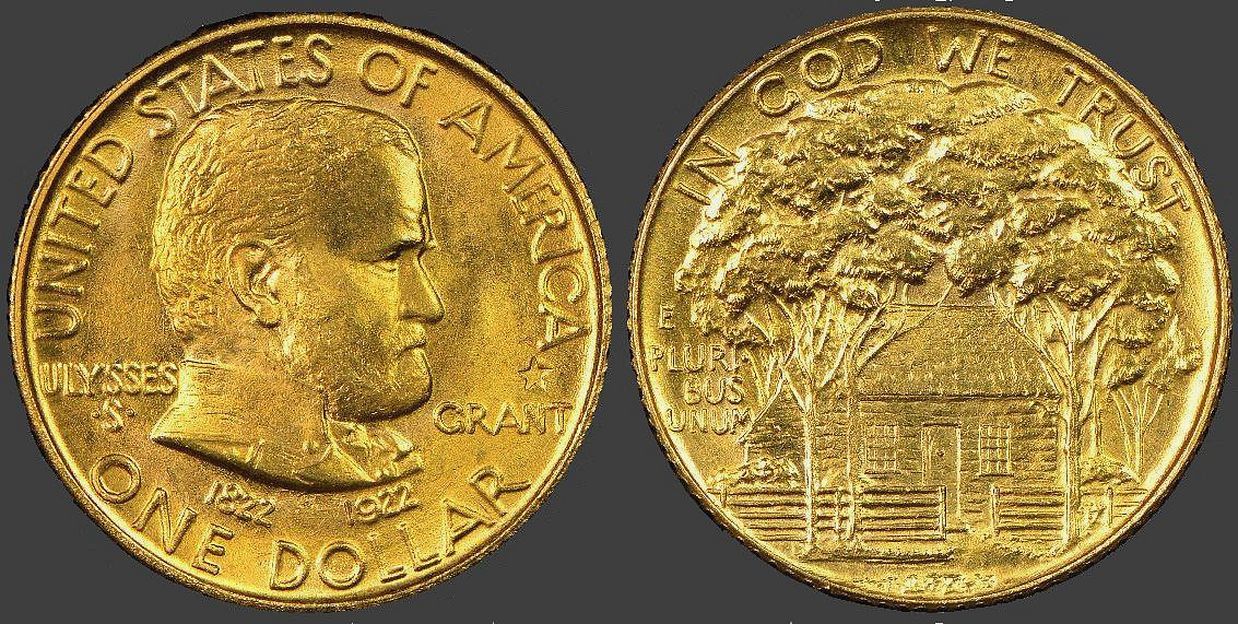
The obverse — the "heads" side — shows Grant in his military coat, modeled on a photograph by the famous Civil War cameraman Mathew Brady. The reverse shows the modest frame house where he was born, tucked among trees. It is a quiet, human design: the soldier-president and the cabin he came from, on a coin smaller than a dime.

Then there is the star. On some of these dollars, a tiny incuse star — pressed into the surface — sits above Grant's name on the obverse. It means nothing. It has no link to Grant, no symbolism, no commemorative purpose. The Grant Centenary Memorial Association asked the Mint to add it to part of the run for one reason: to create a second "variety" so collectors would feel they had to buy both. The star coins were even sold for more.

That makes this one of the franker examples of a recurring problem with 1920s commemoratives — coins designed less to honor history than to be sold twice to the same buyer. Collectors at the time grumbled loudly about it. A century on, the star has become exactly the kind of detail that makes the coin fun to chase.

Key facts

Year struck
1922
Denomination
Gold dollar ($1)
Honors
100th anniversary of Ulysses S. Grant's birth (1822)
Designer
Laura Gardin Fraser
Obverse
Grant in military coat, after a Mathew Brady photograph
Reverse
Grant's birthplace, Point Pleasant, Ohio
Composition
90% gold, 10% copper (1.672 g, ~0.0484 oz gold)
Mintage — With Star
5,016
Mintage — No Star
5,000
Original sale price
$3.50 with star, $3.00 without
Authorizing act
Signed February 2, 1922
Distributor
U.S. Grant Centenary Memorial Association

Collecting it

This is one of the scarcest of the classic U.S. gold commemoratives, and for a good reason: almost none were ever made. Just 5,016 With Star and 5,000 No Star pieces left the Mint — a rounding error next to most circulating coins. Unlike the companion half dollars, the gold dollars effectively sold out; they were not returned and melted in large numbers. So what was struck is roughly what survives.

The two varieties — With Star and No Star — are the heart of collecting this coin. They are otherwise identical, and a complete classic-commemorative set wants both. Despite the original markup on the star coins, the No Star version has often traded at the slightly higher premium in modern markets, depending on grade and demand. Either way, with combined mintage near 10,000, both are genuinely rare.

A few terms worth knowing. Mint State (MS) means a coin that never circulated — never spent, never worn — graded on a 60–70 scale. Because these were sold as keepsakes rather than pocket change, many survive in high grade, but truly pristine examples (MS-66, MS-67) command a strong premium. The incuse star is sunk into the die, so it can be soft or worn on a tired strike — sharpness of that little star is part of what separates a good example from a great one.

Questions collectors ask

Why does the 1922 Grant gold dollar come with and without a star?

The star has no historical meaning. The Grant Centenary Memorial Association had the Mint add a small incuse star above Grant's name to part of the run purely to create a second variety, so collectors would buy both. The star coins were even sold for fifty cents more.

How many 1922 Grant gold dollars were made?

About 10,000 total — 5,016 with the star and 5,000 without. That tiny mintage makes it one of the scarcest classic U.S. gold commemoratives. Unlike the companion half dollars, the gold dollars largely sold out rather than being melted.

Who designed the 1922 Grant gold dollar?

Laura Gardin Fraser, the first woman to design a U.S. coin and the wife of Buffalo nickel designer James Earle Fraser. She did both sides: Grant in uniform on the obverse, his Ohio birthplace on the reverse.

Is the No Star or the With Star variety more valuable?

It depends on grade and the market. Both are rare. The star coins originally sold for more ($3.50 vs $3.00), but in modern trading the No Star variety has often carried a slightly higher premium. Condition usually matters more than the star itself.

What did the coin commemorate?

The 100th anniversary of Ulysses S. Grant's birth on April 27, 1822, in Point Pleasant, Ohio. The surcharge was meant to fund memorials in Grant's home state — though those monuments were reportedly never built.

Sources