US coin · series

The Jefferson Dollar That Hid a Rarer Coin Inside It

A 1993 silver dollar for the founder who redesigned American money — and the bonus set that made a nickel famous.

The Jefferson Dollar That Hid a Rarer Coin Inside It
United States Mint · public domain · source

In 1994, the U.S. Mint sold a silver dollar dated 1993, honoring a man born in 1743. The dates were not a mistake — they were the whole point. And tucked inside one version of the offer sat a five-cent coin that collectors now chase harder than the dollar itself.

The story behind the coin

Thomas Jefferson wrote the Declaration of Independence, doubled the size of the country, and founded a university. He also did something most Americans forget: he helped invent the dollar. As the first Secretary of State, Jefferson pushed for a decimal money system — dollars split into tenths and hundredths — instead of the clumsy British pounds, shillings, and pence. The change in your pocket today traces back to his argument.

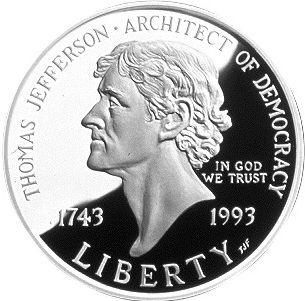
So when his 250th birthday came around — Jefferson was born April 13, 1743 — Congress decided the founder of American coinage deserved a coin of his own. The result is the dual date you'll see on it: 1743–1993, birth year and anniversary side by side.

Congress authorized the coin through the Jefferson Commemorative Coin Act of 1993 (Public Law 103-186). It set a hard ceiling of 600,000 coins and attached a $10 surcharge to every one sold. That money wasn't a tax — it was the point. The first 500,000 coins funded an endowment for Monticello, Jefferson's mountaintop home, and his educational programs. Everything sold beyond that went to Poplar Forest, the octagonal retreat he designed for himself in the Virginia woods. A coin honoring Jefferson literally paid to keep Jefferson's houses standing.

Here's the quiet drama: most commemorative coins fall far short of their authorized limit and quietly fade. This one sold out. All 600,000 were struck and bought — a genuinely rare outcome that tells you how much affection still surrounds the man on the coin.

The design

The artist was T. James Ferrell, a U.S. Mint engraver, who designed both sides.

The obverse — the heads side — shows Jefferson in profile, adapted from a medallion portrait by Gilbert Stuart, the painter behind the George Washington face on the one-dollar bill. Around him runs an unusual title: "Architect of Democracy." It's a deliberate double meaning. Jefferson really was an architect — he drew his own buildings — but the phrase also crowns him as a builder of the republic itself.

The reverse — the tails side — gives you the proof. It shows Monticello, the domed house Jefferson designed and rebuilt over four decades. Ferrell based it not on a photograph but on a formal elevation drawing made by the National Park Service's Historic American Buildings Survey — the same architectural record that documents America's most important structures. The effect is precise and a little severe, like a blueprint pressed into silver.

It's a fitting pairing. The man who insisted American money should be rational and decimal gets a coin that treats his own home as a measured drawing.

Key facts

Official name
Thomas Jefferson 250th Anniversary silver dollar
Date on coin
1743–1993 (struck and sold in 1994)
Designer
T. James Ferrell (obverse and reverse)
Obverse
Jefferson profile after Gilbert Stuart; 'Architect of Democracy'
Reverse
Monticello, from a National Park Service elevation drawing
Composition
90% silver, 10% copper
Weight / diameter
26.73 g / 38.1 mm, reeded edge
Uncirculated (1993-P)
266,927 struck
Proof (1993-S)
332,891 struck
Authorized maximum
600,000 — reached and sold out
Surcharge
$10 per coin — Monticello endowment, then Poplar Forest
Authorizing act
Jefferson Commemorative Coin Act of 1993 (P.L. 103-186)

Collecting it

For a sold-out coin, the Jefferson dollar is surprisingly easy to own. Because 600,000 went out and most were tucked away by careful collectors, high-grade examples are common and prices stay close to the value of the silver inside — about three-quarters of an ounce. There is no rare date and no famous variety. The uncirculated coins carry a P mint mark (Philadelphia); the mirror-finish proofs — struck with polished dies to give frosted devices on a glassy field — carry an S (San Francisco).

The real prize lives one step away. The Mint offered the dollar inside a first-of-its-kind Coinage and Currency Set: the uncirculated silver dollar, a crisp $2 Federal Reserve Note (Jefferson's bill), and a 1994 Jefferson nickel struck with a special matte finish. That nickel was made by striking sandblasted dies twice, giving it a soft, frosted look unlike any nickel sold for circulation.

Only 167,703 of those matte nickels were made — making it the second-lowest mintage in the entire Jefferson nickel series, which has run since 1938. Collectors call it the "Special Uncirculated" or "matte proof" nickel, and it earned a place on lists of the great modern U.S. coins. The lesson is a familiar one in this hobby: the headline coin sold out, but the genuinely scarce piece was the freebie riding along beside it.

If you want the dollar, buy it for the silver and the story. If you want the rarity, hunt the intact 1994 set with the matte nickel still inside.

Questions collectors ask

Why does the coin say 1743–1993?

Those are Jefferson's birth year and his 250th birthday. He was born April 13, 1743, so 1993 marked 250 years. The Mint paired the dates to make the anniversary unmistakable.

It's dated 1993 — why is it often called a 1994 coin?

The dies and design carried the 1993 anniversary date, but the Mint actually struck and sold the coin in early 1994. So it was issued in 1994 while wearing a 1993 date — a common quirk with anniversary commemoratives.

What does 'Architect of Democracy' mean on the obverse?

It's a deliberate pun. Jefferson literally designed buildings — Monticello is on the reverse — and he also helped build the American republic. The phrase honors both.

Is the Jefferson silver dollar rare or valuable?

Not especially. All 600,000 authorized coins were struck and sold, and most survive in high grade, so prices track the silver content closely. The scarce companion piece is the 1994 matte-finish Jefferson nickel from the Coinage and Currency Set, with only 167,703 made.

What was the Coinage and Currency Set?

A first-of-its-kind U.S. Mint package holding the uncirculated 1993 silver dollar, a $2 Federal Reserve Note, and a special 1994 matte-finish Jefferson nickel. The matte nickel is the set's true rarity.

Where did the surcharge money go?

Each coin carried a $10 surcharge. The first 500,000 coins funded an endowment for Monticello and Jefferson's educational programs; surcharges beyond that supported Poplar Forest, his second home in Virginia.

Sources