US coin · series

The World War II 50th Anniversary Half Dollar

A B-17 overhead, three faces under a 'V' for Victory — and a coin that helped pay for a memorial on the National Mall.

The World War II 50th Anniversary Half Dollar
U.S. Mint (www.usmint.gov) · public domain · source

It is dated 1991-1995, but it was struck in a single year — 1993. Those years on the coin aren't when it was made; they mark the half-century since America's war, 1941 to 1945. Every one sold carried a small surcharge, and that money went toward a memorial that did not yet exist.

The story behind the coin

By the early 1990s, the men and women who fought World War II were entering their seventies and eighties. The fiftieth anniversary of the war was arriving year by year — Pearl Harbor in 1991, D-Day in 1994, the Japanese surrender in 1995 — and the United States had no national memorial to the war on the Mall in Washington. Congress decided a coin could help change that.

In October 1992 it passed the World War II 50th Anniversary Commemorative Coins Act (Public Law 102-414). The law ordered three coins: a copper-nickel half dollar, a silver dollar tied specifically to the Battle of Normandy, and a five-dollar gold piece. Each would carry a surcharge — an extra dollar amount added to the price, above the cost of making the coin — and that surcharge would be steered to two memorial funds.

The half dollar's surcharge was two dollars per coin. The statute set the path for the money plainly: the first three million dollars in surcharges would go to the Battle of Normandy Foundation, to build a D-Day memorial in France; the next seven million would go to the American Battle Monuments Commission, toward a memorial in Washington to honor everyone who served. That second fund is the thread that ties this small coin to the National World War II Memorial that finally opened on the Mall in 2004.

There's a quiet wrinkle in the dates. The coin reads "1991-1995," the span of the fiftieth-anniversary years. But the law actually forbade striking these coins after December 31, 1993 — so despite the five-year date, every piece was made in one year. The U.S. Mint released them on May 28, 1993.

What the coin shows

The designs came out of a nationwide competition the Mint ran in late 1992 — its second such contest in a year. Artists submitted drawings; the Treasury chose the winners after consulting veterans' groups including the American Legion and the Veterans of Foreign Wars.

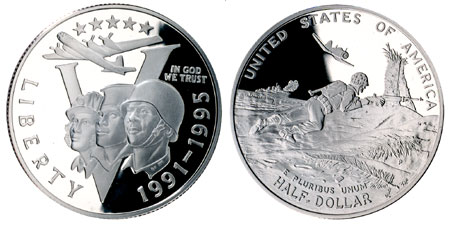
The obverse — the heads side — was designed by George Klauba. Three servicemen, a soldier, a sailor, and an airman, look upward in front of a large "V" for Victory, with a B-17 bomber crossing overhead. It is a deliberately collective image: not one hero, but the three branches together, eyes on the sky.

The reverse — the tails side — was designed by Bill J. Leftwich and turns to the Pacific. A serviceman lies on a beach with his rifle raised while an aircraft passes above and a warship stands offshore — a compressed picture of an island landing, the kind of amphibious assault that defined the Pacific campaign. (The companion silver dollar in the program was reserved for the European theater, emblematic of the Battle of Normandy.)

Key facts

Years on the coin
1991-1995 (commemorating 1941-1945)
Year struck
1993 (released May 28, 1993)
Denomination
Half dollar (50 cents)
Obverse designer
George Klauba
Reverse designer
Bill J. Leftwich
Composition
Copper-nickel clad (outer layers 75% copper / 25% nickel over a copper core)
Weight
11.34 g
Diameter
30.61 mm
Edge
Reeded
Mint / mark
Philadelphia (P)
Uncirculated mintage
197,072
Proof mintage
317,396
Maximum authorized
2,000,000
Surcharge
$2 per coin — to Normandy & WWII memorial funds
Authorizing act
Public Law 102-414 (Oct. 14, 1992)

Collecting it

This is a modern commemorative, not a rarity, and that shapes how collectors approach it. It was sold directly by the Mint — by itself, and bundled into two-coin, three-coin, and larger sets with the program's silver dollar and gold piece. There is only one issue date and one mint, Philadelphia, so there are no scarce date-and-mint combinations to chase the way you would with an older series.

What variety exists is in finish and grade. The coin came two ways: uncirculated (a standard business strike, sold to collectors) and proof — a special strike made with polished dies on polished blanks, giving frosted devices against mirror-like fields. The proof had the higher mintage of the two, at 317,396 against 197,072 uncirculated. Both numbers fell far short of the two million the law allowed, which tells you the market for early-1990s commemoratives had cooled.

Because these were sold as collector coins and almost never circulated, high grades are common — the interest for slabbed-coin collectors lies at the very top of the scale, in the small population of coins graded at or near perfection, and in the deep-cameo proofs. Many also still sit in their original Mint packaging with a certificate of authenticity. For most buyers the appeal isn't scarcity; it's the design and the story behind the surcharge.

Questions collectors ask

Why is the coin dated 1991-1995 if it was only made in 1993?

The dates mark the fiftieth-anniversary years of America's war, 1941 to 1945 plus fifty. The coin actually had to be struck in a single year: the authorizing law barred minting after December 31, 1993, and the Mint released the coins on May 28, 1993.

Is the World War II 50th Anniversary half dollar made of silver?

No. The half dollar is copper-nickel clad — the same non-precious composition as a circulating Kennedy half dollar. The silver in the program was reserved for the companion silver dollar; the gold for the five-dollar piece.

What did the surcharge pay for?

Each half dollar carried a $2 surcharge. By law, the first $3 million in surcharges from the program went to the Battle of Normandy Foundation for a D-Day memorial in France, and the next $7 million went to the American Battle Monuments Commission toward a memorial in Washington — the effort that led to the National World War II Memorial on the Mall.

Who designed it, and what do the two sides show?

George Klauba designed the obverse — three servicemen under a 'V' for Victory with a B-17 overhead. Bill J. Leftwich designed the reverse — a Pacific island landing scene. Both were chosen from a nationwide design competition the Mint held in 1992.

Is it rare or valuable?

It's a common modern commemorative, not a rarity. With one date and one mint, value comes mainly from condition — top-grade examples and deep-cameo proofs — rather than scarcity. Many still come in their original Mint packaging.

Sources